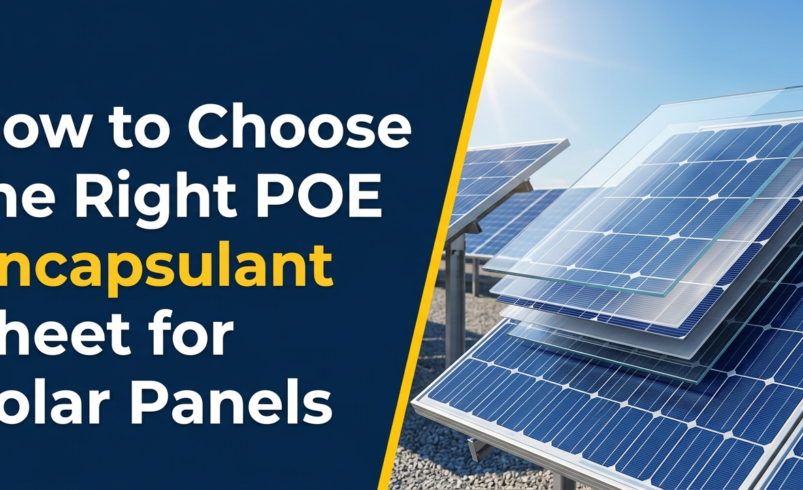

Solar panels are supposed to keep working for many years, even with different weather patterns. But for that to happen, manufacturers really do have to pick materials that, kind of, shield the solar cells from moisture, intense heat, ultraviolet (UV radiation, and also electrical stress. And one major material that shows up a lot in solar module production is a POE encapsulant film —yes, that one.
Picking a good solar POE encapsulant can help with module reliability, and it also helps prevent damage that might come up later. Still, “the right one” isn’t just one easy answer because it depends on the panel layout, the actual operating environment, the manufacturing process being used, and the performance that’s expected. Once those things are understood, it becomes more straightforward for solar manufacturers to find an encapsulant that actually fits their products properly.
Understanding Solar POE Encapsulant
Moisture can affect the materials inside a solar module over time, and kinda mess with things more than people think. If water vapour manages to reach sensitive components, it may contribute to corrosion, weaker insulation performance, or other reliability problems that show up later.
When comparing encapsulant sheets, look at their water vapour transmission rate , and also the electrical insulation properties. A lower moisture transmission rate tends to give better shielding against humidity. At the same time, the right electrical traits help reduce the chance of insulation-related issues, even if the module is sitting in rough weather.
For the solarPOEe encapsulant chosen for production, it should have technical data that fits the module’s design, plus the expected operating conditions. Manufacturers should go through test reports and supplier specifications, not just lean on general product claims or marketing.
Check Moisture Resistance and Electrical Insulation
Different solar modules may need different encapsulation materials. For instance, glass-to-glass and bifacial panels might use different materials than the more conventional glass-to-backsheet kind.
POE is often chosen when the goals are moisture resistance and electrical insulation, you know, the usual top priorities. It can also be handy for module designs where potential-induced degradation, or PID, needs pretty careful control.
Before you settle on a film, it’s worth checking if it matches the cell technology, the glass setup, and the lamination process. If you talk through these things with a technical team, manufacturers can end up picking a product that actually aligns with their production needs, not just in theory.
Consider the Solar Panel Design
POE isn’t the only encapsulant option that solar panel manufacturers can use. EVA and EPE films are also seen in solar module production, and each one sort of brings its own little set of traits.
EVA, or ethylene vinyl acetate, is pretty often selected because of its bonding properties and the well-known role it already has in solar module manufacturing. If a manufacturer is working with an EVA film Supplier , they should look at film transparency, how well it sticks, what the curing needs are, and whether it gels with their lamination process. Sometimes people forget the compatibility part, and then it turns into a hassle later.
EPE encapsulant,t meanwhile, is basically a three-layer structure, built from EVA, PO, and E EVA. It uses different polymer layers to match more specific module requirements. A solar EPE encapsulant that fits could be chosen when manufacturers want a material layout that mixes the strengths of EVA and POE, without losing the simpler handling they are used to.
Picking between these materials really depends on the module design, performance targets, the actual manufacturing conditions, and the total production cost. None of these films is automatically the best option for every solar pane , end of story.
Compare POE, EVA, and EPE Encapsulant Films
POE is not the only encapsulant option you can pick when solar panel manufacturers are making modules. EVA and EPE films are also in the mix, and yeah, each one brings its own kind of qualities, you know.
EVA, or ethylene-vinyl acetate, shows up a lot because of its bonding properties and the pretty long track record in solar module production. If a manufacturer is working with an EVA film Supplier , they should look at film transparency, how well it sticks, what the curing really needs, and whether it matches their lamination process or not.
EPE encapsulant is basically a three-layer setup, built as EVA-POE-EVA. Instead of just one uniform sheet, it uses different polymer layers to match specific module requirements. A solarEPEe encapsulant that fits might be the one to consider when manufacturers want a material arrangement that kind of blends the strengths of EVA and POE simultaneously.
Picking between these materials should really lean on module design, performance targets, the real manufacturing conditions, and the overall production cost. Nothing is automatically the best film for every solar panel, not really.
Review Thickness and Film Quality
Encapsulant thickness kinda decides how the film “slips” into the module structure and how it performs later during lamination. So manufacturers should pick a thickness that lines up with their product specifications and the equipment requirements, not just a number on paper.
But film quality matters just as much. If the thickness is uneven, there is contamination, storage wasn’t handled well, or the material properties come out inconsistent, then you can get issues during processing. That will also show up in the finished module quality, pretty directly.
Before you place a bulk order, ask for technical data sheets and take some samples. Look at the film appearance, confirm the dimensions, check the handling behavior, and see how it actually laminates. Running a small check on the production line can catch possible issues before large-scale manufacturing starts, which is usually the smarter approach.
Evaluate the Supplier’s Technical Support
A reliable supplier should offer more than just a product catalogue, like yea they should really show what they can do. Manufacturers usually need clear specifications, steady quality, correct packaging, and also something like helpful technical support, not only brochures.
When you are selecting a Solar Encapsulant Supplier, you might want to ask about quality control, product traceability, the thickness options they carry, the minimum and maximum order quantities, plus how their delivery schedule actually looks. It also helps to figure out how they respond to technical questions, and what happens when there are product-related concerns.
A dependable Solar Encapsulant Supplier should bring along relevant documentation and genuinely help buyers understand whether a film is good for their specific application. That kind of clarity can make material selection and production planning a lot less chaotic.
If your production line uses different encapsulant types, check whether the supplier can supply POE, EVA, and solar EPE encapsulant options according to your requirements. Partnering with a supplier that understands solar module manufacturing can make purchasing and material evaluation more straightforward and less time-consuming overall.
Check Compatibility With the Lamination Process
Even a high-quality film has to work right with the module’s lamination process, because temperature, pressure vacuum conditions and lamination time can mess with adhesion and the final look of the finished product.
Before you approve a new solar poe encapsulant, test it while you’re using the recommended processing conditions. Then check for adhesion, bubbles, visible defects, and other quality indicators after the lamination step. Also stick to the film manufacturer’s processing guidelines. Make sure you validate the outcome against your own production standards too.
Manufacturers should additionally make sure it fits the cell technology and the other module materials. Those little compatibility checks can help you cut down production waste and keep product quality more steady, most of the time.
Consider Long-Term Value Instead of Price Alone
Price matters a lot when buying materials in bulk, but picking the cheapest film might not give you the best overall value. If quality is a bit all over the place, or the processing characteristics are not really a match, then you can end up with more waste, some annoying production delays, and even lower module reliability.
So instead of just shopping by number, compare suppliers using material specifications, their test results, consistency, how good the technical support is, and also how reliable their delivery timing really is. A solid Solar Encapsulant Supplier should kind of help you check all those things before you commit, not after.
And yeah, t he same idea works if you are evaluating an EVA film Supplier, or when you are sourcing solar EPE encapsulant. Look at the full cost-and-performance needs, not only the price per sheet or roll.
Final Thoughts
Picking the right POE encapsulant sheet is kind of tricky, because you need to look at moisture resistance first, and also electrical insulation, film quality,y thickness, plus how well it matches the solar module design. Of course, manufacturers should not skip the lamination process either, and the supplier reliability, along with whatever long-term production requirements they expect later on.
If you compare POE with EVA, and EPE films too, it gets easier to decide which material is most suitable for that particular application. Still, the real step is to check the technical documents, test a few samples, and collaborate with a dependable Solar Encapsulant Supplier. That way you can make better material decisions and keep module quality more consistent over time, not just today.
Raynex Solar provides solar encapsulant solutions for manufacturers who are evaluating materials for their module production needs. Looking through product specifications and talking with the technical team about their actual application needs can help buyers choose an appropriate encapsulant film, more confidently, even if the requirements shift a bit during development.