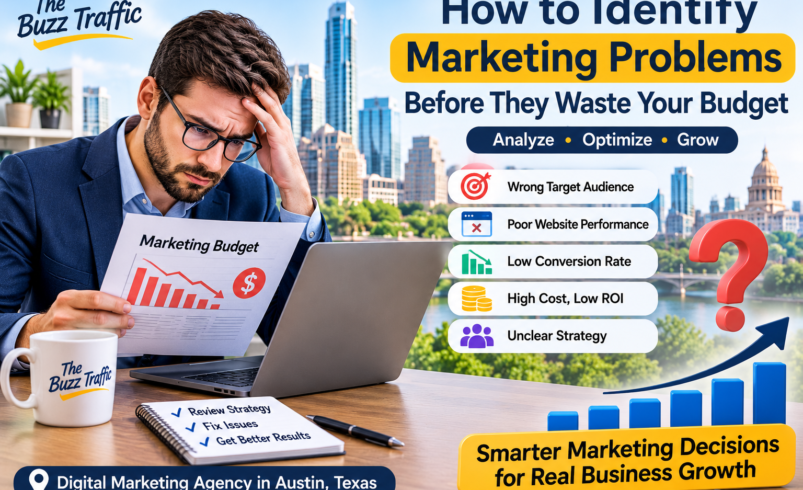

Marketing expenses can increase quickly when businesses invest in advertising, SEO, social media, content creation, and website improvements without understanding what is working. Choosing a Digital Marketing Agency in Austin, Texas should involve more than reviewing service packages; businesses need to identify marketing problems, understand their causes, and prioritize solutions that support measurable goals. The Buzz Traffic perspective emphasizes diagnosing performance issues before increasing spending, helping businesses make more informed decisions about their marketing investments.
Why Marketing Budgets Get Wasted
Marketing budget waste does not always mean a campaign is poorly managed. Sometimes the problem begins before the campaign launches.
A business may target the wrong audience, promote an unclear offer, send visitors to an ineffective landing page, or measure activity without tracking meaningful conversions. Even a campaign generating clicks and impressions can underperform commercially when those interactions do not produce qualified inquiries or sales.
Another common problem is investing in several marketing channels without a coordinated strategy. Businesses may spend on advertising while neglecting website usability, or publish content without understanding what potential customers need.
The solution is not automatically to spend more or stop every campaign. It is to identify where performance breaks down, understand why it happens, and determine which changes are likely to improve results.
Start With Clear Marketing Objectives
Before evaluating campaigns, establish what marketing is supposed to accomplish.
Different businesses require different goals. A local contractor may prioritize qualified quote requests, a professional firm may focus on consultation bookings, and an online retailer may measure completed purchases and customer retention.
Define the Business Outcome
Marketing objectives should connect to meaningful business results.
Examples include:
- Generating qualified leads
- Increasing completed purchases
- Improving consultation bookings
- Reducing customer acquisition costs
- Increasing repeat purchases
- Improving conversion rates
Avoid relying exclusively on broad goals such as increasing traffic or social media engagement. These metrics can provide useful context, but they do not necessarily indicate business growth.
Establish a Baseline
A baseline helps businesses compare current performance with future results.
Review historical website traffic, conversion rates, advertising costs, lead quality, and sales performance where reliable data is available.
Document important campaign changes, seasonal influences, and business conditions. This makes it easier to distinguish genuine improvements from temporary fluctuations.
Without a baseline, businesses may struggle to determine whether marketing investments are producing meaningful progress.
Identify Problems in Your Website and Conversion Process
Marketing campaigns depend on the website or landing page receiving visitors. If that destination creates confusion or friction, additional traffic may not improve results.
Check Whether Your Landing Pages Match Your Campaigns
A landing page should clearly communicate the offer advertised in the campaign.
For example, an advertisement promoting a specific service should lead to a page explaining that service rather than a generic homepage with several unrelated options.
Review the following:
- Does the headline clearly explain the offer?
- Is the page relevant to the advertisement or search query?
- Are benefits and service details easy to understand?
- Can visitors find contact information quickly?
- Is the primary call to action clearly visible?
- Does the page work properly on mobile devices?
If visitors arrive but do not take action, investigate the page experience before assuming that the campaign needs more budget.
Evaluate Website Usability
Slow loading, confusing navigation, broken forms, and difficult mobile layouts can create unnecessary barriers.
Test important landing pages on different devices. Submit contact forms, check phone links, verify buttons, and confirm that successful submissions are recorded correctly.
A technically functioning website is essential for accurate campaign evaluation. If tracking or forms are broken, businesses may underestimate performance or lose opportunities without realizing it.
Find Problems in Paid Advertising Campaigns
Paid advertising can provide useful information about customer demand, but campaign spending needs regular evaluation.
Review Audience and Keyword Targeting
Search advertising should reach people whose queries are relevant to the business’s services.
For example, a company offering commercial roofing may waste money targeting searches related to residential roofing repairs if those services are outside its scope.
Review search terms, geographic targeting, audience settings, exclusions, and campaign structure. Remove irrelevant targeting where appropriate and make sure advertisements accurately reflect available services.
For businesses serving Austin, location targeting should match the actual service area and customer requirements. Avoid advertising in areas where the business cannot realistically serve customers.
Examine Advertising Messages
Advertisements should communicate a clear and relevant offer.
If an advertisement promises a specific service, discount, or consultation, the landing page should explain that offer accurately. Misleading or exaggerated claims can damage trust and reduce campaign effectiveness.
Compare different messages carefully, using controlled tests where possible. Changing several campaign elements simultaneously can make it difficult to identify which adjustment influenced performance.
Evaluate Cost Per Qualified Lead
Cost per lead can provide useful information, but the quality of those leads matters.
A campaign generating inexpensive inquiries may still perform poorly if most prospects are irrelevant, unreachable, or unlikely to purchase.
Track qualified leads separately when possible. Review whether inquiries meet your business requirements and whether they progress into consultations, proposals, or sales.
This helps distinguish campaigns that generate activity from those that contribute to actual business opportunities.
Diagnose SEO and Organic Marketing Problems
Organic search is another area where businesses can waste resources by focusing on the wrong activities.
Check Technical SEO Issues
Technical problems can prevent important website pages from being discovered or understood correctly.
Review indexing status, broken links, redirect problems, canonical tags, mobile usability, and website performance. Google Search Console can help identify indexing issues and provide information about search visibility.
Not every technical warning requires immediate action. Prioritize issues that affect important pages, prevent crawling or indexing, or create significant usability problems.
Evaluate Content Relevance
Publishing more articles does not automatically improve organic search performance.
Content should match the questions people ask and provide meaningful answers. If an article attracts visitors who are unrelated to the business’s services, it may contribute little to lead generation.
Review search queries, page topics, internal links, and the relationship between educational content and commercial service pages.
A useful SEO strategy connects informational content with relevant business offerings without turning every article into a sales pitch.
Avoid Unrealistic SEO Expectations
SEO takes time, and results depend on competition, website history, content quality, technical condition, and other factors.
Businesses should be cautious of promises involving guaranteed rankings, immediate organic growth, or fixed numbers of leads without a clear explanation of the work involved.
Instead, establish realistic objectives, monitor progress, and evaluate whether improvements are helping the intended audience find and use the website.
Understand Marketing Data Before Making Decisions
Marketing reports can contain many metrics, but not all are equally useful for every business.
Separate Activity Metrics From Business Outcomes
Activity metrics describe what happens during marketing campaigns.
Examples include impressions, clicks, page views, video views, and social media interactions.
Business outcome metrics describe what those activities contribute to.
Examples include qualified leads, completed purchases, consultation bookings, revenue, and customer acquisition costs.
Both categories can be useful, but businesses should not confuse increased activity with improved profitability.
Check Conversion Tracking
Reliable conversion tracking is essential for understanding campaign performance.
Depending on the business, conversions may include completed forms, calls, purchases, bookings, or other meaningful actions.
Verify that tracking works correctly and that duplicate events, spam submissions, or incomplete transactions are not inflating results.
For phone-based businesses, consider how calls are recorded and evaluated. A call is not necessarily a qualified lead, and a qualified lead is not necessarily a completed sale.
Understand Attribution Limitations
Customers may interact with several marketing channels before purchasing.
Someone might discover a business through organic search, return through an advertisement, and eventually contact the company directly. Different analytics systems may assign credit differently.
Attribution reports are useful for understanding patterns, but they do not always prove that one channel caused a sale.
Consider customer journeys, sales records, and business context alongside analytics data before reallocating the entire budget.
How to Prioritize Marketing Improvements
Once problems are identified, businesses need a practical way to decide which changes deserve attention first.
Fix Measurement Problems Before Scaling
If conversions are not tracked reliably, campaign performance cannot be evaluated accurately.
Start by checking analytics configuration, form tracking, advertising conversion events, and reporting consistency. Correct measurement problems before making major budget decisions based on incomplete data.
Address High-Impact Website Problems
Broken contact forms, misleading landing pages, and serious mobile usability issues can affect multiple marketing channels simultaneously.
Resolving these problems may improve the effectiveness of existing traffic without requiring additional advertising expenditure.
Prioritize Campaigns With Better Business Potential
Compare campaigns using relevant factors such as lead quality, conversion rates, costs, service profitability, and sales outcomes.
A campaign producing fewer leads may still be more valuable if those leads are substantially more likely to become customers.
Test Changes Before Expanding Spending
Use controlled tests when appropriate and establish what success would look like before making changes.
For example, businesses can compare landing-page messaging, calls to action, or relevant audience segments while maintaining enough consistency to interpret results.
Avoid expanding budgets simply because one campaign produced a temporary improvement. Confirm that performance remains meaningful over an appropriate evaluation period.
When Should a Business Hire a Digital Marketing Agency?
Professional marketing support can be useful when businesses lack internal expertise, have difficulty interpreting campaign data, or need help coordinating several marketing channels.
An agency should begin by understanding business objectives, existing performance, audience requirements, and available resources.
Before hiring a provider, ask:
- How will you identify existing marketing problems?
- Which metrics will you use to evaluate performance?
- How will qualified leads be distinguished from general inquiries?
- What work is included in the proposed service?
- How frequently will reporting and strategy reviews occur?
- Who owns the website, advertising accounts, and analytics data?
- How will the strategy change if performance is below expectations?
A reliable agency should explain its recommendations, communicate limitations, and provide transparent reporting. It should not rely on guaranteed rankings or unsupported revenue promises.
Frequently Asked Questions
How can I tell if my marketing budget is being wasted?
Look for patterns such as irrelevant leads, high campaign costs without meaningful conversions, broken tracking, poor landing-page performance, or spending on audiences outside your service area. Investigate the cause before deciding whether to increase, reduce, or redirect the budget.
Should I stop advertising if campaigns are not generating leads?
Not necessarily. First check targeting, search terms, landing pages, conversion tracking, and the offer itself. If the campaign remains commercially ineffective after reasonable evaluation and improvements, reducing or pausing spending may be appropriate.
What is a good marketing ROI for a small business?
There is no universal marketing ROI benchmark suitable for every business. Profit margins, customer lifetime value, acquisition costs, sales cycles, and service types differ. Businesses should establish their own targets using realistic financial assumptions.
How often should businesses review marketing performance?
Review important campaign metrics regularly and conduct more comprehensive strategic evaluations at appropriate intervals. The frequency depends on campaign volume, budget, sales cycle, and how quickly reliable data becomes available.
Can a digital marketing agency guarantee leads or sales?
An agency can manage activities designed to generate leads, but it cannot guarantee customer demand, sales outcomes, or specific search rankings. Business results depend on multiple factors, including competition, pricing, offer quality, and sales processes.
Conclusion
Marketing budget efficiency begins with identifying problems rather than automatically increasing spending. Businesses can make better decisions by establishing clear objectives, reviewing website usability, checking campaign targeting, measuring qualified conversions, and evaluating performance against meaningful business outcomes. The Buzz Traffic approach prioritizes evidence-based marketing decisions, transparent reporting, and practical improvements that help businesses use their resources more effectively and build a stronger foundation for sustainable growth.