

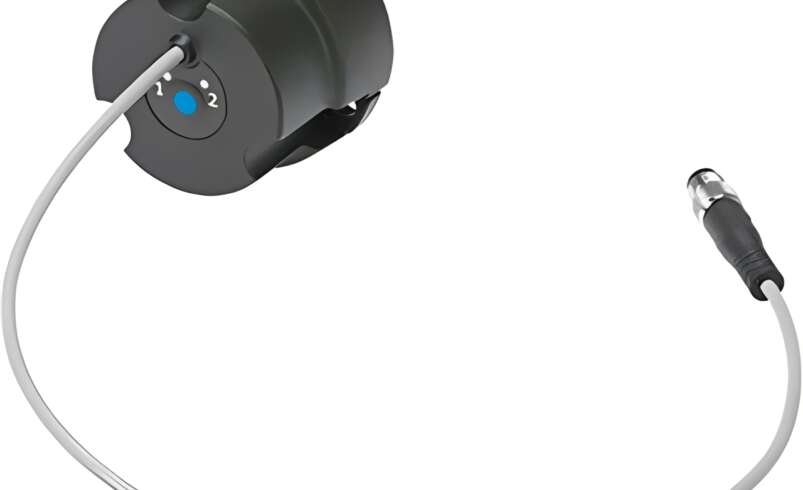

Introduction
A Festo Pneumatic Sensor gives automated machinery the feedback needed to confirm movement, monitor air conditions, and respond to process changes. Instead of relying only on programmed timing, a controller receives real information about piston position, pressure, vacuum, or airflow before allowing the next action to begin.
What Is a Festo Pneumatic Sensor?
A pneumatic sensor detects a physical condition within a compressed-air system and converts it into a usable electrical output. Festo’s portfolio includes cylinder sensors, pressure and vacuum sensors, flow sensors, inductive devices, and position transmitters for different monitoring tasks.
The wider Sensors & Transducers category supports designers comparing sensing methods, signal formats, and accessories for complete automation systems.
Why Is Sensor Feedback Better Than Timing Alone?
A timer assumes that an actuator completes its movement within a fixed period. However, pressure changes, friction, load variation, or mechanical wear can delay motion. A sensor verifies the actual condition, helping the controller avoid starting the next step too early.
This feedback supports faster fault detection and more stable sequences. In addition, modern Smart Sensors can provide enhanced diagnostics and communication features for connected machinery.
Which Conditions Can Festo Sensors Monitor?
Cylinder Position and End-of-Stroke Detection
Festo cylinder sensors detect the magnetic field produced by a permanent magnet inside the piston. When the piston enters the selected sensing zone, the sensor changes its output and confirms the position to the control system.
This method supports clamps, slides, grippers, stops, and transfer mechanisms. It allows the controller to confirm that an actuator has extended or retracted before another machine movement begins.
Pressure and Vacuum Monitoring
Pressure sensors evaluate the air pressure applied to their measuring input and convert the result into an electrical signal. Selected Festo models can provide binary switching, analogue output, or digital measured values through IO-Link.
Suitable Pressure Sensors can help identify low supply pressure, vacuum loss, leakage, or an incorrectly adjusted branch before machine performance becomes unstable.
Flow and Air-Consumption Measurement
Flow sensors measure the movement of gaseous or liquid media and can support condition monitoring. Festo identifies air-consumption measurement, leak monitoring, presence checks, vacuum pickup detection, and leak-tightness testing as common applications.
For compressed-air efficiency projects, Mass Flow Sensors can provide useful consumption data while maintenance teams investigate unusual demand.
Where Are Festo Pneumatic Sensors Used?
Assembly and Packaging Machinery
Assembly cells use sensor feedback to confirm that clamps, ejectors, slides, and positioning devices have completed their movements. Packaging machines apply the same principle before sealing, cutting, diverting, or transferring a product.
Because the controller checks the real machine state, the sequence becomes less dependent on conservative delays. This can improve cycle consistency without sacrificing process control.
Pick-and-Place and Vacuum Handling
Vacuum systems must confirm that a suction cup has gripped the workpiece before movement begins. A configurable threshold helps the controller decide whether the part is secure enough to lift and transfer.
If vacuum falls unexpectedly, the system can stop the sequence, reject the cycle, or alert the operator. This response helps reduce dropped components and incomplete transfers.
How Does IO-Link Improve Pneumatic Sensing?
IO-Link allows compatible sensors to exchange process values, parameters, and diagnostic information with the automation system. Selected Festo pressure sensors can transmit switching or analogue signals and can also communicate digitally through IO-Link.
Compatible IO Link Masters connect field devices to the higher-level controller, supporting centralised parameter access and clearer diagnostics.
This communication can simplify changeovers by restoring approved settings and can help maintenance teams identify disconnected sensors or out-of-range values.
How Should the Correct Sensor Be Selected?
Match the Sensing Task
First, define what the machine must confirm. A binary cylinder sensor answers whether the piston has reached a specific point, while a position transmitter provides a changing value across a sensing range.
Pressure and vacuum sensors suit air monitoring, whereas flow sensors support consumption and leakage analysis. The sensing principle must match the required condition.
Confirm the Electrical Output
Check the supply voltage, PNP or NPN output, normally open or normally closed function, analogue range, connector type, and communication method. The controller input must accept the selected signal.
Where several sensor connections need organised distribution, Sensor Interface – Junction Blocks can simplify field wiring and create clearer service points inside machinery.
Review the Operating Environment
Temperature, vibration, weld fields, washdown, chemicals, and installation space can affect sensor choice. Festo offers cylinder-sensor solutions for standard duties as well as specialised environments.
Switching frequency and response time should also match the cycle rate. A sensor that reacts too slowly or produces unstable signals may disrupt high-speed equipment.
How Should a Pneumatic Sensor Be Installed?
Before installation, isolate electrical power and secure moving machine parts. Confirm the product code, mounting slot, switching distance, cable route, voltage, and controller input.
Reliable Sensor Mounting & Fixing Accessories help keep compatible devices stable at the required detection point during vibration and repeated cycling.
Good installation practices include:
- Position the sensor where the required condition occurs
- Keep cables away from sharp edges and heat
- Avoid excessive bending near the sensor housing
- Secure connectors against movement and contamination
- Test the output at reduced machine speed
- Record switching points and parameter settings
- Confirm operation through several cycles
How Can Sensor Reliability Be Maintained?
Routine inspection should cover the sensor body, mounting hardware, cable, connector, indicator, and controller signal. Intermittent feedback can result from movement, damaged wiring, incorrect alignment, contamination, or electromagnetic interference.
Maintenance teams should compare the electrical signal with actual machine behaviour. If a sensor switches early, late, or inconsistently, technicians should correct the cause instead of extending a timer to hide the problem.
Why Choose a Festo Pneumatic Sensor?
A Festo Pneumatic Sensor helps machinery understand what is happening inside its pneumatic process. Position, pressure, vacuum, and flow feedback can improve sequencing, diagnostics, quality control, and energy awareness.
By matching the sensing principle, output, range, response, mounting, environment, and communication method to the application, engineers can build a more responsive automation system with dependable long-term monitoring.