

Enterprise AI is moving rapidly from experimentation to real-world production. Businesses are using Large Language Models to automate customer support, analyze documents, assist employees, generate content, improve software development, and power intelligent business applications. However, successfully deploying an LLM is very different from building a basic proof of concept.
Production AI requires reliable infrastructure, continuous monitoring, security, scalability, cost control, and consistent model performance. This is where LLMOps for Enterprise becomes increasingly important.
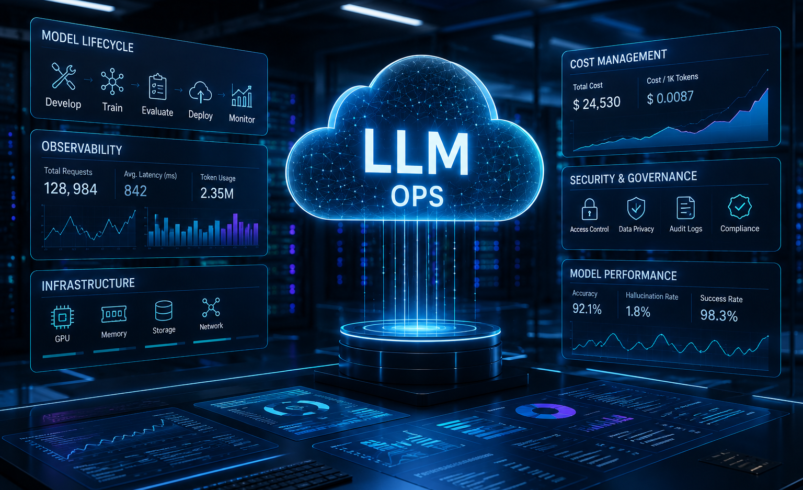
LLMOps provides the operational framework required to manage Large Language Models throughout their lifecycle. It connects model deployment with AI infrastructure, observability, evaluation, security, automation, and optimization.
For organizations looking to scale enterprise AI, adopting the right LLMOps practices can help transform experimental AI projects into reliable production systems. Infratailors.ai helps organizations strengthen this foundation by focusing on AI infrastructure optimization, workload performance, GPU efficiency, deployment planning, and operational scalability.
What Is LLMOps for Enterprise?
LLMOps is the set of processes, technologies, and practices used to develop, deploy, monitor, evaluate, and optimize Large Language Model applications.
While traditional MLOps focuses on machine learning models and their lifecycle, LLMOps introduces additional challenges associated with foundation models and generative AI.
Enterprise LLM applications may involve prompts, model APIs, vector databases, retrieval systems, GPU infrastructure, inference engines, external tools, and business applications.
Managing these components independently can create operational complexity.
LLMOps for Enterprise brings these elements together so organizations can establish repeatable processes for deploying and maintaining production AI applications.
Why Enterprise AI Needs LLMOps
A prototype can work perfectly with a few test users and still fail when exposed to real production traffic.
Enterprise environments introduce higher request volumes, stricter security requirements, unpredictable workloads, regulatory considerations, and demanding performance expectations.
Organizations also need to understand how much each AI request costs and whether the model continues delivering reliable results over time.
Without an effective LLMOps strategy, teams may struggle to identify performance bottlenecks, control infrastructure costs, manage model changes, or detect quality degradation.
A structured LLMOps approach provides the operational visibility and control required to manage AI applications at scale.
Build Production-Ready AI Infrastructure
Infrastructure is one of the most important components of enterprise LLM deployment.
Large Language Models can require significant GPU memory, compute capacity, high-speed networking, and scalable storage. The infrastructure configuration directly influences inference latency, throughput, scalability, and cost.
Organizations should avoid selecting infrastructure based only on the model’s advertised specifications.
The actual workload should determine infrastructure requirements.
Factors such as model size, context length, concurrency, request volume, latency expectations, and inference framework should be evaluated before selecting GPU resources.
Infratailors.ai helps enterprises analyze AI workloads and infrastructure requirements so that organizations can make more informed decisions about deployment architecture and resource allocation.
Choose Models Based on Business Requirements
The largest or newest model is not always the best choice for an enterprise application.
Different business use cases require different levels of reasoning, accuracy, speed, and context handling.
A simple classification or summarization workflow may not require the same model used for complex reasoning. Using an unnecessarily large model can increase infrastructure and API costs without delivering meaningful business benefits.
Enterprise teams should evaluate models based on accuracy, latency, context requirements, infrastructure requirements, security, and total cost.
A mature LLMOps for Enterprise strategy makes model selection an engineering and business decision rather than simply choosing the most powerful available model.
Establish Model Evaluation Processes
Production AI requires continuous evaluation.
Model performance can change when prompts are modified, models are upgraded, retrieval systems are updated, or infrastructure configurations change.
A response that appears acceptable during testing may not meet enterprise requirements at scale.
Organizations should establish evaluation processes that measure factors such as accuracy, relevance, consistency, instruction following, latency, and response quality.
For Retrieval-Augmented Generation applications, evaluation should also consider retrieval quality because poor source information can result in inaccurate responses.
Continuous evaluation helps organizations detect regressions before they become widespread production problems.
Implement AI Observability
Traditional infrastructure monitoring is not enough for LLM applications.
A server can be operational while the AI application delivers poor responses. Similarly, an API request can complete successfully while response latency or token consumption becomes excessive.
This makes AI Observability an essential part of LLMOps.
Teams should monitor model latency, token consumption, GPU utilization, request volume, error rates, response quality, retrieval performance, and infrastructure behavior.
Observability provides the information required to understand how an AI system behaves in production.
It also helps engineering teams determine whether a problem originates from the model, application, retrieval layer, or underlying infrastructure.
Optimize GPU Utilization
GPU resources can represent a major portion of enterprise AI infrastructure costs.
However, simply adding more GPUs does not guarantee better performance.
Underutilized GPUs increase costs while providing limited additional value.
Organizations should analyze GPU memory consumption, utilization, workload concurrency, inference throughput, and scheduling behavior.
Efficient workload scheduling and dynamic resource allocation can help enterprises improve utilization without unnecessarily expanding infrastructure capacity.
This becomes particularly important as organizations move from small AI experiments to high-volume production workloads.
Manage LLM Costs From the Beginning
Cost optimization should be included in the initial LLMOps strategy rather than introduced after cloud bills increase.
LLM costs can come from model API usage, GPU infrastructure, storage, networking, vector databases, monitoring systems, and supporting cloud services.
Organizations can improve cost efficiency by selecting appropriate models, optimizing prompts, reducing unnecessary context, improving GPU utilization, and matching infrastructure capacity to actual workloads.
Monitoring cost per request can also provide valuable insight into which applications are financially sustainable.
Infratailors.ai helps organizations approach infrastructure optimization through workload analysis and performance-focused resource planning.
Automate LLM Deployment
Manual deployment processes become increasingly difficult as enterprise AI environments grow.
Organizations may need to manage multiple models, prompts, environments, GPU configurations, and application versions.
Automation creates repeatable deployment processes and reduces the risk of configuration errors.
Infrastructure as Code, containerization, CI/CD pipelines, automated testing, and orchestration can help engineering teams deploy AI applications consistently.
Automation also makes it easier to roll back changes when a new model or configuration produces unexpected results.
For LLMOps for Enterprise, deployment automation is essential for maintaining speed without sacrificing reliability.
Secure Enterprise LLM Applications
Enterprise AI applications often interact with sensitive information.
Customer records, financial information, internal documents, intellectual property, and confidential communications may be processed by AI systems.
Security must therefore be integrated into every stage of the LLM lifecycle.
Organizations should establish access controls, encryption, authentication, secrets management, network isolation, audit logging, and secure model deployment practices.
Teams should also understand which models and AI services are approved for specific types of business information.
A strong LLMOps strategy makes security part of the architecture rather than treating it as a final deployment step.
Scale AI Workloads Intelligently
Production AI workloads can change dramatically throughout the day.
An enterprise chatbot may experience significant demand during business hours, while document-processing workloads may generate large processing queues at specific times.
Static infrastructure can result in either wasted resources or insufficient capacity.
Dynamic scaling allows infrastructure to respond to changing workload requirements.
However, AI workloads require more careful scaling than conventional applications because GPU memory, model loading times, concurrency, and inference latency all influence capacity.
Intelligent workload management enables organizations to maintain performance while controlling infrastructure costs.
Manage Prompts and Model Versions
Prompt engineering is an important part of modern LLM applications.
Small changes to system prompts can significantly affect response quality, token consumption, and application behavior.
Enterprise teams should therefore treat prompts as production assets that require version control and testing.
Model versions should also be tracked carefully.
When performance changes, engineers need to determine whether the cause was a model update, prompt modification, retrieval change, or infrastructure adjustment.
Version management creates traceability and makes troubleshooting significantly easier.
Prepare LLMOps for Enterprise Growth
Enterprise AI rarely remains limited to one application.
Successful deployments often expand across departments and business processes.
Organizations may eventually operate multiple models, AI agents, RAG applications, internal assistants, and automated workflows.
The LLMOps architecture should therefore support future growth.
Flexible infrastructure, centralized observability, automated deployment, standardized security policies, and workload optimization create a stronger foundation for scaling AI across the organization.
Building these capabilities early reduces technical debt and makes future AI deployments easier to manage.
How Infratailors.ai Supports Production AI
Building reliable enterprise AI requires a close relationship between software, models, and infrastructure.
Infratailors.ai focuses on the infrastructure side of this equation, helping organizations understand workload requirements and optimize the resources supporting AI applications.
Through workload analysis, GPU optimization, infrastructure planning, observability, and performance-focused strategies, organizations can build environments designed for production rather than experimentation alone.
This infrastructure-first approach helps enterprises improve utilization, control costs, and prepare AI workloads for long-term scalability.
Conclusion
LLMOps for Enterprise is becoming essential as businesses move Large Language Models from experimentation into production.
Successful enterprise AI requires much more than selecting a capable model. Organizations need optimized AI infrastructure, continuous evaluation, AI observability, automated deployment, security, scalability, and cost management.
A mature LLMOps strategy creates the operational foundation required to manage these challenges consistently.
Infratailors.ai helps enterprises strengthen this foundation by connecting AI workload requirements with infrastructure optimization, GPU efficiency, deployment planning, and production performance.
As enterprise AI adoption continues to expand, organizations that invest in LLMOps today will be better positioned to build AI applications that are reliable, scalable, secure, and cost-efficient.