

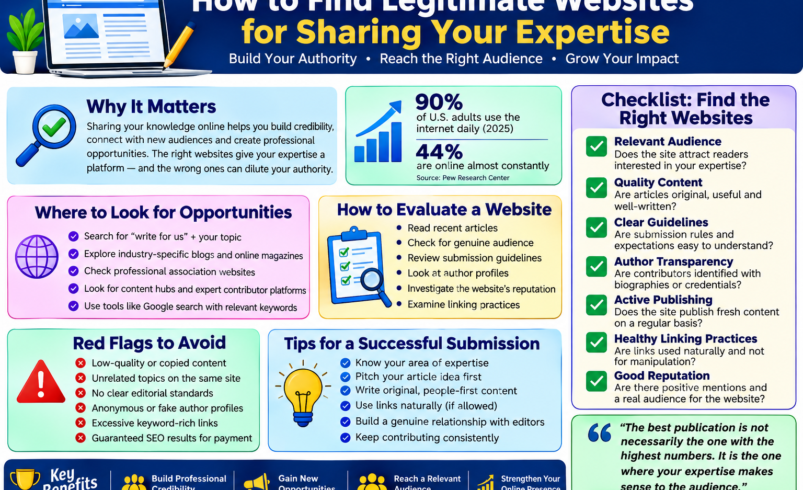

Sharing your expertise online can open doors to new readers, professional connections, business opportunities, and long-term credibility. However, not every website that accepts guest contributions is worth your time. Some platforms have strong editorial standards and a genuine audience, while others exist mainly to publish low-quality articles and collect links.
That is why finding legitimate free article blogging sites requires more than searching for a list and submitting an article to every website you find. You need to evaluate the site’s reputation, audience, editorial process, content quality, and purpose before contributing.
The opportunity is still significant. In the United States, 90% of adults reported using the internet daily in 2025, while 44% said they were online almost constantly, according to Pew Research Center. This means experts have an enormous digital audience available to them. The challenge is not simply getting published. It is getting published in the right places.
Whether you are a writer, marketer, consultant, entrepreneur, fitness professional, educator, or business owner, the right publication can help demonstrate what you know.
The wrong one can do the opposite.
Why the Website You Choose Matters
Publishing an article is not automatically valuable.
Imagine spending several hours researching and writing an excellent article, only to publish it on a website filled with unrelated posts, excessive advertisements, broken links, and hundreds of low-quality submissions.
You may technically have a published article, but you have not built much authority.
A legitimate publication should ideally give you access to at least one of these benefits:
- A relevant audience
- Credibility within your industry
- Opportunities to demonstrate expertise
- Genuine referral traffic
- Professional networking opportunities
- A strong portfolio example
- Exposure to potential customers or collaborators
Content Marketing Institute’s 2025 B2B research found that 87% of surveyed B2B marketers said content marketing helped create brand awareness, while 74% said it helped generate demand or leads.
That does not mean every guest article will generate leads. It means useful content can play an important role in building visibility when it is part of a thoughtful strategy.
Start With Your Area of Expertise
Before searching for websites, define what you can genuinely contribute.
This step is often skipped.
Someone may search for hundreds of “write for us” pages without first deciding what subjects they can discuss confidently. That leads to irrelevant submissions and weak pitches.
Instead, write down three to five areas where you have meaningful knowledge or experience.
For example:
Digital marketer
- SEO
- Content strategy
- Paid advertising
- Social media
- Analytics
Fitness professional
- Strength training
- Mobility
- Beginner fitness
- Exercise habits
- Wellness
Business consultant
- Entrepreneurship
- Leadership
- Operations
- Customer experience
- Business growth
Your expertise does not have to come from a Ph.D. or decades of experience.
Practical experience counts too.
If you have managed campaigns, built websites, worked with customers, tested strategies, completed projects, or solved problems repeatedly, you have experiences that can become useful content.
Google’s guidance on E-E-A-T specifically emphasizes Experience alongside expertise, authoritativeness, and trustworthiness.
Search for Relevant Publications, Not Just “Free” Opportunities
This is where many people get it wrong.
Searching only for “free guest posting websites” can produce enormous lists, but quantity is not quality.
A better approach is to combine your subject with terms such as:
- Write for us
- Guest contributor
- Contributor guidelines
- Submit an article
- Become a contributor
- Expert contribution
- Guest author
- Editorial submission
For example, a health writer could search:
health + write for us
wellness + guest contributor
fitness + submit an article
nutrition + contributor guidelines
You can also explore resources using phrases such as free guest blogging sites, but treat search results as a starting point—not proof that every listed site is legitimate.
The goal is to discover publications and then evaluate them individually.
Check Whether the Website Has a Real Audience
A website can look professional and still have little real readership.
Before submitting, investigate whether people actually interact with its content.
Look for:
- Recent articles
- Genuine comments or discussions
- Active social profiles
- Consistent publishing
- Author profiles
- Shares or engagement
- Brand mentions
- Search visibility
- A recognizable audience
You do not need millions of visitors.
A small publication with a highly relevant audience can be more useful than a large site where your topic feels completely out of place.
For example, a cybersecurity expert may benefit more from a specialized technology publication than a general website with a much larger but unrelated audience.
Examine the Existing Content
Spend ten minutes reading the site’s recent articles.
This simple step can tell you a lot.
Ask:
Are the articles original?
Are they genuinely useful?
Do authors appear to know their subjects?
Are articles edited?
Are sources cited where necessary?
Does the content have a consistent standard?
Are topics related to the site’s stated purpose?
If you see dozens of poorly written articles covering completely unrelated subjects, that is a warning sign.
For example, imagine a website that publishes articles about:
- Fitness
- Plumbing
- Gambling
- Cryptocurrency
- Pet food
- Casino promotions
- Medical advice
- Car insurance
all within the same week.
That is not necessarily proof of wrongdoing, but it should make you question the site’s editorial purpose.
A legitimate publication generally has a recognizable audience and content direction.
Look for Clear Editorial Guidelines
Reputable websites usually explain what they expect from contributors.
A good submission page may explain:
- Accepted topics
- Word count
- Formatting requirements
- Originality requirements
- Image requirements
- Author bio rules
- Linking policies
- Review process
- Editing process
- Submission method
Clear guidelines show that the publisher has thought about editorial quality.
However, the presence of a “Write for Us” page alone proves nothing.
A legitimate-looking page can still belong to a low-quality website.
Evaluate the entire publication.
Check the Author Profiles
Author transparency is another useful quality signal.
Look for articles where writers have:
- Real names
- Short biographies
- Professional backgrounds
- Author pages
- Relevant credentials
- Links to professional profiles where appropriate
This is particularly important for health, finance, legal, technology, and other subjects where inaccurate information can have serious consequences.
Google states that its systems place greater emphasis on strong E-E-A-T for topics that can significantly affect people’s health, financial stability, safety, or well-being.
Therefore, if you are contributing to a health publication, simply writing confidently is not enough.
You should demonstrate responsible expertise.
Check Whether the Site Publishes Original Content
Originality matters for both readers and search engines.
If a website publishes the same article—or nearly the same article—across multiple domains, its value is questionable.
Likewise, avoid submitting articles that are simply rewritten versions of something already published elsewhere.
A strong guest article should be created specifically for its target publication.
You can reuse your knowledge.
Do not simply recycle the same article.
For example, if you previously wrote about beginner fitness, you could develop a new article about strength training for busy professionals. The underlying expertise is similar, but the audience, angle, examples, and content should be distinct.
Investigate the Website’s Linking Practices
This is one of the most important checks if your goal includes SEO.
Do not judge a site solely by whether it allows backlinks.
Instead, examine how it uses links.
Warning signs include:
- Excessive keyword-rich anchor text
- Multiple unrelated commercial links
- Links inserted unnaturally
- Huge lists of external links
- Articles created primarily around backlinks
- Publishers guaranteeing SEO rankings
- Requests for payment specifically to pass ranking value
Google’s current spam policies specifically identify link spam as creating links primarily to manipulate search rankings. The policy also addresses paid or sponsored guest posts where links are used to pass ranking credit, as well as low-quality content created mainly to manipulate linking signals.
That does not mean guest posting itself is bad.
The problem is using guest posting as a link-manipulation scheme.
Google has also stated that it can detect and neutralize low-quality sponsored and guest-post link schemes and recommends appropriate link attributes for sponsored and guest-post relationships.
Do Not Obsess Over DoFollow Links
This deserves emphasis.
If a website offers only nofollow or appropriately qualified links, that does not automatically make the opportunity worthless.
Think about the broader value.
A published article can:
- Introduce you to new readers.
- Demonstrate your expertise.
- Generate referral traffic.
- Build your portfolio.
- Create networking opportunities.
- Strengthen your professional reputation.
Google’s documentation explains that nofollow, sponsored, and ugc are ways to qualify certain types of links, including paid, sponsored, and user-generated links.
So do not reject a genuinely respected publication simply because it does not provide the type of backlink you wanted.
That would be a narrow SEO mindset.
Evaluate Topical Relevance
Relevance is one of the strongest filters you can use.
Ask:
Would the site’s readers actually care about my article?
If the answer is no, move on.
For example:
A marketing expert writing about conversion optimization should look for marketing, business, entrepreneurship, technology, or e-commerce publications.
A health writer should focus on health, wellness, fitness, nutrition, lifestyle, or related publications.
A travel writer should prioritize travel publications, destination blogs, hospitality websites, and lifestyle platforms.
Do not force your topic onto a website simply because it accepts submissions.
The best publication is not necessarily the website with the highest numbers. It is the website where your expertise makes sense to the audience.
Review the Website’s Publishing Frequency
A website that has not published anything for a year may not provide much value.
Check the date of recent posts.
Look for a consistent publishing pattern.
A publication does not need to publish every day. However, consistent recent activity indicates that the website is still maintained.
Also check whether the homepage contains outdated announcements, broken pages, or expired offers.
A neglected website is rarely the best place to invest your strongest work.
Look at Its Social Presence
Social media can provide another clue about whether a publication has an active audience.
Check whether the website has profiles on platforms relevant to its audience.
In the U.S., social platforms remain major channels for reaching people. Pew Research Center’s 2025 research found that 84% of U.S. adults use YouTube, 71% use Facebook, and half use Instagram.
You should not assume that a large social following guarantees quality.
Instead, look for signs of genuine activity.
Do posts receive meaningful engagement?
Are articles actually shared?
Does the publication interact with its audience?
Are posts consistently updated?
These clues can help you understand whether the site is building a real community.
Search for Independent Mentions
Do not rely entirely on what the website says about itself.
Search for the publication elsewhere.
Try searches such as:
“Website name” reviews
“Website name” contributors
“Website name” reputation
“Website name” scam
“Website name” guest post
You are looking for independent evidence.
If a publication claims to be highly authoritative but has almost no mentions, no recognizable writers, and no visible audience, be cautious.
Likewise, one negative comment should not automatically disqualify a site. Look for patterns rather than isolated complaints.
Beware of Websites That Ask for Money Immediately
Not every paid opportunity is illegitimate.
Publications can charge for advertising, sponsorships, or other promotional placements.
The problem occurs when the arrangement is presented as editorial publishing but is actually a paid link scheme.
If money is involved, ask:
- What exactly am I paying for?
- Is this editorial or advertising?
- Will the article be labeled as sponsored?
- How will links be qualified?
- Who controls the editorial decision?
- Is the audience genuine?
Google recommends using rel=”sponsored” for advertising or paid placements, with nofollow also being acceptable in appropriate cases.
Transparency protects both publishers and contributors.
Prepare a Strong Author Profile
Once you find a legitimate website, make it easy for the editor to trust you.
Your author bio should quickly explain:
- Who you are
- What you specialize in
- Your professional experience
- What readers can learn from you
Avoid writing a biography that sounds like an advertisement.
Instead of:
“John is the world’s greatest digital marketing expert who helps businesses dominate Google.”
Use something more credible:
“John is a digital marketing specialist focused on SEO, content strategy, and search visibility. He has worked with small businesses and online brands to develop practical content strategies.”
Specificity sounds more trustworthy than exaggerated claims.
Pitch the Article Before Writing It
Unless the publication specifically requests complete drafts, consider pitching your idea first.
A good pitch should be short.
Include:
- Proposed title
- Article angle
- Target audience
- Short summary
- Why you are qualified to write it
- Relevant examples of previous work
Do not send a 1,000-word email explaining your entire career.
Editors are busy.
Make the decision easy.
Create Content That Earns Its Place
Once your pitch is accepted, do not produce a thin article designed primarily to accommodate a backlink.
That is trash strategy.
Write something the publication would be proud to publish even if there were no link involved.
Your article should have:
- A clear purpose
- A useful introduction
- Logical headings
- Original insights
- Practical examples
- Reliable sources
- Natural language
- Strong conclusions
If appropriate, include firsthand observations or examples from your experience.
This is one of the simplest ways to demonstrate E-E-A-T.
Use Links Naturally
When linking to your own website, ask one question:
Does this link genuinely help the reader?
If yes, it may belong.
If the only reason for the link is “I need a backlink,” reconsider it.
Google’s link guidance recommends descriptive, concise anchor text and specifically warns against keyword stuffing.
For example, instead of forcing an awkward commercial keyword into every article, use natural descriptive wording that tells the reader what they will find after clicking.
The reader should always come first.
Build Relationships Instead of Chasing Placements
One successful article can lead to something more valuable: a relationship with the editor.
If your article performs well, thank the editor.
Share the published piece.
Respond professionally to feedback.
Pitch another genuinely useful topic later.
Over time, you may become a regular contributor.
That is far more valuable than submitting to 200 random websites.
A strong publishing network can become an asset for your professional career.
Create a Simple Website Evaluation Checklist
Before submitting to any website, score it against these questions:
Audience
- Is the audience relevant to my expertise?
- Does the site appear to have real readers?
Content
- Are articles original and useful?
- Is the writing quality reasonable?
- Are contributors credible?
Editorial Standards
- Are submission guidelines clear?
- Does someone appear to review submissions?
- Are articles edited?
Reputation
- Is the website established?
- Does it have independent mentions?
- Does it maintain active publishing?
SEO and Links
- Are links used naturally?
- Does the site avoid obvious link schemes?
- Are sponsored or user-generated links properly qualified?
Transparency
- Are authors identified?
- Is editorial responsibility clear?
- Is the purpose of the website obvious?
If a website fails several of these checks, move on.
There are plenty of other opportunities.
Final Thoughts
Finding legitimate websites for sharing your expertise is not about collecting the largest possible list of guest-posting opportunities.
It is about quality.
A strong publication has a real purpose, a relevant audience, useful content, reasonable editorial standards, and transparent publishing practices. More importantly, it gives you a place where your knowledge can genuinely help readers.
That is why phrases such as free guest blogging sites should be treated as search starting points rather than a quality guarantee.
Do your research.
Read existing articles.
Check authors.
Investigate the audience.
Review the linking practices.
Look for editorial standards.
Then create something genuinely useful.
Google’s Search Essentials emphasize helpful, reliable, people-first content, while its spam policies warn against tactics designed primarily to manipulate search rankings.
The lesson is simple: do not publish everywhere. Publish where your expertise belongs.
When you consistently contribute useful, trustworthy information to relevant publications, visibility becomes a by-product of credibility rather than the entire objective.
And that is a much stronger foundation for long-term online authority.
FAQs
1. What makes a guest blogging website legitimate?
A legitimate website usually has a clear purpose, relevant audience, original content, identifiable authors, consistent publishing activity, transparent editorial guidelines, and reasonable linking practices. It should provide value to readers rather than exist primarily to sell or manipulate backlinks.
2. Are free guest blogging sites good for SEO?
They can provide useful exposure, referral traffic, and portfolio opportunities. However, free does not automatically mean high quality. Evaluate the website’s relevance, reputation, content quality, audience, and linking practices before contributing.
3. Should I only submit to websites that offer dofollow links?
No. A publication can be valuable even when links are nofollow or otherwise appropriately qualified. Audience relevance, credibility, referral traffic, professional exposure, and relationship-building can be more valuable than one particular link attribute.
4. How can I tell if a website has a real audience?
Check its recent content, social activity, engagement, author profiles, independent mentions, and overall publishing consistency. You can also search for the site’s brand name and examine whether people discuss or reference its content outside the website.
5. Should I pay to publish a guest post?
Be careful. Paid placements can be legitimate advertising or sponsorship arrangements, but they should be transparent and appropriately labeled. Google recommends qualifying paid links with rel=”sponsored” or, where appropriate, rel=”nofollow”. Never pay solely because someone promises that a paid guest post will manipulate Google rankings.