

In today’s competitive market, product quality and regulatory compliance play an important role in building consumer confidence. Manufacturers, importers, and businesses dealing with regulated products in India may need to comply with applicable standards before introducing their products into the market. BIS Certification is one of the important conformity assessment requirements for products covered under mandatory Indian Standards.
The Bureau of Indian Standards (BIS) operates certification schemes to help ensure that applicable products meet prescribed Indian Standards. Depending on the product category and certification scheme, businesses may need to complete documentation, product testing, factory-related requirements, and the approval process before certification is granted.
Understanding the complete process in advance can help businesses avoid unnecessary delays and prepare their applications correctly.
What Is BIS Certification?
BIS Certification is a conformity assessment process associated with standards prescribed for specific products in India. The applicable certification route depends on factors such as the product category, manufacturing location, applicable Quality Control Orders (QCOs), and the relevant Indian Standard.
Different BIS schemes may apply to different products. For example, certain products may require certification under the ISI Mark Scheme, while various electronic and IT products may fall under the Compulsory Registration Scheme (CRS).
For businesses planning to manufacture, import, or sell regulated products, understanding the applicable india bis certification requirements is an important first step. The exact documentation and approval requirements can vary based on the product and certification scheme.
Documents Required for BIS Certification
Proper documentation is an essential part of the application process. While the exact list depends on the applicable scheme and product, businesses generally need to prepare company and product-related documents.
Common documents and information may include:
- Business registration and company details
- Manufacturing unit information
- Product specifications and technical details
- Details of manufacturing processes
- Quality control procedures
- Product test reports, where applicable
- Factory layout and machinery details
- Authorized signatory information
- Brand and trademark-related documents, where required
- Details of raw materials and components
Foreign manufacturers may have additional requirements depending on the applicable certification route. Therefore, applicants should carefully identify the relevant standard and scheme before submitting their documents.
A properly prepared application can reduce the chances of avoidable queries during the bis certification process.
Product Testing and BIS Requirements
Testing is an important stage in the certification journey. Products are generally required to demonstrate compliance with the applicable Indian Standard through testing under the prescribed process.
The type of testing depends on the product category and certification scheme. In many cases, samples may need to be tested at an appropriate laboratory according to the applicable requirements.
Testing may examine various product characteristics, including:
Product Safety
Applicable products may be evaluated for safety-related requirements to ensure they meet the relevant Indian Standard.
Performance and Quality
Testing can verify whether the product performs according to prescribed technical specifications and quality parameters.
Construction and Technical Parameters
Certain products may be assessed for dimensions, materials, design specifications, electrical characteristics, or other technical requirements.
Businesses should ensure that their product samples and technical documents are consistent with the applicable standards before proceeding with testing. If a product fails testing, additional corrections or modifications may be required before the certification process can move forward.
BIS Certificate Online Application Process
Today, businesses can complete various stages of the certification procedure through designated online systems, depending on the applicable scheme. A bis certificate online application generally requires accurate information about the manufacturer, product, manufacturing location, and applicable standards.
The general process may involve the following stages:
Step 1: Identify the Applicable Standard and Scheme
The first step is determining whether the product falls under a mandatory certification requirement and identifying the correct Indian Standard.
Step 2: Prepare Documentation
The applicant collects and prepares the required company, manufacturing, product, and technical documents.
Step 3: Product Testing
Product samples may be tested according to the applicable Indian Standard and certification requirements.
Step 4: Submit the Application
The application is submitted through the relevant process along with the prescribed documents, declarations, and supporting information.
Step 5: Inspection or Verification
Depending on the certification scheme, BIS may conduct inspection, verification, or assessment of the manufacturing facilities and quality control arrangements.
Step 6: Review and Approval
The submitted application, documents, test reports, and other requirements are reviewed. Once the applicable requirements are fulfilled, approval may be granted according to the relevant certification scheme.
BIS Certification Cost: What Businesses Should Consider
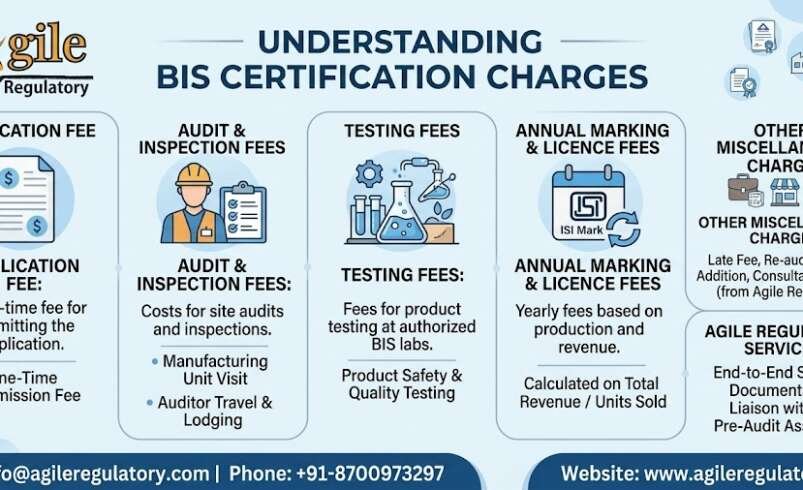
The BIS certification cost can vary significantly depending on the product, certification scheme, testing requirements, number of products or models, and other applicable factors.
Businesses should consider potential costs related to:
- Application and processing charges
- Product testing
- Factory inspection, where applicable
- Marking or licensing fees
- Professional consultancy support
- Renewal and ongoing compliance requirements
Instead of considering certification expenses as a single fixed amount, businesses should evaluate the complete compliance requirements applicable to their specific product.
How Agile Regulatory Can Help
Understanding regulatory standards and completing the certification process can be challenging, especially for businesses dealing with technical products or multiple compliance requirements. Agile Regulatory provides professional guidance to businesses seeking assistance with applicable BIS-related procedures.
The team can help businesses understand product applicability, identify relevant standards, organize required documentation, coordinate the application process, and understand testing and compliance requirements.
Agile Regulatory focuses on providing structured compliance support so that manufacturers and businesses can better understand each stage of the certification journey. Whether a business is applying for the first time or managing regulatory requirements for multiple products, professional guidance can help improve application preparedness and reduce procedural confusion.
However, the final certification and approval remain subject to the requirements, assessment, and decision of the competent authority.
Conclusion
BIS Certification is an important compliance requirement for products covered under applicable Indian Standards and mandatory regulations. The process may involve identifying the correct certification scheme, preparing documents, completing product testing, submitting the application, and fulfilling inspection or verification requirements.
Businesses should begin by understanding their product category and applicable standard before starting the application. Proper planning and documentation can make the process more systematic and help avoid unnecessary delays.
Agile Regulatory can provide professional assistance throughout the compliance journey by helping businesses understand documentation, testing requirements, application procedures, and applicable certification processes. With the right preparation and regulatory guidance, businesses can approach product compliance with greater clarity and confidence.
Frequently Asked Questions
1. What is BIS Certification?
BIS Certification is a conformity assessment process for applicable products based on prescribed Indian Standards and relevant certification schemes.
2. How long does the BIS certification process take?
The timeline depends on factors such as the product category, testing requirements, document readiness, applicable certification scheme, and regulatory review.
3. What documents are required for BIS Certification?
Requirements vary by product and scheme but may include business documents, manufacturing details, product specifications, quality control information, and applicable test reports.
4. What is included in BIS certification cost?
The cost may include application-related charges, product testing, inspection requirements, licensing fees, and other applicable expenses.
5. Can I apply for a BIS certificate online?
Depending on the applicable certification scheme and process, businesses can complete application-related procedures through designated online systems.
6. Can Agile Regulatory help with BIS Certification?
Yes. Agile Regulatory provides professional guidance for understanding applicable requirements, preparing documentation, managing application procedures, and navigating the compliance process.