

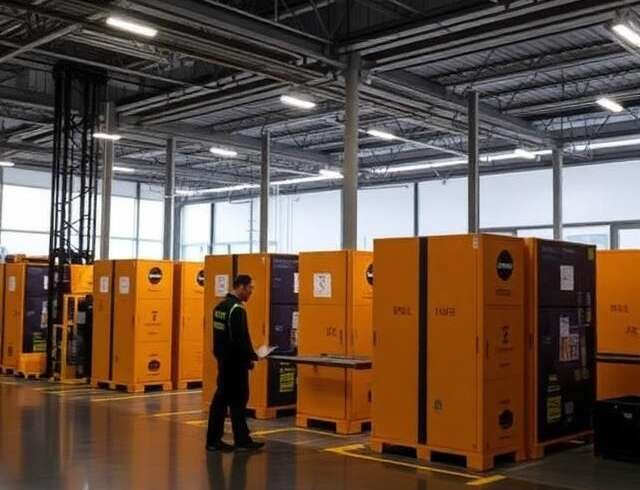

For today’s eCommerce businesses, fulfillment is no longer simply about storing inventory, packing orders, and shipping products. It has become a strategic capability that directly influences customer experience, operating margins, inventory efficiency, and the ability to scale. As consumer expectations rise and distribution networks become increasingly complex, businesses need Fulfillment services USA that connect warehousing, transportation, technology, and delivery into one coordinated ecosystem.
At the same time, relying on a single transportation mode can limit flexibility and expose businesses to unnecessary cost and disruption. Integrating Multimodal Transportation Services into the fulfillment strategy gives organizations more options for moving inventory across regions while balancing speed, capacity, reliability, and cost.
For leadership teams evaluating their next phase of growth, the question is shifting from “How do we ship more orders?” to “How do we build a fulfillment and transportation network that scales profitably?”
Fulfillment Is Becoming a Business Growth Infrastructure
The traditional fulfillment model was primarily operational. Inventory entered a warehouse, customer orders were processed, products were packed, and shipments were handed over to carriers.
Modern commerce demands considerably more.
Brands are managing orders across websites, marketplaces, retail channels, wholesale partners, and increasingly complex omnichannel environments. Customers expect fast delivery, accurate tracking, convenient returns, and consistent service regardless of where they purchase.
Modern Fulfillment services USA therefore need to connect inventory management, warehousing, order processing, transportation management, parcel shipping, returns, and data visibility.
When these capabilities operate as one ecosystem rather than disconnected functions, fulfillment can move from being a cost center to becoming an enabler of growth.
Why Transportation Strategy Matters More Than Ever
Transportation can represent a significant portion of the overall cost of fulfilling an eCommerce order. Carrier rates, fuel costs, capacity constraints, delivery zones, shipment distances, and service-level requirements can quickly affect margins.
This makes transportation optimization a leadership-level concern.
A sophisticated e-commerce transportation services provider can help businesses determine how inventory and orders should move through the network rather than simply selecting a carrier after an order reaches the warehouse.
The objective is to find the right combination of transportation modes, routes, carriers, fulfillment locations, and service levels for each shipment.
That approach can create a transportation network that responds dynamically to changing business requirements instead of operating according to rigid shipping rules.
Multimodal Transportation Services Create Greater Network Flexibility
No single transportation mode is ideal for every shipment.
Air transportation can provide speed but at a premium. Road transportation offers extensive reach and flexibility. Rail can provide economic advantages for certain long-distance movements, while ocean freight remains essential for many international supply chains.
Multimodal Transportation Services bring these options together within a coordinated transportation strategy.
Instead of evaluating individual shipments in isolation, businesses can determine which combination of modes delivers the appropriate balance between cost, transit time, capacity, and reliability.
For example, inventory entering the United States may move through ocean freight, rail, truckload transportation, regional distribution centers, and parcel networks before ultimately reaching customers.
When these movements are connected through a unified logistics strategy, businesses gain more opportunities to optimize the entire journey rather than individual transportation legs.
Connecting Transportation and Fulfillment Creates a Stronger Network
Fulfillment and transportation decisions should not happen independently.
Where inventory is stored directly affects shipping distance. Shipping distance influences transportation costs and delivery times. Delivery expectations influence warehouse locations and inventory positioning.
These decisions are interconnected.
An integrated fulfillment strategy can analyze where customers are located, where demand is increasing, how quickly orders need to arrive, and how inventory should be distributed across the network.
Businesses can then position inventory closer to high-demand markets and select transportation services according to the requirements of individual orders.
The result is a more responsive network capable of supporting both customer expectations and financial objectives.
The Rise of Intelligent Transportation Decisions
Technology is rapidly changing how fulfillment and transportation networks operate.
Transportation management platforms, warehouse management systems, order management technologies, analytics platforms, automation, and AI-driven decision engines are giving businesses greater visibility into inventory and shipment movements.
For an e-commerce transportation services provider, this creates opportunities to make smarter decisions around carrier selection, route optimization, load consolidation, inventory positioning, and service-level management.
Rather than following static rules, technology-enabled networks can use operational data to determine the most appropriate fulfillment location and transportation option for each order.
This intelligence becomes particularly valuable as order volumes increase and transportation networks become more complex.
Turning Transportation Data Into Executive Visibility
Executives do not need another dashboard filled with operational metrics. They need visibility that supports business decisions.
A connected fulfillment and transportation ecosystem can provide insight into metrics such as transportation cost per order, on-time delivery performance, average shipping distance, inventory utilization, order cycle time, carrier performance, fulfillment accuracy, and return costs.
These metrics help leadership teams understand how logistics decisions influence profitability and customer experience.
More importantly, they can reveal where network improvements could create measurable business value.
For example, consistently high shipping costs within a particular region may indicate that inventory should be positioned closer to that customer base. Repeated delays from one transportation lane may suggest the need for alternative carriers or transportation modes.
Data turns logistics from reactive problem-solving into proactive network management.
Managing the Cost-to-Serve Equation
Fast delivery can improve customer satisfaction, but faster transportation generally comes with higher costs.
The challenge is determining when additional speed creates enough business value to justify the expense.
A sophisticated Fulfillment services USA strategy should therefore focus on cost-to-serve rather than simply transportation cost.
Different customers, products, regions, and order types may require different fulfillment approaches.
High-value orders might justify expedited delivery. Standard orders could move through more economical transportation services. Inventory replenishment may benefit from consolidated freight or multimodal transportation.
Creating differentiated fulfillment rules enables businesses to protect margins while maintaining competitive service levels.
Scalability Without Building Everything Internally
Rapid growth can expose weaknesses in a logistics network.
Higher order volumes require more warehouse capacity, labor, carrier relationships, technology infrastructure, and transportation management expertise. Expanding internally can require significant capital investment and operational resources.
Partnering with an experienced e-commerce transportation services provider can provide access to infrastructure and capabilities without requiring businesses to build every component themselves.
A scalable logistics partner can help organizations expand warehouse capacity, enter new markets, manage seasonal demand, diversify transportation options, and integrate new sales channels.
For leadership teams, this creates greater flexibility when planning growth.
Instead of logistics infrastructure becoming a constraint, the fulfillment network can expand alongside the business.
Building Resilience Into the Fulfillment Network
Recent supply chain disruptions have demonstrated the risks associated with overly concentrated logistics networks.
A single warehouse, transportation mode, carrier, or distribution route can create significant operational exposure.
Resilient fulfillment strategies introduce alternatives.
Multiple fulfillment locations can reduce dependence on one facility. Multiple carrier relationships provide additional capacity options. Multimodal Transportation Services can provide alternative routes when one transportation channel experiences disruption.
Resilience does not mean creating unnecessary redundancy everywhere. It means understanding critical dependencies and building practical alternatives into the network.
For growing organizations, that flexibility can become a meaningful competitive advantage.