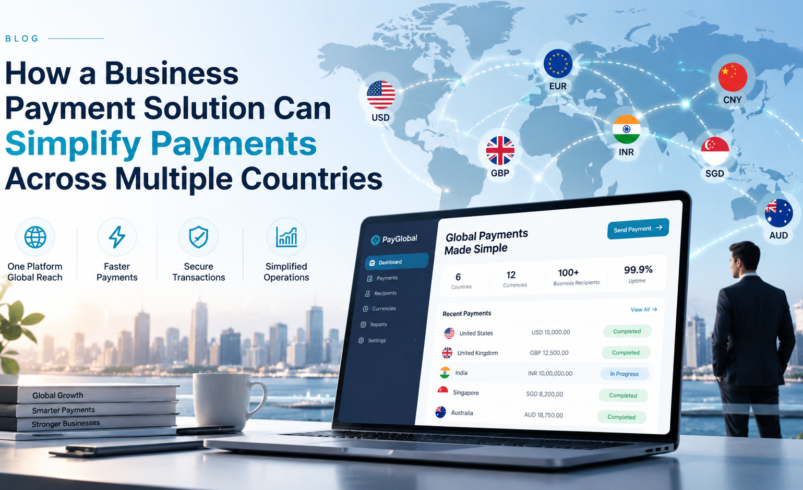

Introduction
Expanding into multiple countries introduces more than new customers and revenue opportunities.
Businesses must also manage increasingly complex financial operations.
A company may collect customer payments in several currencies, pay suppliers in different markets, monitor international settlements, and prepare consolidated financial reports.
If every country uses a separate payment process, operational complexity increases quickly.
A scalable business payment solution can help companies organize payment activity across several markets.
Centralizing International Transactions
Centralization can improve visibility.
Finance teams can maintain clearer records of:
- Customer payments
- Supplier transactions
- Currency
- Payment status
- Settlement information
Centralized transaction data makes multi-country operations easier to manage.
Supporting Cross Border Payments
International companies regularly make cross border payments.
These transactions may involve customers, suppliers, distributors, or service providers.
Businesses need systems that can track payments efficiently.
Handling Multiple Currencies
A multi-country company may work with several currencies every day.
Finance teams need clear information about transaction and settlement amounts.
Better currency visibility improves budgeting and reporting.
Managing Customer Collections
Pay-in services help businesses organize incoming customer payments across different markets.
Efficient collection processes can improve transaction tracking and cash flow visibility.
Supporting Online Customers
Flexible online payment solutions can help businesses provide digital payment experiences for customers across several countries.
Businesses should adapt payment options where necessary while keeping internal processes standardized.
Improving B2B Cross Border Payments
Multi-country businesses often work with international commercial partners.
Reliable b2b cross border payments help companies manage supplier and customer transactions with more structured records.
Standardizing Business Payments
Companies should establish consistent internal rules for business payments.
These can include:
- Approval procedures
- Transaction records
- Payment scheduling
- Reconciliation standards
- Reporting
Standardization improves accountability.
Automating Payment Administration
Automation can reduce repetitive work associated with:
- Invoice matching
- Payment confirmation
- Settlement monitoring
- Reconciliation
- Reporting
This becomes especially valuable as transaction volumes grow.
Improving Reporting Across Countries
Management teams need consolidated payment information.
A centralized system can help companies compare:
- Transaction volume
- Payment values
- Settlement timing
- Currency exposure
- Payment costs
This supports better international decision-making.
Improving Cash Flow Planning
Multi-country businesses need to understand when funds will arrive and when obligations must be paid.
Payment visibility supports more accurate working capital planning.
Integrating Payment Systems
Payment infrastructure may connect with:
- ERP platforms
- Accounting systems
- Billing software
- E-commerce platforms
Integration improves data consistency and reduces manual work.
Strengthening Security
International operations require appropriate access controls and transaction monitoring.
Companies should define who can initiate and approve payments.
Strong controls reduce operational and financial risk.
Supporting Growth
A scalable payment platform should support:
- New countries
- Additional currencies
- Higher transaction volumes
- New customer groups
- More suppliers
Planning for future growth helps avoid major payment infrastructure changes later.
Considering Uniteller
Businesses comparing multi-country payment platforms may evaluate Uniteller alongside other providers.
Companies should compare international payment capabilities, Pay-in services, digital payment support, B2B payment tools, security, integrations, and reporting.
Conclusion
Managing payments across several countries can become complicated without structured financial infrastructure.
A centralized business payment solution can help companies improve transaction visibility, reporting, and operational consistency.
Modern payment solutions can support reliable cross border payments, b2b cross border payments, and international business payments.
Flexible online payment solutions and efficient Pay-in services can also improve customer collections.
By evaluating providers such as Uniteller according to their international payment requirements, businesses can create scalable financial processes that support multi-country growth.