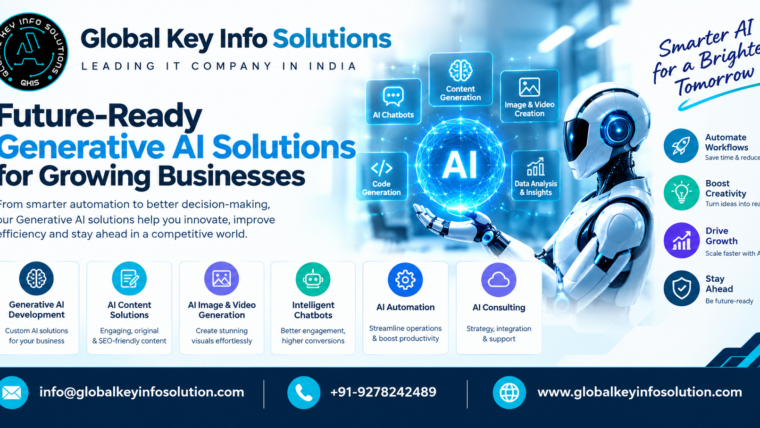

Businesses today are looking for smarter ways to improve productivity, reduce repetitive work, and deliver better customer experiences. Traditional software solutions can handle many business operations, but growing companies increasingly need tools that can understand information, generate content, analyze data, and support faster decision-making. This is where Generative AI solutions are becoming valuable.
Generative AI helps businesses create new content, summarize documents, answer customer questions, generate code, and automate various knowledge-based tasks. When implemented strategically, it can help startups, small and medium-sized businesses, and large enterprises improve operational efficiency while preparing for future growth.
Global Key Info Solutions helps businesses explore modern technology solutions that support digital transformation, process automation, and scalable growth. By adopting the right generative AI technologies, organizations can build more flexible workflows and prepare for changing customer expectations.
What Are Generative AI Solutions?
Generative AI solutions are applications and systems that use artificial intelligence models to generate new content or responses based on user instructions and available information. These systems can work with text, images, code, documents, and other forms of data, depending on the technology used.
For example, a business can use generative AI to draft marketing content, summarize lengthy reports, create customer support responses, or help employees find information from internal documents.
Unlike basic automation tools that follow predefined rules, generative AI can interpret natural language instructions and produce context-aware outputs. However, its results should be reviewed for accuracy, relevance, and compliance, particularly when used for important business decisions.
Why Growing Businesses Need Future-Ready Generative AI
As companies expand, their operations become more complex. Customer inquiries increase, teams manage larger volumes of information, and employees spend more time on repetitive tasks. Generative AI can help address these challenges when applied to suitable business processes.
1. Improve Productivity Across Teams
Employees often spend significant time drafting emails, preparing reports, researching topics, and organizing information. Generative AI tools can assist with these activities, allowing teams to focus more on strategic and creative work.
For example, a sales team can use AI to prepare initial email drafts, summarize customer conversations, and organize meeting notes. Marketing teams can generate content ideas, develop campaign outlines, and adapt messaging for different audiences.
Human review remains important to ensure that the final output meets business standards.
2. Deliver Better Customer Experiences
Customers expect quick responses and relevant support across digital channels. Generative AI-powered chatbots and virtual assistants can help businesses answer common questions, explain services, and guide users through routine processes.
When connected to approved business information, these tools can provide more relevant responses than basic scripted chatbots.
Businesses can also use AI to support multilingual communication and offer assistance outside regular working hours. For complex or sensitive issues, the system should provide a clear option to connect with a human representative.
3. Automate Repetitive Business Processes
Growing organizations often rely on manual processes to handle documents, extract information, prepare summaries, and respond to routine requests.
Generative AI can assist with document processing, email classification, knowledge retrieval, and content preparation. When integrated with existing business applications, it can reduce manual effort across selected workflows.
For example, an organization could use AI to summarize incoming service requests, identify relevant information, and prepare a response for an employee to review before sending.
The best starting point is usually a repetitive task with a clear workflow, measurable outcomes, and manageable risks.
4. Support Data-Driven Decision-Making
Business teams work with information from sales reports, customer feedback, market research, and internal documents. Generative AI can help summarize these sources and present important findings in an accessible format.
Managers may use AI assistants to explore business reports, identify recurring customer concerns, or prepare summaries for meetings.
However, AI-generated insights should be checked against reliable source data. Generative AI can produce inaccurate information, so it should support informed decisions rather than replace professional judgment.
Key Generative AI Solutions for Modern Businesses
Different organizations have different technology requirements. Selecting the right solution depends on business goals, available data, existing software, and operational challenges.
AI-Powered Chatbots and Virtual Assistants
AI chatbots can help businesses manage frequently asked questions, explain products and services, and direct customers to relevant resources. Internal virtual assistants can also help employees locate policies, procedures, and company information.
These solutions are particularly useful for customer service teams, ecommerce businesses, educational platforms, and service-based organizations.
Generative AI for Content and Marketing
Marketing teams can use generative AI to brainstorm campaign ideas, prepare content outlines, draft product descriptions, and personalize communication for different customer segments.
AI-generated content should be reviewed for originality, factual accuracy, brand consistency, and search intent before publication. Businesses should prioritize helpful, original information rather than publishing large volumes of unedited AI content.
AI Document Processing and Knowledge Management
Companies often store important information across PDFs, spreadsheets, contracts, reports, and internal knowledge bases. AI-powered document solutions can summarize files, extract relevant details, and help employees retrieve information more efficiently.
With appropriate access controls, retrieval-based systems can use approved company documents to provide answers supported by internal sources.
Custom Generative AI Applications
Some businesses require more than general-purpose AI tools. Custom applications can be designed around specific workflows, industry requirements, and internal systems.
Examples include AI assistants for sales teams, internal research tools, automated report-generation systems, and intelligent knowledge platforms.
Custom development can help organizations maintain greater control over integrations, permissions, user experiences, and business-specific functionality.
How Generative AI Supports Different Industries
Generative AI can support a wide range of business operations, although its suitability depends on the use case.
Ecommerce: Businesses can use AI to draft product descriptions, assist customers, summarize product reviews, and organize product information.
Healthcare: Administrative teams may use AI to summarize approved documentation or assist with non-clinical workflows, subject to privacy requirements and appropriate professional oversight.
Education: Educational organizations can explore AI-powered learning assistants, study-material generation, and administrative support tools.
IT and software development: Development teams can use AI to assist with code explanations, documentation, test-case drafting, and troubleshooting. Developers must review generated code for security, quality, and correctness.
Professional services: Consulting, legal, and other professional service firms can use AI to summarize documents and prepare initial drafts, with confidentiality safeguards and expert review.
Manufacturing and logistics: AI assistants can help employees retrieve operational documentation, prepare reports, and summarize maintenance records.
The goal is not to introduce AI into every activity. It is to identify where the technology can deliver measurable value without creating unnecessary complexity.
Essential Features of Future-Ready Generative AI Solutions
A future-ready AI system should be designed to evolve alongside the business. Organizations should evaluate several important capabilities before investing in a solution.
Scalability
The solution should support increasing workloads, additional users, and new business requirements without requiring a complete redesign.
Integration With Existing Systems
AI applications become more useful when they work with approved business tools, customer relationship management platforms, document repositories, and internal applications.
Integration should follow appropriate permissions and security controls.
Data Privacy and Security
Businesses must consider how information is collected, processed, stored, and shared with AI providers. Sensitive data should be protected through access controls, encryption where appropriate, data-handling policies, and vendor assessments.
Organizations should also review applicable privacy laws and contractual requirements.
Accuracy and Human Oversight
Generative AI can produce convincing but incorrect answers. Businesses should establish review processes, test the system with realistic scenarios, and provide human oversight for high-impact activities.
Where possible, responses should reference reliable source material so users can verify important claims.
Flexibility and Model Selection
AI technology continues to evolve. A well-designed solution should allow businesses to evaluate different models, update workflows, and adapt to changing requirements without becoming unnecessarily dependent on a single provider.
Performance Monitoring
Organizations should track response quality, usage, operating costs, user satisfaction, and time saved. Continuous monitoring helps identify problems and determine whether the solution is delivering its intended benefits.
How to Implement Generative AI in Your Business
Successful AI adoption requires a clear plan rather than simply choosing a popular tool.
Step 1: Identify a Business Challenge
Start with a specific problem, such as repetitive customer inquiries, lengthy document reviews, or time-consuming report preparation.
Step 2: Define Measurable Goals
Establish what success means. Possible measures include reduced processing time, faster customer responses, improved employee productivity, or fewer manual errors.
Step 3: Evaluate Your Data and Technology
Review data quality, system compatibility, privacy requirements, and existing infrastructure before selecting an AI solution.
Step 4: Start With a Pilot Project
Test the solution on a limited workflow with a defined group of users. A pilot helps uncover limitations and provides evidence before a wider rollout.
Step 5: Integrate Security and Governance
Define who can access the system, which information it can use, when human approval is required, and how errors should be reported.
Step 6: Measure Results and Improve
Collect feedback, compare results with the original goals, and refine the system based on real-world performance. Expand only when the initial use case demonstrates meaningful value.
Common Challenges Businesses Should Consider
Although generative AI offers significant opportunities, implementation can involve practical challenges.
- Unreliable outputs: AI-generated responses require testing and verification.
- Data protection: Sensitive business and customer information must be handled appropriately.
- Integration complexity: Connecting AI with older applications may require additional development.
- Unclear return on investment: Projects without measurable objectives can consume resources without delivering meaningful benefits.
- Employee adoption: Teams need training and clear guidance on when and how to use AI.
- Ongoing costs: Model usage, infrastructure, monitoring, maintenance, and integration should be included in the overall budget.
Addressing these challenges early helps organizations make more informed technology decisions and build solutions that remain useful over time.
Why Choose Global Key Info Solutions for Generative AI Development?
Choosing an appropriate technology partner can help businesses move from experimentation to practical implementation. Global Key Info Solutions provides technology and digital solutions designed to support business requirements and digital transformation initiatives.
Businesses exploring generative AI can benefit from a structured approach that focuses on their goals, workflows, and existing systems.
The key considerations include understanding the business problem, identifying suitable AI capabilities, planning integrations, establishing security requirements, and evaluating performance after deployment.
Whether an organization wants to explore an AI-powered chatbot, streamline document workflows, or develop a custom AI application, the first step is to define the expected outcome and select a solution that fits its operational needs.
Learn more about Global Key Info Solutions and explore technology solutions that can support your business growth.
The Future of Generative AI in Business
Generative AI is moving beyond basic content generation toward more connected business applications. Organizations are exploring systems that can retrieve information from approved sources, interact with existing software, assist with multistep workflows, and provide context-aware support.
As these capabilities mature, businesses may be able to coordinate more activities across customer service, marketing, software development, and internal operations.
However, long-term success will depend on more than adopting the newest AI model. Data quality, integration, security, governance, employee skills, and continuous evaluation will remain essential.
Businesses that approach AI strategically can build a stronger foundation for adapting to new opportunities and changing market demands.
Conclusion
Future-ready generative AI solutions can help growing businesses improve productivity, streamline workflows, enhance customer experiences, and make better use of information. The most effective implementations begin with clear business objectives and develop through careful testing, secure integration, and continuous improvement.
Rather than adopting AI simply because it is popular, businesses should focus on practical applications that solve real problems and deliver measurable results.
With the right strategy and technology partner, organizations can explore generative AI as a practical part of their long-term digital growth plans.
Frequently Asked Questions
1. What are generative AI solutions for businesses?
Generative AI solutions use artificial intelligence to create content, summarize information, answer questions, assist employees, and support business workflows. They can be adapted to different operational needs.
2. How can generative AI help small businesses?
Small businesses can use generative AI to draft marketing materials, support customer inquiries, summarize documents, prepare reports, and reduce repetitive administrative work.
3. Can generative AI be integrated with existing business software?
Yes. Depending on the available APIs, permissions, and system architecture, generative AI can be integrated with selected CRM platforms, document systems, websites, and internal applications.
4. Is generative AI suitable for every business?
Not necessarily. Its suitability depends on the business problem, data availability, implementation costs, risk level, and expected benefits. Businesses should evaluate individual use cases before investing.
5. How much do custom generative AI solutions cost?
Costs vary according to application complexity, model selection, integrations, infrastructure, security requirements, and ongoing maintenance. A clearly defined project scope helps establish a realistic budget.
6. How can businesses implement generative AI securely?
Businesses should evaluate AI providers, restrict access to sensitive information, establish data-handling policies, test outputs, monitor performance, and require human approval for important decisions.
7. Why should businesses consider custom generative AI development?
Custom development can help organizations address specialized workflows, connect AI with existing systems, apply business-specific rules, and create experiences tailored to their users.