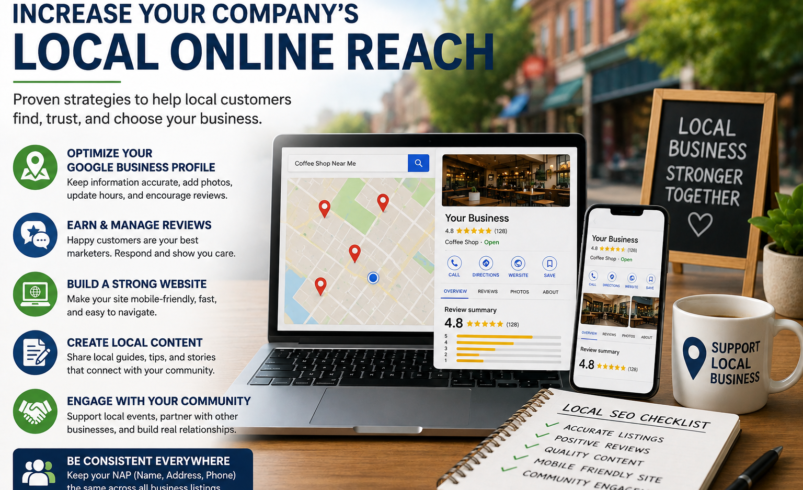

Introduction
Getting your company noticed online can be challenging, especially when customers have countless businesses to choose from. A local customer searching for a restaurant, contractor, healthcare provider, retailer, lawyer, or professional service can compare several options within minutes. That is why building a strong local online presence is no longer something only large companies should prioritize. It has become an essential part of competing in almost every local market.
One of the foundations of local visibility is maintaining accurate information across business listing sites and local business citations. These references help customers discover important information about your company while contributing to a consistent digital footprint. When your business name, address, phone number, website, services, and hours are accurate across relevant platforms, potential customers have fewer reasons to hesitate.
Consumer behavior also shows why local businesses need to take their online presence seriously. BrightLocal’s 2025 Local Consumer Review Survey found that 96% of consumers are open to writing a review for a local business. The study also found that consumers are increasingly interested in the actual details of customer experiences rather than simply looking at star ratings.
Google explains that local results are primarily influenced by relevance, distance, and prominence. It also notes that prominence can be influenced by information such as links from other websites and the number and quality of reviews a business receives.
The good news is that improving local online reach does not require a massive advertising budget or a complicated marketing department. A business can make meaningful progress by getting the fundamentals right, consistently publishing useful information, building genuine relationships, and creating experiences customers are willing to recommend.
Understand What Local Online Reach Really Means
Local online reach is more than ranking first on Google.
It means making your business visible across the digital channels your customers use to discover, compare, and evaluate local companies.
A customer may find your company through Google Search, Google Maps, a business directory, a review platform, social media, a local publication, a community website, or a recommendation from another customer.
That means your goal should not be to depend entirely on one platform.
Instead, create a connected digital presence where each channel supports the others.
Your Google Business Profile can help customers discover you. Your website can explain your services. Reviews can provide social proof. Local directories can reinforce business information. Social media can build familiarity. Local partnerships can generate awareness and legitimate mentions.
Together, these elements can create a much stronger local presence than any single channel could provide.
Optimize Your Google Business Profile
For most businesses serving a local audience, Google Business Profile should be one of the first areas to address.
Google recommends that businesses keep their profile information complete and accurate. This helps Google understand what the company does and match it with relevant searches.
Start by verifying your business and providing accurate information.
Make sure your business name is correct. Select an appropriate primary category. Add relevant services, operating hours, contact details, website information, and photographs.
Don’t treat your profile as something you create once and forget.
Businesses change over time. Hours change, services are added, employees change, locations move, and seasonal schedules appear.
Keep the profile updated whenever something changes.
If customers arrive at your location based on outdated information and discover that you’re closed, that experience can hurt trust even if your search ranking remains strong.
Build a Consistent Business Information Network
Customers should not have to investigate your company to figure out which information is correct.
If your website shows one phone number while a directory displays another, potential customers may question whether the business is still operating.
This is where business listing sites and local business citations can become valuable components of a local visibility strategy.
A local citation generally includes identifying information about a business, such as its name, address, phone number, website, or other business details.
These references can appear on directories, review platforms, industry websites, local organizations, mapping services, and community websites.
Google also explains that information shown in local listings can come from several sources, including publicly available content, third-party information, user contributions, and information supplied by business owners.
For this reason, businesses should periodically review their most important online profiles.
Prioritize reputable and relevant platforms instead of attempting to create hundreds of low-quality listings.
A smaller number of accurate and relevant profiles is more useful than a large collection of abandoned pages.
Choose Directories That Match Your Industry
Not every business directory is worth your time.
A common mistake is assuming that creating a listing on every available website will automatically improve local visibility.
Instead, consider relevance.
A restaurant may benefit from food-related platforms, local tourism websites, and community directories. A contractor might focus on home-service platforms and industry organizations. A healthcare practice may use reputable healthcare directories. A professional firm may benefit from industry associations and local business organizations.
The question should always be:
Would my customers realistically use this platform to research a business like mine?
If the answer is yes, the listing may be worth maintaining.
If the platform is unrelated, low-quality, or clearly designed only to generate search-engine pages, it may provide little value.
Create a Website That Supports Local Discovery
Your website should be the central hub of your local digital presence.
When customers discover you through Google, a directory, social media, or a local publication, your website should provide the information they need to take the next step.
Your homepage should quickly communicate what you do and where you operate.
Your service pages should explain your offerings in useful detail. Your contact page should make it easy to call, email, request a quote, book an appointment, or visit your location.
If you serve multiple areas, location-specific pages can be useful when they provide genuinely different information.
However, avoid creating dozens of nearly identical pages with only the city name changed.
Local content should be written for people, not manufactured for search engines.
Make Your Website Mobile-Friendly
Local searches frequently happen when people are away from their computers.
A customer might search for a restaurant while walking downtown. A homeowner might search for an emergency plumber from a smartphone. Someone looking for a nearby retailer may be standing in a parking lot.
Your website needs to work well in these situations.
Make sure text is easy to read, buttons are easy to tap, navigation is simple, and contact information is immediately accessible.
Your phone number should be easy to find.
Directions should be straightforward.
Forms should not require unnecessary information.
The goal is to reduce friction between discovering your business and contacting it.
Earn Genuine Customer Reviews
Reviews are one of the strongest forms of social proof available to local businesses.
Customers want to know what other people experienced before they make a decision.
BrightLocal’s 2025 research found that consumers are interested in detailed accounts of both positive and negative experiences. The survey also found that 96% of consumers are open to writing a review for a local business.
This creates an opportunity for businesses that provide genuinely good experiences.
After completing a successful transaction or service, politely invite customers to leave honest feedback.
Make the process easy by providing a direct link to the relevant review platform.
Avoid pressuring customers to leave only positive reviews.
Your objective should be authentic feedback.
A detailed review explaining what a customer appreciated can be much more persuasive than a generic five-star rating.
Never Purchase Fake Reviews
A business may be tempted to buy reviews when competitors appear to have hundreds of positive ratings.
That is a dangerous shortcut.
The Federal Trade Commission’s Consumer Reviews and Testimonials Rule prohibits certain deceptive practices involving fake or false reviews, including buying or selling fake reviews. The rule also addresses incentives conditioned on a particular positive or negative sentiment.
Beyond compliance concerns, fake reviews can destroy customer trust.
If people discover that testimonials are artificial, the reputation you’re trying to build can quickly turn into a liability.
The better approach is to improve the customer experience and make it easy for real customers to share honest feedback.
Respond to Reviews Like a Human
Your review strategy should include responding to feedback.
When customers leave positive reviews, thank them.
When someone has a negative experience, respond calmly and professionally.
Don’t argue. Don’t insult the customer. Don’t reveal private information.
Instead, acknowledge the concern and offer an appropriate way to continue the conversation privately.
Your response is visible to future customers too.
Someone reading a negative review may be less concerned about the complaint if they see that the business responded respectfully and attempted to resolve the problem.
Google itself recommends engaging with reviews as part of managing your Business Profile.
Publish Content That Solves Real Problems
Content marketing can help your company become a useful resource in its local market.
Don’t create blog posts simply because someone told you that your website needs a blog.
Start with customer questions.
What do people ask before buying your products?
What problems do they encounter?
What decisions are confusing?
What mistakes do customers commonly make?
Turn those questions into useful articles, guides, FAQs, videos, and resources.
A roofing company could explain how to identify early signs of roof damage.
A local fitness studio could create a beginner’s guide to choosing a workout program.
A restaurant could publish a guide to planning a private event.
A home-service company could explain how customers can prepare for a service appointment.
This content demonstrates knowledge while helping potential customers before they ever become customers.
Use Local Context Instead of Keyword Stuffing
Local content should have a genuine connection to the communities you serve.
For example, an HVAC company in Texas could create content about preparing cooling systems for intense summer temperatures.
A landscaping business in Colorado could discuss seasonal lawn and garden preparation.
A retailer in New York could create neighborhood-specific shopping guides.
The purpose isn’t to repeat the city name over and over.
The purpose is to demonstrate that your business understands the local customer.
Natural local context is more useful than artificial keyword repetition.
Demonstrate Experience and Expertise
Trust grows when you show evidence of your experience.
Don’t simply say that your business is “experienced” or “the best.”
Show people what you’ve accomplished.
Publish project case studies. Introduce experienced team members. Explain professional qualifications. Share photographs of completed work. Highlight relevant certifications, memberships, awards, or industry experience when they are accurate.
For example, a contractor can show before-and-after photographs. A restaurant can introduce its chef. A professional service firm can publish educational resources written by qualified team members.
These details make your business more credible because they provide evidence rather than empty claims.
Build Relationships With Local Organizations
One of the most effective ways to increase local reach is to become part of the community.
Local businesses can work with chambers of commerce, nonprofits, schools, community groups, professional associations, event organizers, and complementary businesses.
You might sponsor a local event, participate in a community program, provide educational expertise, or collaborate with another business.
These relationships can lead to word-of-mouth referrals, social exposure, community recognition, and legitimate mentions on local websites.
The important thing is to participate because the relationship provides real value.
Don’t approach community involvement as nothing more than a backlink-building tactic.
People can usually tell the difference between genuine participation and marketing disguised as community involvement.
Use Social Media to Stay Visible
Social media can support your local online reach by keeping your business familiar to customers.
You don’t have to use every platform.
Choose the channels your audience actually uses and focus on useful, authentic content.
Show behind-the-scenes moments, introduce employees, share helpful tips, highlight new products, answer questions, showcase community involvement, and celebrate customer milestones when appropriate.
Social media can be particularly effective for local businesses because it gives customers a sense of the people behind the company.
A customer who regularly sees your business providing useful information may feel more comfortable contacting you when they need your service.
Strengthen Your Local Link Profile
Links from relevant websites can help build authority and discovery.
However, quality matters more than quantity.
Instead of purchasing random backlinks, look for legitimate opportunities to earn mentions.
Local newspapers, industry associations, chambers of commerce, community organizations, universities, nonprofits, event websites, and local publications may provide opportunities for relevant coverage.
You can also create useful resources that other organizations naturally want to reference.
For example, a local business could publish a community guide, original research, educational resource, or useful checklist.
The strongest links are usually connected to something genuinely useful.
Use Internal Linking to Guide Visitors
Internal links are a simple but powerful website strategy.
When you publish a useful article, link naturally to relevant service pages.
A blog post about roof maintenance can link to your roof inspection service.
A guide about preparing for a home renovation can link to your remodeling services.
A local event guide can connect to your relevant booking or contact page.
Internal links help visitors discover more information and can help search engines understand the relationship between pages.
Just keep them natural.
Don’t fill every paragraph with links.
Make Your Business Information Easy to Verify
Trust increases when customers can independently confirm important details.
Your website should clearly display your contact information, location, services, business hours, and other relevant details.
If you have a physical location, provide accurate directions.
If appointments are required, explain the process.
If your business operates in a defined service area, explain it.
If your company has professional qualifications, provide appropriate evidence.
The more important information customers can verify easily, the less uncertainty they have.
Use Real Photographs
Stock photography can make a local business feel generic.
Whenever possible, use real photographs of your team, location, products, projects, vehicles, equipment, or work environment.
Authentic images help customers recognize your business.
For example, someone visiting your store for the first time may feel more comfortable when they already know what the storefront looks like.
A customer considering a contractor may feel more confident after seeing genuine examples of completed projects.
Real photographs also make your online presence feel more human.
Keep Your Online Profiles Updated
An outdated profile can quietly reduce trust.
Imagine finding a business that advertises an event from 2021, displays old operating hours, links to a broken website, and shows employees who no longer work there.
You might wonder whether the company is still actively operating.
Schedule regular checks of your most important online profiles.
Review your:
- Business hours
- Phone number
- Address
- Website links
- Services
- Team information
- Photographs
- Reviews
- Seasonal information
These updates don’t need to take hours.
A simple monthly review can prevent many problems.
Create a Consistent Brand Experience
Your website, social profiles, business listings, advertisements, signage, and customer communications should feel like they belong to the same company.
This doesn’t mean every platform needs identical wording.
It means your business name, visual identity, services, and core message should remain consistent.
Consistency creates familiarity.
When customers see the same company information repeatedly across different platforms, it becomes easier for them to recognize and remember your business.
Make Customer Experience Part of Your SEO Strategy
Local SEO can attract customers, but customer experience determines what happens afterward.
If your business ranks well but customers encounter poor service, confusing communication, or unreliable scheduling, your reputation can suffer.
Marketing cannot permanently hide a bad experience.
Train employees to answer questions clearly. Respond to inquiries promptly. Be transparent about pricing. Follow through on commitments.
These offline actions can eventually influence your online presence through reviews, referrals, repeat business, and word-of-mouth recommendations.
“The best local marketing strategy is a customer experience so good that people naturally want to tell others about it.”
Avoid Local SEO Shortcuts
When results are slow, businesses may be tempted to take shortcuts.
Avoid keyword stuffing, fake reviews, low-quality link schemes, duplicate location pages, misleading business information, and other tactics designed primarily to manipulate rankings.
Google states that businesses cannot pay for better local rankings and that local results are primarily determined by relevance, distance, and prominence.
A sustainable strategy focuses on making your business genuinely useful and trustworthy.
That may take longer than a shortcut, but it creates a stronger foundation.
Track the Right Metrics
Local reach should ultimately produce business results.
Track website traffic, calls, contact forms, appointment requests, direction requests, review growth, and other meaningful conversions.
Also pay attention to where customers say they found you.
If more customers mention Google Maps, referrals, local directories, social media, or a community event, you have valuable information about which channels are working.
Ranking position can be useful, but it shouldn’t be your only measurement.
A slightly lower ranking that produces qualified leads can be more valuable than a high ranking that generates visitors who never contact you.
Continue Improving Your Local Presence
Local online visibility isn’t a one-time project.
Your competitors change. Customer behavior changes. Platforms change. Your business changes.
Review your online presence regularly and look for opportunities to improve.
Update old content. Add new photographs. Improve important service pages. Correct outdated listings. Respond to reviews. Publish useful resources.
You don’t need to make massive changes every week.
Small improvements, repeated consistently, can create substantial results over time.
Conclusion
Increasing your company’s local online reach requires more than simply creating a website or opening a social media account. Customers today move across search engines, maps, directories, review platforms, websites, social media, and community resources before deciding which business to trust.
That means your company needs a connected digital presence.
Start with accurate business information and a complete Google Business Profile. Maintain consistent information across relevant business listing sites and local business citations. Build a professional website that answers customer questions and works smoothly on mobile devices.
Then focus on reputation.
Deliver excellent customer experiences. Encourage honest reviews. Respond professionally to feedback. Avoid fake testimonials and other deceptive shortcuts. The FTC’s Consumer Reviews and Testimonials Rule specifically prohibits several deceptive review practices, including buying or selling fake reviews.
Build authority by demonstrating genuine expertise. Publish helpful content. Showcase real work. Introduce your team. Participate in your local community. Build relationships with organizations and businesses that share your audience.
Most importantly, remember that local reach is not simply about getting more people to see your business.
It is about getting the right local people to discover you and giving them enough useful, accurate, and trustworthy information to take the next step.
When your website, listings, reviews, content, social presence, and real-world customer experience all tell the same positive story, your business becomes easier to find—and easier to trust.
That is what sustainable local online growth looks like.
Frequently Asked Questions
1. What is the fastest way to increase local online visibility?
Start by claiming and verifying your Google Business Profile, correcting inaccurate business information, improving your website, and ensuring your important online listings are consistent. Then focus on reviews, useful local content, and genuine community relationships.
2. Are local business citations still useful?
Yes. Accurate citations on reputable and relevant platforms can support a consistent digital presence and make it easier for customers to discover and verify your company. Focus on quality, relevance, and accuracy rather than creating hundreds of low-quality listings.
3. How can I get more genuine customer reviews?
Provide a good customer experience and politely ask satisfied customers to share honest feedback. Make the process convenient by providing a direct review link. Avoid offering incentives that require customers to leave a particular positive or negative sentiment, and never purchase fake reviews.
4. How important is Google Business Profile for a local company?
It is extremely important for many local businesses because it can help customers discover the company through Google Search and Maps. Google recommends keeping the profile complete and accurate and explains that local results are mainly influenced by relevance, distance, and prominence.
5. How long does it take to improve local online reach?
There is no guaranteed timeline. Some improvements, such as correcting inaccurate listings or improving a website’s contact information, can help relatively quickly. Building stronger authority, reviews, content, and community recognition usually takes consistent effort over a longer period.
6. Should small businesses focus on social media or SEO?
Ideally, use both where appropriate. SEO can help people discover your business when they are actively searching, while social media can build familiarity and engagement. The best choice depends on where your target customers spend time and how they research businesses.
7. Can a small business compete with larger companies in local search?
Yes. Local businesses can compete by building strong geographic relevance, maintaining accurate information, developing genuine customer reviews, creating useful local content, earning relevant local mentions, and providing excellent customer experiences. A small company does not need national visibility to become highly visible within its local market.