

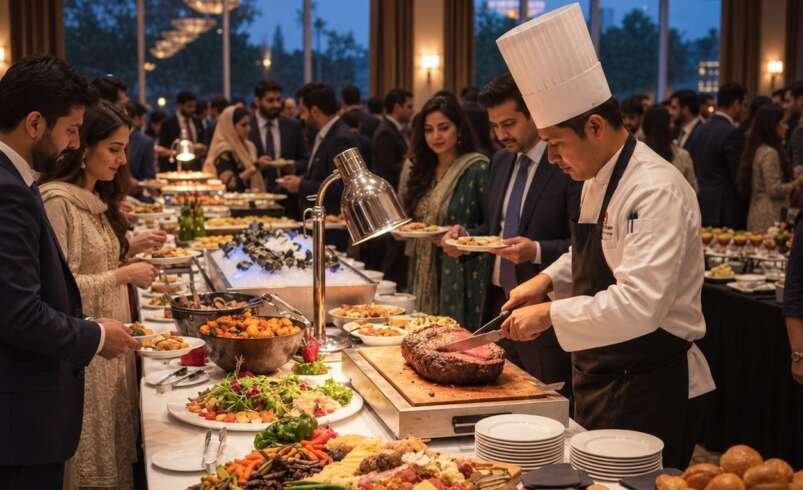

Wedding menus in Karachi have shifted noticeably over the past few years, moving away from a single large static buffet toward something more interactive, more varied, and often more deliberately curated around presentation rather than sheer quantity. Families comparing options for best wedding catering in Karachi in 2026 are working with a genuinely different set of expectations than families planning weddings even five years ago, and understanding what has actually changed helps avoid booking a menu style that already feels dated by the time the event takes place.
Live Stations Replace the Buffet
The single sprawling buffet table, once the default format for large Karachi weddings, has increasingly given way to multiple smaller, distinct stations spread across the venue, each focused on one cuisine or category rather than one continuous line of chafing dishes. A BBQ station, a separate chaat counter, a dedicated dessert table, and sometimes a live pasta or wok station now commonly operate simultaneously rather than everything being served from one central buffet line.
This shift solves a real practical problem beyond just aesthetics. Multiple smaller stations reduce the queue length at any single point, since guests naturally distribute themselves across different stations based on preference rather than all converging on one long line at the same time. It also allows food to be prepared closer to the moment of serving rather than sitting under a warmer for an extended period, which noticeably improves quality for items that do not hold well over time, something Karachi’s climate makes particularly relevant during outdoor functions.
Dessert tables specifically have become a significant investment area for many families, moving well beyond a simple selection of traditional sweets toward a more elaborate spread that might include a mix of local mithai, international-style pastries, and interactive elements like a build-your-own kulfi or falooda station. Caterers who have adapted to this trend typically staff dessert service separately from the main meal, recognizing that guests approach dessert at different times throughout the evening rather than all at once immediately after the main course, and often position the dessert station somewhere guests naturally pass by later in the evening rather than tucked away near the main buffet.
Fusion and Presentation Now Matter
Karachi wedding menus increasingly blend traditional desi dishes with continental, Chinese, and occasionally Mediterranean influences within the same event, reflecting a more internationally exposed generation of couples and guests who want variety beyond a single cuisine tradition. This fusion approach works best when it is executed by a kitchen genuinely equipped to prepare each style properly, rather than treated as a token addition, since a poorly executed fusion dish tends to disappoint guests more than simply offering a smaller, well-executed traditional menu.
Plating and presentation have also become a meaningful differentiator among caterers competing for the same wedding bookings. Where food was once judged almost entirely on taste and quantity, families now frequently ask to see how dishes are actually plated and presented, since photography and social sharing have made visual presentation a genuine consideration rather than an afterthought. Caterers who have invested in this aspect, coordinating garnish, serving dishware, and station design with the event’s overall visual theme, are increasingly differentiating themselves from competitors offering similar food at a similar price point but with far less attention to how it actually looks on the table during the moments guests are most likely to photograph it.
Portion control has shifted alongside this presentation focus as well, with some Karachi caterers moving toward smaller, more thoughtfully composed plates at certain stations rather than the traditionally generous, less structured servings of the past. This does not necessarily mean less food overall, since multiple stations still add up to a substantial meal, but it does reflect a broader shift toward quality and intentional composition over sheer visible abundance as the primary signal of a generous, well-catered event.
Ask the Best Wedding Catering in Karachi This
Families genuinely interested in these newer formats should ask a prospective caterer directly for recent examples, photographs, and, ideally, references from weddings catered within the last year rather than relying on an older portfolio that may not reflect current capability. A caterer who has successfully executed a multi-station, fusion-influenced menu recently is a meaningfully different proposition than one whose most recent comparable example is several years old, even if their underlying cooking skill has not changed.
It is also worth asking specifically how a caterer sources ingredients and staff for cuisines outside their traditional specialty, since a Chinese or continental station staffed by cooks primarily trained in desi cuisine often produces noticeably weaker results than one where the caterer has genuinely built or partnered for that specific expertise. This distinction rarely shows up clearly in a menu tasting limited to one or two dishes, so asking the direct question tends to be more revealing than the tasting alone. Families who raise these questions early in the booking process, rather than assuming any well-reviewed caterer automatically keeps pace with shifting expectations, are far more likely to end up with a wedding menu that genuinely reflects what current guests are looking for rather than a format that quietly peaked several wedding seasons ago.
Pricing for these newer, more elaborate formats also deserves a direct conversation, since multiple stations, fusion menus, and enhanced presentation generally cost more than a traditional single buffet, and families should understand that trade-off clearly before committing to a specific vision rather than discovering the added cost only once quotes start arriving. A caterer willing to walk through which elements of a trend-forward menu drive the most additional cost and which can be scaled back without meaningfully compromising the overall experience gives families genuine flexibility to prioritize what matters most to them within a realistic budget.
Guest expectations are also worth considering honestly rather than assuming every trend suits every wedding. A large, multi-generational guest list may respond better to a menu that blends familiar traditional dishes with a few newer additions rather than a fully reimagined, heavily fusion-forward spread that risks alienating guests who came specifically expecting the food they associate with a proper Karachi wedding. The strongest menu choices tend to balance genuine innovation with enough familiarity that no part of the guest list feels like an afterthought, and a caterer who asks about the specific makeup of the guest list before finalizing a menu is generally thinking about this balance more carefully than one presenting the same trend-driven proposal to every client regardless of who will actually be eating it.