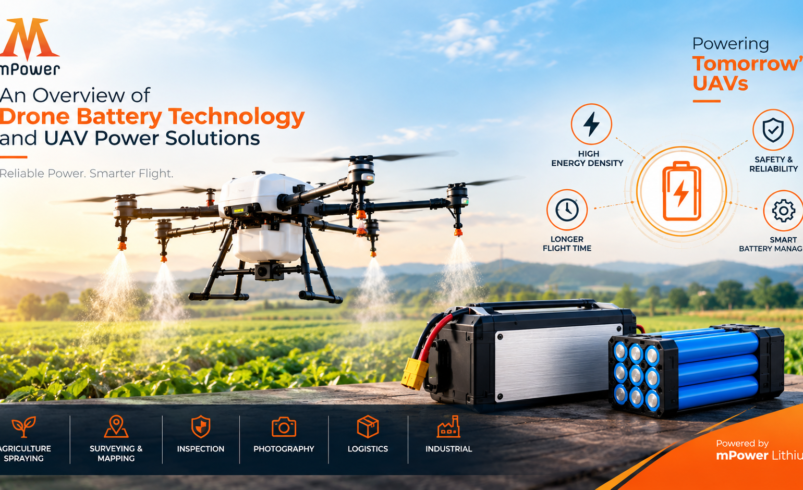

Drones, also known as Unmanned Aerial Vehicles (UAVs), are used across agriculture, surveying, mapping, inspection, photography, logistics, and industrial applications. As these applications continue to develop, reliable power systems have become an important part of UAV design.
The battery is responsible for supplying energy to the propulsion system, flight controller, sensors, cameras, communication equipment, and other onboard components. Understanding drone battery technology can help UAV users select a power solution that matches their operational requirements.
Understanding UAV Battery Technology
Drone batteries are designed to provide electrical energy within the weight, size, and power requirements of a UAV. Unlike stationary applications, UAV batteries need to support an aircraft that must carry its own energy source while remaining within an appropriate weight range.
Battery selection therefore involves balancing energy storage, power delivery, weight, dimensions, and operating requirements.
Battery Capacity
The appropriate capacity depends on the UAV’s power consumption, expected flight duration, payload, motor configuration, and mission requirements. A higher capacity does not automatically mean better performance because additional capacity may also increase battery weight.
Energy Density
Energy density is an important consideration for UAV power systems. It represents the amount of energy stored relative to battery weight.
For drones, an appropriate energy-to-weight ratio can help support efficient operation. The required energy density depends on the size and design of the aircraft and the type of mission it performs.
Voltage and Power Requirements
Every UAV has specific electrical requirements. The battery voltage should be compatible with the drone’s propulsion system and electronic components.
The battery should also be capable of providing the required current during different phases of flight, including takeoff, hovering, acceleration, and payload operation.
Battery Weight and UAV Performance
Battery weight contributes to the total weight of the aircraft. If the battery is unnecessarily heavy, the drone may require more energy to maintain flight.
For this reason, battery selection involves finding an appropriate balance between capacity and weight rather than simply selecting the largest available battery.
Lithium-Based Battery Technology
Lithium-based battery technologies are considered for various UAV applications because of their energy-storage characteristics and weight considerations.
The appropriate battery chemistry depends on the specific requirements of the UAV, including power demand, flight duration, operating environment, charging requirements, and system design.
Battery Management
Depending on the battery configuration, a Battery Management System (BMS) can provide monitoring and protection functions. It may monitor parameters such as voltage, current, temperature, and battery condition.
These functions can help support controlled battery operation and provide information that is useful for battery management.
Charging and Maintenance
Proper charging and maintenance can contribute to consistent battery performance. UAV operators should use compatible charging equipment and follow the manufacturer’s instructions.
Battery storage conditions, inspection procedures, charging frequency, and operating practices can all influence battery service life.
Application-Specific Power Solutions
Different UAV applications have different energy requirements. For example, an agricultural spraying drone may require significant power for both propulsion and spraying equipment, while a mapping drone may prioritize flight duration and sensor operation.
Battery selection should therefore be based on the complete mission profile, including payload, operating duration, flight conditions, and onboard equipment.
Factors to Consider When Selecting a UAV Battery
Before selecting a drone battery, users should evaluate:
- Voltage requirements
- Battery capacity
- Energy density
- Discharge capability
- Battery weight
- Physical dimensions
- Connector compatibility
- Charging requirements
- Operating temperature
- Safety and monitoring features
- Expected operating conditions
Considering these factors can help users identify a battery solution that is appropriate for their specific UAV.
Conclusion
Drone battery technology is an important part of modern UAV power systems. Capacity, energy density, voltage, discharge performance, weight, thermal characteristics, charging requirements, and battery management all contribute to the suitability of a battery for a particular application.
Rather than selecting a battery based on a single specification, UAV users should evaluate the complete power requirements of their aircraft and mission.
mPower Lithium focuses on battery solutions for UAV applications, with attention to the energy, power, weight, and operational requirements of modern unmanned aerial systems.
Frequently Asked Questions (FAQs)
1. What is drone battery technology?
Drone battery technology refers to the battery systems used to store and deliver electrical energy to UAV propulsion systems and onboard electronics.
2. Why is battery weight important for UAVs?
Battery weight contributes to the total aircraft weight. A heavier aircraft can require additional energy for flight, so battery capacity and weight need to be considered together.
3. What does drone battery capacity mean?
Battery capacity, usually measured in mAh or Ah, indicates how much electrical charge a battery can store. The required capacity depends on the UAV’s design and power requirements.
4. What is energy density in a UAV battery?
Energy density describes the amount of energy stored relative to battery weight. It is an important consideration for UAVs because weight affects overall flight energy requirements.
5. How do I select the right battery for my drone?
Check the UAV manufacturer’s recommended voltage, capacity, discharge requirements, dimensions, weight, connector type, and other electrical specifications before selecting a battery.
6. Why is battery management important?
Battery management can help monitor important operating parameters and, depending on the system, provide protection and monitoring functions related to voltage, current, and temperature.
7. Does temperature affect drone battery performance?
Yes. Temperature can influence battery performance and charging characteristics. Batteries should be operated and stored according to the manufacturer’s recommended conditions.
8. Can one battery be used for different UAV models?
Not necessarily. Different UAVs can have different voltage, capacity, dimensions, connector, and discharge requirements. Compatibility should always be verified before use.
9. How can battery maintenance support performance?
Following recommended charging, storage, inspection, and operating procedures can help maintain battery performance and service life.
10. What industries use UAV battery solutions?
UAVs are used in industries and applications including agriculture, surveying, mapping, inspection, photography, infrastructure monitoring, logistics, and other commercial operations.
Address
Plot No. 4&5,
Sivapadam Street, Ponniamman Nagar,
Ayanambakkam, Chennai – 600095 ,Tamil Nadu, India.
Contact Us
+91 73059 89715
Email
support@mpowerlithium.com