| Asset situation |
Usually best route |
| Working, recent, in demand |
Buyback, or direct resale for a few high-value items |
| Mixed lot of working and ageing assets |
Buyback, with the provider sorting by value |
| Working but low demand |
Buyback with refurbishment, or recycling |
| Faulty, damaged or obsolete |
E-waste recycling |
| Data-bearing devices |
Secure first, then buyback or recycling |
| Branded furniture in good condition |
Buyback or resale |
| Fixed fit-out and partitions |
Dismantling, as part of reinstatement |
How Do You Decide? Six Questions
- Do the assets still work and have market demand? If yes, recover value. If no, recycle.
- How many are there? Large lots suit buyback. A handful may justify resale.
- What data do they hold? The more sensitive the data, the more you need documented custody and destruction.
- How much time and staff do you have? Resale consumes both.
- What will auditors and compliance teams ask for? You need records for any route.
- Is this part of a bigger project? For an office move or closure, one partner handling everything usually wins.
Which Route Is Right in Common Scenarios?
| Scenario |
Recommended approach |
| Technology refresh |
Buyback for the batch, recycling for faulty units |
| Office closure or downsizing |
Buyback plus reinstatement under one contract |
| Data centre decommission |
Buyback for resalable equipment, secure data handling and recycling for the rest |
| Office relocation |
Move what you need, buy back what you don’t. See how to shift an office in India |
| Small, one-off batch |
Resale or local recycling, if you can manage the data risk |
| Multi-city rollout |
One provider with national reach |
| Returned work-from-home devices |
Retrieve, assess, then buyback or recycle |
Why Is Informal Resale Risky?
- Devices may leave with company data still on them
- There is no reconciliation against your asset register
- There is no certificate or audit trail for finance
- Pricing is inconsistent and time-consuming
- Staff time goes into logistics instead of the business
Why Not Recycle Everything?
Recycling is the right route for end-of-life equipment, but sending working assets there throws away value. A structured process routes each asset to its highest-value next use before anything reaches disposal.
How Does a Combined Process Work?
Hybrid Shifting runs buyback, resale, refurbishment and recycling as one sequence rather than three separate vendor relationships:
- Assessment and valuation: site survey and independent valuation of assets in scope
- Buyback agreement: transparent pricing and a signed agreement before work begins
- Secure removal: controlled dismantling and removal, with chain-of-custody handling for IT assets
- Sort, resell and recycle: assets are routed to resale, refurbishment or responsible recycling
- Space restoration: cleaning, repair and reinstatement, if the premises are being vacated
- Certification and handover: compliance documentation and sign-off
See how buyback value is calculated for how assets are valued.
What About Data Security?
Whatever route you choose, data is the biggest risk. Whichever you pick:
- Track every device from your premises onward
- Ask which method and standard is used for data destruction and what proof you receive
- Get a record for each batch
- Follow your own data policy before pickup
Our IT asset buyback guide covers this in more detail.
What Documents Should You Receive?
- Signed agreement with pricing (for buyback)
- Asset list and reconciliation report
- Chain-of-custody records
- Disposal or recycling certificates
- Audit trail
- Formal handover sign-off
Pair these with a clean asset register. Our guide on ERP integration with physical asset data shows how to keep records aligned.
What About Sustainability and ESG?
A well-run exit works as a resource-recovery loop, not a one-way disposal:
- Resale, refurbishment and responsible recycling come before disposal
- A zero-landfill approach applies to eligible waste streams
- ESG-ready reporting supports sustainability disclosures to investors and clients
How Should You Account for the Sale or Disposal?
Valuation is a market figure, not your book value, so a fully depreciated asset can still be worth something. Ask your finance team how the sale, write-off and any gains or losses are treated before you sign.
What Should You Ask a Provider?
- How are assets valued, and who does it?
- Which assets go to resale, refurbishment and recycling, and who decides?
- How is data destroyed, and what proof do we get?
- Which authorised recyclers do you use for non-resalable items?
- What documents do we receive at the end?
- Can you handle all our locations?
- Can you also handle the move, removal and reinstatement?
Why Choose Hybrid Shifting for Asset Retirement?
Hybrid Shifting is India’s Corporate Services Solutions company, offering asset management, asset buyback and reinstatement, commercial moving and relocation under one partner.
- One contract, one point of contact for valuation, removal, resale or recycling and handover
- Independent valuation and a signed agreement before work begins
- Chain-of-custody handling for IT assets ahead of disposition
- Disposal certificates, audit trail and sign-off to close every project
- Circular approach: resale, refurbishment and responsible recycling before disposal
- Scale: 1M+ assets tagged, 2M+ sq. ft. of space reinstated, 100+ clients and 15,000+ PIN codes
Whether you need corporate relocation services for an office move or a clean exit from a site you are closing, Hybrid Shifting can plan the move, the asset recovery and the handover as one project. See our commercial moving solutions guide, infrastructure, clients and about us.
Not sure which route fits your assets? Talk to Hybrid Shifting for a site survey and valuation. Request a quote
FAQs
What is the difference between asset buyback and resale?
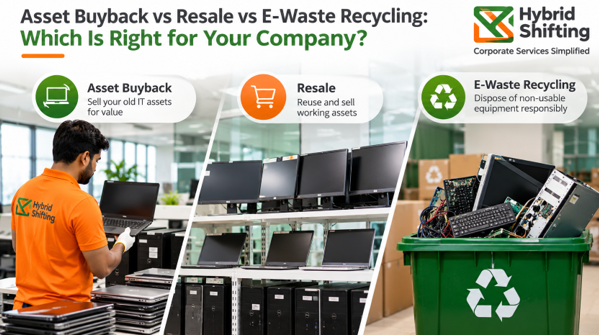
In a buyback, a provider values and buys your assets under one agreement and handles removal. In resale, you find buyers and manage the sale yourself.
When should I choose e-waste recycling?
When equipment is faulty, damaged or obsolete and has no resale value. Use an authorised recycler and keep disposal records.
Which route recovers the most value?
Buyback or well-managed resale for working assets. Recycling recovers little value, so avoid it for assets that still have demand.
Is selling old laptops to employees or dealers safe?
Only if data is properly removed and the sale is documented. Informal sales leave data exposure and no audit trail for finance or compliance.
What happens to assets that can’t be resold?
They go to responsible recycling, with a zero-landfill approach on eligible waste streams and documentation for your records.
Can I combine buyback and recycling in one project?
Yes. A structured process sorts each asset to resale, refurbishment or recycling, so one provider and one agreement cover everything.
What documents prove proper disposal?
Chain-of-custody records, disposal or recycling certificates, an audit trail and a signed handover.
How do I handle accounting for sold or scrapped assets?
Valuation is a market figure, not book value. Ask your finance team how the sale and write-off will be treated.