
Industrial air quality problems rarely come from a single source. A manufacturing plant may generate dust during material handling, fumes during processing, paint overspray in finishing areas, and gaseous contaminants from chemical operations. Treating every pollutant with the same equipment can lead to poor results because particles, vapours, and heat behave differently in an airflow system.
A practical air pollution control strategy starts by identifying what needs to be removed and selecting technology suited to that contaminant. A Cyclone Dust Collector can help separate suitable particulate matter, a Dust Extractor can capture dust close to its source, and an Activated carbon filter can adsorb certain gaseous pollutants and odorous compounds. Meanwhile, a Paint booth and an Air washer system address different process and air-conditioning requirements.
GPT-INDIA, also known as Green Planet Technologies, works in industrial air pollution control, dust collection, ventilation, and exhaust technology. Understanding how these systems differ can help factories plan equipment more effectively and avoid expecting one machine to solve every air quality challenge.
Activated Carbon Filter: When Gas-Phase Treatment Is Needed
An Activated carbon filter is used to treat selected gases, vapours, and odorous compounds in an air stream. Unlike a conventional particulate filter, which captures solid particles, activated carbon works through adsorption. Contaminant molecules come into contact with the porous carbon surface and are retained within its pore structure.
The United States Environmental Protection Agency explains that activated carbon adsorbers transfer gaseous pollutants from an air stream to a solid adsorbent. However, the carbon has a finite capacity, and its effectiveness depends on the pollutants and operating conditions. Once the available adsorption capacity is exhausted, the media may need to be replaced or regenerated. EPA guidance on activated carbon adsorbers.
This makes activated carbon useful in selected industrial applications involving solvent vapours, certain volatile organic compounds, and odour-related contaminants. Its suitability must be established for the actual chemical mixture rather than assumed from the presence of a smell alone.
Several factors influence performance, including the contaminant concentration, airflow, gas temperature, humidity, carbon type, and contact time. A carbon bed that is too small for the application may become exhausted quickly, while unsuitable humidity or competing compounds may affect adsorption performance.
Pre-filtration can also be important. If the incoming air contains substantial dust or droplets, a suitable upstream collection stage may help protect the carbon bed from unwanted loading. The complete arrangement should be selected according to the process and the required outlet-air quality.
Why Activated Carbon Filter Selection Should Start With the Pollutant
A common mistake is to choose an activated carbon unit before identifying the compounds in the exhaust stream. Two processes can produce similar odours while releasing different chemicals, and not every compound is adsorbed equally well by every carbon formulation.
Before selecting the system, establish what the process emits, how much air must be treated, the typical operating temperature, the humidity level, and whether pollutant concentrations change during production. Where necessary, obtain suitable process measurements or a chemical assessment.
The design should also address media replacement or regeneration. As contaminants accumulate, the carbon gradually loses available adsorption capacity. A planned replacement strategy helps avoid relying on the unit after its treatment performance has declined.
Monitoring may include outlet contaminant concentrations, airflow, temperature, moisture, pressure difference, and the condition of the carbon media, depending on the system design. Odour alone is not always a reliable measure of treatment performance because human sensitivity varies and some hazardous pollutants may not have a noticeable smell.
For applications involving hazardous or flammable vapours, system design must also consider appropriate safety controls and the characteristics of the contaminants. Activated carbon should be selected as part of an engineered treatment system, not treated as a universal filter for all industrial emissions.
Cyclone Dust Collector: Separating Particles Before Filtration
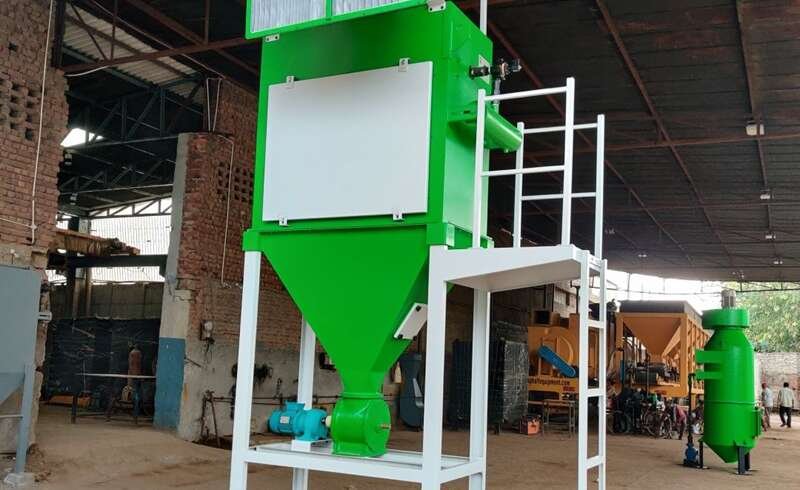
A Cyclone Dust Collector uses centrifugal action to separate suitable particles from an air stream. Dust-laden air enters the cyclone and follows a rotating path. The resulting motion drives many particles toward the outer wall, where they lose momentum and move toward the collection section. The air then exits through the designated outlet.
Cyclones are commonly considered for processes that generate dry particulate matter, including material handling, woodworking, mineral processing, and certain manufacturing operations. They can serve as primary collectors or as part of a larger filtration arrangement.
Their performance depends on particle size and density, inlet velocity, cyclone geometry, pressure drop, and the characteristics of the dust. A cyclone generally does not capture every fine particle, so downstream filtration may be necessary when the application requires more extensive particulate removal.
One useful role is to separate a portion of the heavier dust before it reaches a fabric filter. Depending on the system design, this can reduce the particulate load reaching downstream equipment. However, the benefit should be confirmed for the actual material and operating conditions.
When comparing cyclone designs, buyers should examine the expected particle characteristics, required airflow, available space, dust discharge method, and pressure losses. A cyclone should be chosen for its intended separation role rather than treated as a replacement for every type of dust filtration.
Dust Extractor: Capturing Contaminants at Their Source
A Dust Extractor is intended to collect dust from a machine, workstation, or process point before it spreads into the surrounding area. It may serve an individual machine or form part of a larger extraction network, depending on the equipment and application.
Effective extraction begins with the collection hood or inlet arrangement. If the capture point is too far from the source, or if its geometry does not suit the way dust is released, particles may escape before reaching the extractor. The airflow must be sufficient for the process, and ductwork should be designed to transport the material without excessive resistance or unwanted accumulation.
Different operations require different arrangements. Woodworking may generate chips and fine sanding dust, while grinding and polishing can produce heavier or more abrasive particulate matter. Powder handling may create lightweight dust that disperses quickly. The filter media and collection mechanism should be matched to the application.
For an existing plant, recurring dust on machinery or nearby surfaces may indicate that the collection point, airflow, ductwork, or filtration unit needs review. Simply increasing the fan size is not always the correct solution because the full system resistance and source-capture arrangement must be considered.
A Dust Extractor can be part of a broader dust management strategy, but it does not automatically address gaseous contaminants or solvent vapours. If the process produces both particles and gases, separate treatment stages may be required.
Paint Booth: Managing Overspray and Finishing Airflow
Painting and coating operations create a different air quality challenge. During spray application, some coating material does not reach the workpiece and instead becomes airborne overspray. A suitable Paint booth helps contain this material and directs the airflow through the intended capture or filtration arrangement.
The appropriate booth depends on the coating method, workpiece dimensions, production rate, paint characteristics, available space, and ventilation requirements. A water curtain booth, for example, uses a water-based arrangement to help capture paint overspray. Other booth designs may use dry filtration or different collection configurations.
The booth must be designed around the actual finishing process. Airflow should carry overspray toward the intended collection section without creating avoidable disturbances around the workpiece. The collection medium, residue-handling method, and maintenance requirements also need consideration.
A Paint booth should not be assumed to remove every chemical emitted during coating. Depending on the paint formulation, solvents and other gaseous compounds may remain in the exhaust air and require separate treatment. An activated carbon system may be considered for suitable vapours only after evaluating the pollutant mixture, concentration, temperature, humidity, and carbon compatibility.
Wood dust extraction and paint-booth ventilation should likewise be assessed as separate functions. Their collected materials and operating hazards differ, so combining them without a suitable engineering assessment can create maintenance and safety problems.
Air Washer System: Supporting Industrial Air Conditioning
An Air washer system brings air into contact with water to support selected air-conditioning, humidification, cooling, or air-washing functions. Its exact role depends on the design, the incoming air conditions, and the needs of the facility.
In industrial settings, air washers may be considered where process or comfort requirements call for control of temperature and humidity, or where a particular air-handling arrangement is needed. The system generally includes air movement, a water circulation arrangement, and components that manage water contact and carryover.
An air washer is not the same as an activated carbon adsorber. Water contact may help address certain airborne particles or soluble contaminants under suitable conditions, but it should not be assumed to remove all gases, vapours, or volatile organic compounds. Activated carbon, by contrast, is intended for adsorption of specific compounds that are suitable for the selected media.
Choosing an Air washer system requires understanding the required air volume, entering-air conditions, desired outlet conditions, water quality, operating environment, and maintenance access. Water circulation, cleaning, drainage, and control of unwanted moisture carryover also need to be considered.
For factories combining ventilation with pollution control, the air washer should be selected according to its specific function in the system. It should not be used as a substitute for a dedicated dust collector or gas-treatment stage where those technologies are needed.
How These Five Technologies Work Together
The five technologies serve different purposes, so the best arrangement depends on which pollutants a facility generates and where they enter the airflow.
A Cyclone Dust Collector may be used to separate suitable particulate matter before downstream filtration. A Dust Extractor captures dust at a machine or process point. An Activated carbon filter may treat selected gaseous pollutants after the relevant pre-treatment stage. A Paint booth manages overspray during finishing, while an Air washer system serves its designated air-conditioning or air-washing function.
In a facility that cuts and paints wood products, for example, woodworking machines may require dedicated dust extraction. The painting area may need a booth designed for its coating process. If the exhaust contains compounds suitable for activated carbon adsorption, a separate treatment stage may be considered after the relevant technical assessment.
The sequence of equipment should not be decided from product names alone. It must account for the actual contaminants, airflow, temperature, humidity, operating schedule, and any safety requirements. Poorly coordinated equipment can increase pressure losses, complicate maintenance, and leave gaps in pollutant control.
A useful project assessment begins with a process map showing where dust, fumes, vapours, heat, and moisture are generated. Once the sources are identified, the appropriate collection and treatment methods can be evaluated individually and then coordinated into a complete system.
Maintenance and Operating Costs: Plan Beyond Installation
The initial purchase price is only one component of an industrial air pollution control project. Ongoing costs may include electricity, filter replacement, activated carbon, water consumption, cleaning, inspections, disposal of collected material, and downtime for servicing.
For a cyclone, operators should check the dust discharge arrangement and look for blockages, leakage, or changes in operating performance. For a Dust Extractor, the collection hood, ductwork, filter condition, and fan performance should be inspected as appropriate.
Activated carbon requires particular attention because its capacity is finite. A replacement schedule should be supported by suitable operating information or monitoring rather than relying only on a fixed calendar interval. A Paint booth requires maintenance of its overspray collection arrangement and appropriate handling of accumulated residue. An Air washer system needs inspection of water circulation, drainage, cleanliness, and components that influence airflow and moisture carryover.
Maintenance procedures must be suited to the equipment and the contaminants involved. Where hazardous dusts, solvents, or flammable vapours are present, appropriate isolation and safety procedures are essential.
Planning for routine maintenance at the design stage can make the system easier to operate. Accessible components, clear inspection procedures, replacement-media availability, and records of operating conditions help teams identify problems before they cause a major interruption.
Why Consider GPT-INDIA for Industrial Air Management?
GPT-INDIA, also known as Green Planet Technologies, works in industrial air pollution control, dust collection, ventilation, and exhaust technology. Its product range includes activated carbon filters, cyclone dust collectors, dust extraction equipment, paint booths, air washer systems, bag filters, wet scrubbers, and other industrial airflow solutions.
The appropriate equipment depends on the application. A facility dealing with dust from production machinery will have different requirements from a plant managing solvent vapours or controlling air conditions in a process area.
For a new project or an upgrade, buyers should share details about the process, pollutants, airflow, operating temperature, humidity, available space, and required performance. For existing installations, information about recurring problems, maintenance history, and current equipment can help clarify what needs to change.
A process-based assessment helps identify which technologies are relevant, whether pre-treatment is needed, and how the equipment should be integrated with the existing plant.
Contact GPT-INDIA
Green Planet Technologies (GPT-INDIA)
Office Address: 59/2/1, Site 4, Industrial Area, Sahibabad, Distt. Ghaziabad–201010, Uttar Pradesh, India
Phone: +91-9773500660
Email: info@gpt-india.com
For an enquiry, share the type of contaminant, the source process, required airflow, operating conditions, and available installation space. If you are planning more than one treatment stage, describe how the equipment will connect to the existing production and ventilation systems.
Frequently Asked Questions
What is an Activated carbon filter used for?
An Activated carbon filter adsorbs selected gaseous pollutants, vapours, and odorous compounds from an air stream. Its suitability depends on the contaminant chemistry, concentration, temperature, humidity, airflow, and the selected carbon media.
What is the difference between a Cyclone Dust Collector and a Dust Extractor?
A cyclone separates suitable particles from an air stream using centrifugal action. A Dust Extractor is a broader collection unit or system designed to capture dust at a process source. An extractor may use different filtration technologies, and a cyclone can sometimes form part of a larger extraction system.
Can activated carbon remove every industrial gas?
No. Activated carbon does not adsorb every compound equally well. The pollutant mixture and operating conditions must be assessed to determine whether the selected carbon is appropriate and how frequently the media may need replacement or regeneration.
What does a Paint booth control?
A Paint booth is designed to contain the finishing area and manage overspray through suitable airflow and a collection arrangement. Additional treatment may be needed for gaseous emissions, depending on the coating materials and process.
What is an Air washer system used for?
An Air washer system brings air into contact with water and may be used for selected cooling, humidification, air-washing, or air-conditioning functions. Its exact capabilities depend on the design and operating conditions.
Can a Cyclone Dust Collector replace a bag filter?
Not in every application. Cyclones can separate suitable particles, particularly larger or heavier dust, but fine-particle requirements may call for additional filtration. The correct choice depends on particle characteristics and the required outlet-air quality.
How can industrial air pollution control costs be managed?
Costs can be managed by matching equipment to the process, avoiding unnecessary airflow and pressure losses, selecting compatible filter or carbon media, maintaining equipment according to its design, and monitoring performance trends. Maintenance and consumable costs should be considered alongside the initial purchase price.
Conclusion
Industrial air management works best when each technology is assigned the job it is designed to perform. An Activated carbon filter treats selected gases and vapours, a Cyclone Dust Collector separates suitable particles, a Dust Extractor captures dust at its source, a Paint booth manages overspray, and an Air washer system supports its specified air-conditioning or air-washing function.
These systems may be used individually or coordinated in a broader industrial air pollution control plan, but their suitability must be established against the real process conditions. Evaluating pollutant characteristics, airflow, maintenance needs, and safety requirements before selecting equipment helps avoid mismatched systems and unnecessary operating costs.
GPT-INDIA supports industrial air management requirements through its range of dust collection, filtration, ventilation, and treatment solutions. A clear understanding of the production process is the first step toward selecting equipment that fits the facility and its long-term operating needs.