

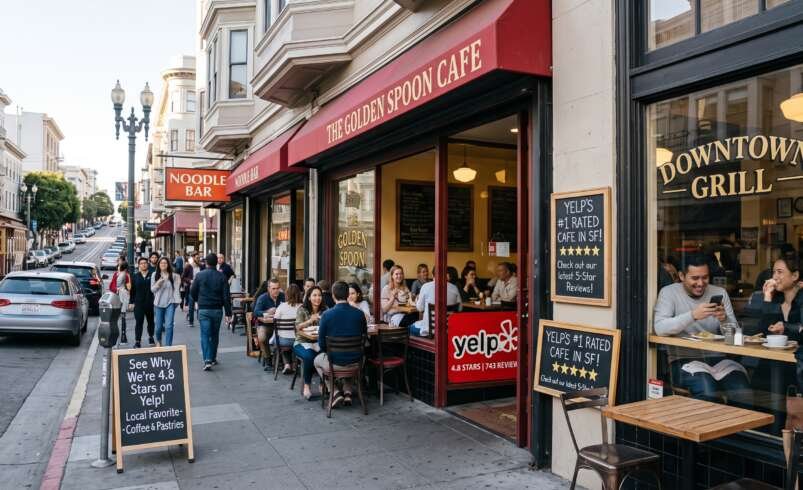

When customers are comparing several businesses, they rarely look at price and services alone. They also want to know what other people think. That’s where Yelp reviews can become a powerful part of your online reputation.
Imagine a customer searching Yelp for a restaurant, moving company, salon, dentist, repair service, or local retailer. They may find five businesses offering similar services.
One has very few reviews, another has mixed feedback, and a third has hundreds of detailed reviews with thoughtful responses from the business owner. Which one looks more trustworthy?
In many cases, the business with the stronger review profile gets the customer’s attention first.
Yelp reviews can provide valuable social proof because they show real experiences from customers. A strong profile can communicate reliability, professionalism, service quality, and customer satisfaction before a prospect ever contacts your business.
However, collecting reviews isn’t simply about having the highest possible star rating. Businesses need to focus on authentic customer experiences, consistent service, helpful responses, and long-term reputation management.
This article explains how Yelp reviews can help you stand out from competitors and how you can build a stronger review presence without relying on misleading tactics.
Why Are Yelp Reviews Important for Local Businesses?
Yelp is widely used by consumers who want to research local businesses before making a purchase or booking a service. Customers can compare ratings, read comments, view business information, and learn about other people’s experiences.
That makes Yelp more than a place where people leave comments. It can become part of the customer journey.
A potential customer may discover your business through a search and then use your reviews to decide whether you’re worth considering. If your profile has useful, recent, and authentic feedback, it can make your company appear more established.
Consider these factors:
- A higher volume of genuine reviews can demonstrate customer activity.
- Detailed reviews can explain what customers actually liked.
- Recent feedback can make a business look active and relevant.
- Owner responses can demonstrate professionalism.
- Consistent positive experiences can strengthen consumer confidence.
- Constructive criticism can reveal opportunities for improvement.
The key is balance. A business shouldn’t try to create a perfect-looking profile. Instead, it should work toward delivering experiences that naturally encourage customers to share positive feedback.
How Do Yelp Reviews Build Customer Trust?
Trust is one of the biggest factors behind online purchasing decisions.
Customers don’t know your business personally. They can’t always judge your service before buying. Reviews help reduce that uncertainty by showing what previous customers experienced.
For example, a person looking for a local moving company may be nervous about damaged belongings, hidden charges, delays, or poor communication. Reading detailed reviews from previous customers can answer questions that a standard service page may not address.
The same principle applies to almost every local business.
A strong review can tell prospective customers:
- The business communicates clearly.
- Staff members are professional.
- Services are delivered as promised.
- Problems are handled responsibly.
- Customers feel valued.
- The business has experience serving people like them.
This type of information can be more persuasive than generic marketing claims.
After all, almost every company says it provides excellent service. Customer experiences provide a different kind of evidence.
Can Yelp Reviews Improve Business Visibility?
Visibility is another important reason to pay attention to Yelp reviews.
When customers search for local businesses, they often compare multiple listings. Your business information, rating, review volume, category, location, and other profile details can all contribute to how attractive your listing appears.
A well-maintained Yelp profile can therefore support your broader local marketing strategy.
However, it’s important not to assume that reviews alone guarantee higher rankings everywhere. Local search systems use many signals, and Yelp has its own systems and policies.
Instead, think of reviews as one component of a larger reputation strategy.
Your business can strengthen its presence by keeping information accurate, providing excellent service, encouraging genuine customer feedback, and responding professionally.
That combination creates a more complete online footprint.
How Can Yelp Reviews Help You Stand Out From Competitors?
One of the biggest advantages of Yelp reviews is differentiation.
Suppose three competitors offer almost identical services. Their websites may contain similar claims, pricing structures, and service descriptions. Reviews can give customers a much clearer picture of how each company actually performs.
For instance:
| Business | Rating | Review Count | Customer Impression |
| Business A | 4.8 | 18 | Positive but limited feedback |
| Business B | 4.6 | 165 | Established customer history |
| Business C | 4.7 | 420 | Strong volume and consistent feedback |
The numbers alone don’t tell the entire story. Customers may read the reviews to understand why people gave those ratings.
Business C might stand out because customers repeatedly mention fast service, friendly employees, transparent pricing, and excellent communication.
That’s powerful because competitors can’t easily copy genuine customer experiences.
Your brand can copy a competitor’s color scheme or advertising idea, but it can’t manufacture years of authentic customer relationships.
Why Does Review Quality Matter More Than Review Quantity Alone?
It’s tempting to think that getting as many reviews as possible is the ultimate goal. That’s not necessarily true.
One detailed review can sometimes provide more useful information than several one-line comments.
Compare:
“Great service!”
with:
“The team arrived on time, explained the process clearly, protected our furniture, and completed the job faster than expected.”
The second review gives potential customers useful information.
It also contains specific details that can help someone understand what working with the business may actually be like.
Businesses should therefore focus on creating excellent customer experiences and making it easy for satisfied customers to share honest feedback.
Don’t pressure customers to leave a specific rating or tell them exactly what to write. Genuine experiences are more valuable for long-term reputation building.
How Do Yelp Reviews Influence Buying Decisions?
Customers often experience uncertainty before making a purchase.
They may ask:
- Is this company reliable?
- Will the service match the price?
- Do customers complain about communication?
- Does the business handle problems well?
- Is the company experienced?
- Would other people recommend it?
Yelp reviews can help answer these questions.
Positive feedback creates reassurance, while negative feedback can highlight potential concerns. Customers can then make a more informed decision.
This is particularly important for services where the customer has to trust a business before seeing the final result.
Examples include:
- Home services
- Moving companies
- Restaurants
- Auto repair businesses
- Healthcare-related services
- Beauty salons
- Professional services
- Hotels
- Local retailers
The more expensive, personal, or important the purchase is, the more likely customers may be to research reviews before committing.
How Can Reviews Act as Social Proof?
Social proof is the idea that people often look at the behavior and experiences of others when deciding what to do.
If hundreds of customers have positive experiences with a company, a new customer may feel more comfortable considering that company.
Yelp reviews provide visible social proof.
A business with consistent feedback can communicate that it has served real customers over time.
This can be especially useful for newer prospects who have never interacted with your company.
Instead of asking customers to simply trust your advertising, reviews allow them to see what others experienced.
That’s a major difference.
Can Yelp Reviews Strengthen Your Local Reputation?
Your local reputation extends beyond your website.
Customers may encounter your brand through search engines, maps, social media, directories, review websites, and word-of-mouth recommendations.
Yelp can be one part of this broader reputation ecosystem.
A positive Yelp presence can reinforce the idea that your business is established and customer-focused.
For local businesses, reputation consistency matters. If your business has strong reviews across multiple reputable platforms and customers see similar themes in the feedback, your brand can appear more credible.
For example, if customers repeatedly mention:
- Friendly staff
- Accurate estimates
- Fast communication
- High-quality workmanship
- Reliable scheduling
those themes can become part of your reputation.
They show prospective customers what your business is known for.
Why Should Businesses Respond to Yelp Reviews?
Getting reviews is only half the job. How you respond to them matters too.
A thoughtful response to a positive review can show appreciation. A professional response to criticism can demonstrate accountability.
For positive reviews, keep your response simple and genuine.
For example:
“Thank you for sharing your experience. We’re glad our team could help and appreciate you taking the time to leave feedback.”
For negative feedback, avoid becoming defensive.
Instead:
- Thank the customer for sharing the concern.
- Acknowledge the issue.
- Avoid arguing publicly.
- Explain what you can do to investigate.
- Invite the customer to continue the conversation privately when appropriate.
- Use the feedback internally to improve.
A calm response can sometimes leave a better impression than no response at all.
Remember, you’re not only responding to the reviewer. You’re also communicating with every future customer who reads the conversation.
How Can Negative Yelp Reviews Help a Business Improve?
Negative reviews aren’t automatically bad for a business.
In fact, criticism can reveal problems that management might not otherwise notice.
Suppose multiple customers mention:
- Long wait times
- Poor communication
- Unexpected fees
- Difficult booking
- Unclear policies
That’s valuable business intelligence.
Instead of simply trying to hide negative feedback, look for patterns.
A single complaint may represent an isolated incident. Repeated complaints may reveal a process problem.
Businesses can use this information to improve training, communication, pricing transparency, scheduling, and customer support.
A reputation strategy shouldn’t only ask, “How can we get more five-star reviews?”
It should also ask, “How can we create better customer experiences?”
That’s where sustainable reputation management begins.
How Can Better Customer Experiences Generate More Yelp Reviews?
The most reliable way to earn positive reviews is to provide a service customers genuinely appreciate.
Start with the basics:
Make Expectations Clear
Tell customers what the service includes, what it costs, and what they should expect.
Communicate Consistently
Customers become frustrated when they don’t know what’s happening. Regular updates can reduce uncertainty.
Solve Problems Quickly
Mistakes happen. The way a business responds can determine whether a customer remembers the experience positively or negatively.
Make Service Convenient
Easy scheduling, clear instructions, simple communication, and transparent processes can improve satisfaction.
Follow Up
After completing a service, businesses can politely invite customers to share honest feedback. Don’t demand a positive review or offer misleading incentives.
These practices can create a natural cycle: better service leads to happier customers, happier customers are more likely to recommend the business, and authentic reviews strengthen reputation.
How Can Businesses Use Yelp Reviews for Market Research?
Reviews aren’t only marketing assets. They’re also a source of customer insight.
Read your reviews regularly and look for recurring words, complaints, compliments, and suggestions.
Create a simple feedback table:
| Customer Feedback | Possible Business Insight |
| “Very responsive” | Communication is a strength |
| “Price was clear” | Pricing transparency is valuable |
| “Had to wait” | Scheduling may need improvement |
| “Friendly staff” | Customer service is a strength |
| “Hard to reach” | Communication channels need work |
You can also examine competitor reviews.
What do customers praise about competitors? What do they complain about?
This can reveal opportunities.
For example, if customers love a competitor’s speed but regularly complain about its communication, your business could position itself around both speed and clear communication—provided you can actually deliver those benefits.
That’s a much stronger strategy than simply copying another company’s advertising.
What Common Yelp Review Mistakes Should Businesses Avoid?
A few mistakes can damage an otherwise strong reputation strategy.
1. Buying Fake or Misleading Reviews
Artificial reviews can undermine trust and may violate platform policies. Businesses should prioritize authentic customer experiences.
2. Asking Everyone for a Five-Star Rating
It’s better to invite honest feedback than to pressure customers for a particular rating.
3. Arguing With Customers
Public arguments rarely help. Even when you believe you’re right, remain professional.
4. Ignoring Reviews
No response can make a business look disconnected from customer feedback.
5. Writing Generic Responses
Copy-and-paste responses can feel impersonal. Mention something specific when possible.
6. Focusing Only on Ratings
A 4.7-star business with useful reviews can sometimes look more trustworthy than a profile with an impressive rating but very little detail.
7. Neglecting the Business Profile
Keep contact information, hours, categories, descriptions, and other important details accurate.
How Does Online Boost Fit Into Online Reputation Management?
Businesses interested in improving their online presence may come across platforms such as Online Boost, which operates in the online review and reputation space.
Online Boost can be discussed as part of the broader conversation around review visibility and online reputation. However, businesses should always prioritize genuine customer feedback and follow the policies of the review platform they’re using.
If a company is considering any review-related service, it’s important to understand exactly what is being provided, whether the approach complies with platform rules, and whether it supports a trustworthy long-term reputation.
The strongest Yelp strategy isn’t simply about collecting a large number of reviews. It’s about building a reputation that reflects real customer experiences.
That means service quality should come first.
A business can use reputation tools to organize its review strategy, monitor feedback, and understand customer sentiment, but those tools work best when they support genuine customer relationships rather than replace them.
What Are the Best Ways to Get Genuine Yelp Reviews?
Businesses can encourage authentic feedback without manipulating customers.
Here are practical approaches:
- Provide excellent service consistently.
- Ask customers for honest feedback after completing a transaction.
- Make your Yelp profile easy to find.
- Train employees to deliver consistent service.
- Respond professionally to reviews.
- Monitor recurring complaints.
- Thank customers for taking the time to provide feedback.
- Improve the customer experience based on review insights.
- Keep your business information updated.
- Never pressure customers to leave a specific rating.
The phrase “honest feedback” is important.
Customers should have the freedom to describe their experience in their own words. This creates more credible feedback and gives future customers a realistic picture of your business.
How Should You Measure Yelp Review Performance?
A review strategy should be measured over time.
You can monitor several useful indicators:
| Metric | What It Tells You |
| Total review count | Volume of customer feedback |
| Average rating | Overall customer sentiment |
| Recent review activity | Whether feedback is current |
| Response rate | How actively the business engages |
| Common complaints | Areas requiring improvement |
| Common compliments | Business strengths |
| Review sentiment | General customer perception |
| Competitor review trends | Market positioning |
Don’t obsess over daily rating changes.
Instead, look for long-term trends.
Are customers mentioning better communication? Are complaints about wait times declining? Are more customers discussing a particular service positively?
These changes can tell you whether operational improvements are actually working.
How Can Yelp Reviews Support a Larger SEO Strategy?
Yelp should not be treated as a replacement for your website or other local SEO activities.
Instead, it can complement them.
A broader local marketing strategy may include:
- Optimizing your website.
- Maintaining accurate business information.
- Managing your Google Business Profile.
- Building relevant local citations.
- Earning legitimate backlinks.
- Creating helpful local content.
- Managing reviews across relevant platforms.
- Maintaining consistent business details.
For official information about Yelp’s own approach and policies, businesses should review Yelp for Business.
The goal is to create a consistent digital presence where customers can find reliable information about your company wherever they research it.
Frequently Asked Questions About Yelp Reviews
1. Why are Yelp reviews important for businesses?
Yelp reviews can help potential customers evaluate a business before making a purchase. They provide social proof, reveal customer experiences, and can help businesses differentiate themselves from competitors.
2. Can Yelp reviews help me get more customers?
They can contribute to customer acquisition by increasing trust and reducing uncertainty. However, reviews aren’t a guarantee of new customers. Service quality, pricing, location, visibility, and other factors also influence buying decisions.
3. How many Yelp reviews should a business have?
There’s no universal number that guarantees success. A consistent flow of authentic reviews is generally more useful than focusing on a specific target number.
4. Should I respond to negative Yelp reviews?
Yes. A calm, professional response can show potential customers that your business takes feedback seriously. Avoid arguments and focus on understanding and resolving legitimate concerns.
5. Can negative Yelp reviews hurt my business?
Negative reviews can influence customer perceptions, especially when they identify recurring problems. However, occasional negative feedback is normal. Businesses can use it as an opportunity to identify weaknesses and improve.
6. Is it better to have five stars or many reviews?
Both rating quality and review volume can matter, but neither should be considered in isolation. Customers often look at the details behind the rating, including how recent reviews are and what people actually say.
7. Should businesses buy Yelp reviews?
Businesses should be cautious about purchasing or manufacturing reviews. Authentic customer feedback is more trustworthy and supports a sustainable reputation. Businesses should also follow Yelp’s applicable rules and policies.
8. How can I encourage customers to leave Yelp reviews?
Provide excellent service and politely invite customers to share honest feedback. Don’t pressure them to give a specific rating or write particular comments.
9. Can Yelp reviews improve local SEO?
Yelp can contribute to your broader local online presence, but reviews on Yelp shouldn’t be treated as a guaranteed direct ranking factor for every search engine. Local SEO depends on many signals.
10. What should I do if a customer leaves an unfair review?
Stay professional. Review the complaint, determine whether it can be addressed, and respond factually without attacking the customer. If the review violates the platform’s policies, explore the appropriate reporting process.
11. How can Online Boost help with online reputation?
Online Boost operates in the online review space and may be considered by businesses researching review-related services. Businesses should evaluate any service carefully and prioritize authentic customer feedback, transparency, and compliance with review-platform policies.
Conclusion: Turn Yelp Reviews Into a Competitive Advantage
In a crowded marketplace, customers need reasons to choose one business over another. Yelp reviews can provide those reasons by showing real customer experiences, building social proof, and giving prospects additional confidence.
The strongest advantage doesn’t come from chasing a perfect rating. It comes from creating excellent experiences that customers genuinely want to talk about.
Businesses that consistently deliver quality service, communicate clearly, respond professionally, and learn from feedback can build a reputation that competitors can’t easily copy.
Use Yelp as more than a review website. Treat it as a source of customer insight, a trust-building channel, and one part of your wider digital reputation strategy.