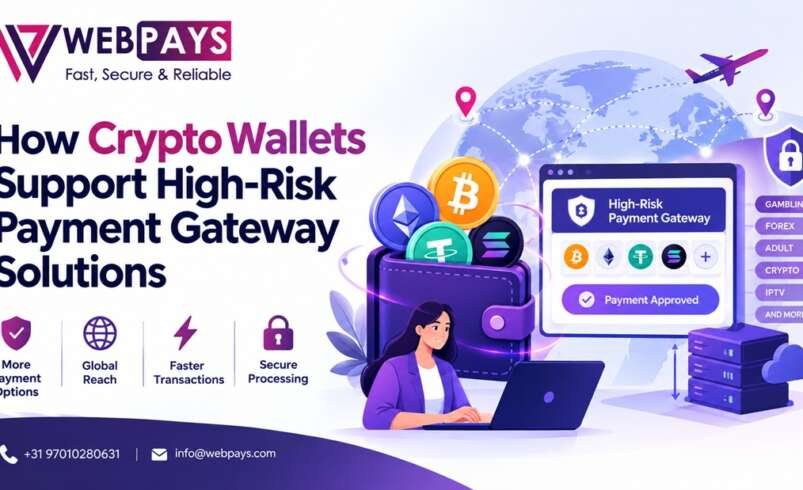

How Crypto Wallets Support High-Risk Payment Gateway Solutions
Online payments are no longer limited to cards and bank transfers. Many customers now hold digital assets and expect to pay with them. For merchants, a crypto wallet can add another payment route alongside existing methods.
For businesses that depend on a high-risk payment gateway, this matters. Card acceptance can be restricted or expensive, so a second rail can reduce reliance on a single method. WebPays crypto wallet functionality should be evaluated as part of the full payment setup, not as a standalone fix.
What is a crypto wallet?
A crypto wallet is an application or service that stores the keys needed to send, receive, and manage digital assets such as Bitcoin, Ethereum, or stablecoins. Depending on the type, users may be able to:
- Receive and send digital assets
- Pay merchants directly from their balance
- Hold multiple currencies or tokens
- Convert assets to other currencies (on some platforms)
- Withdraw funds to an external wallet or exchange
There are two main types. Custodial wallets are managed by a provider that holds the keys for the user. Non-custodial wallets give the user full control of their own keys. Features, security, and compliance obligations differ between them.
Why does a crypto wallet matter for a high-risk payment gateway?
High-risk merchants often face:
- Higher chargeback exposure on card payments
- Restricted or declined card categories
- International customers and multiple currencies
- Complex customer journeys
- Strict regulatory requirements
A crypto wallet option can widen the payment mix and help reach customers who prefer digital assets. It also lets merchants offer cross-border payments without relying only on card networks.
Adding a payment method does not reduce compliance duties. Identity verification, transaction monitoring, and fraud screening still apply.
Benefits of accepting crypto wallet payments
Cross-border reach. Customers in different countries can pay in the same asset, without relying on local card acceptance.
Faster settlement. Depending on the network and asset, payments can confirm in minutes, compared with the multi-day settlement common for cards.
Reduced chargeback exposure. Blockchain transactions are generally irreversible, so the traditional card chargeback process does not apply. Refunds, disputes, and customer service still need clear merchant policies, and fraud and compliance risks remain.
Payment diversification. A crypto wallet option provides a backup route if one payment method is restricted or unavailable.
Security considerations
Security depends on the wallet type, the provider, and how the gateway is implemented. Common controls include:
- Private key protection or custody safeguards
- Multi-factor authentication
- Address verification and whitelisting
- Transaction limits
- Fraud and blockchain analytics monitoring
- Encryption
Because crypto transactions are irreversible, sending to the wrong address or losing access to a wallet can mean permanent loss. Customer education and clear checkout flows are important.
Crypto wallets and high-risk categories
Industries such as gaming, digital assets, adult services, international trading, and supplements should first confirm that the provider permits their merchant category. A crypto wallet should never be used as a workaround for prohibited activity. Merchants remain responsible for licensing, KYC/AML obligations, and local regulations.
The importance of withdrawals
For some business models, payouts matter as much as deposits. Customers may need to withdraw winnings, balances, or refunds. This requires:
- Identity verification
- Wallet address and account ownership checks
- Fraud prevention
- Withdrawal limits
- Transaction monitoring
- Reconciliation and reporting
In gaming-related businesses especially, withdrawal controls are critical.
Crypto wallet vs. cards
| Feature | Cards | Crypto wallet |
| Familiarity | Very high | Growing, varies by market |
| Reversibility | Chargebacks possible | Generally irreversible |
| Settlement speed | Often 1–3 days | Often minutes to hours |
| Funding | Bank or credit line | Digital asset balance |
| Price volatility | None | Depends on asset (stablecoins reduce this) |
| International use | Broad | Network and provider dependent |
| Fraud controls | Network and issuer controls | Wallet, provider, and blockchain monitoring |
Both methods can coexist within a high-risk payment gateway setup.
A crypto wallet strategy with WebPays
Before adding crypto wallet payments, merchants should ask:
- Which countries and regions are supported?
- Which digital assets and currencies are accepted?
- Are payments settled in crypto or converted to fiat?
- How are customers verified?
- How are transactions monitored for fraud and sanctions risk?
- How are withdrawals and refunds handled?
- What are the transaction limits and network fees?
- How are disputes managed without chargebacks?
- What reporting and reconciliation tools are available?
FAQs
- What is a crypto wallet in payment processing?
A crypto wallet is an application or account that stores the keys to digital assets and lets users send, receive, and pay with them. - Is a crypto wallet suitable for a high-risk payment gateway?
It can be useful in certain high-risk environments, but merchant-category eligibility and compliance requirements must be confirmed with the provider. - Are crypto wallet payments faster than cards?
Often, yes. Settlement can be quicker than card processing, but speed depends on the blockchain network and asset used. - Can a crypto wallet support international transactions?
Yes, in many cases, but supported regions, assets, and regulations vary by provider. - Does a crypto wallet remove chargeback risk?
It removes the card chargeback process because transactions are generally irreversible, but fraud, disputes, refunds, and compliance risks still exist.
online casinos merchant account
online gambling merchant account
online betting merchant account
online betting payment gateway