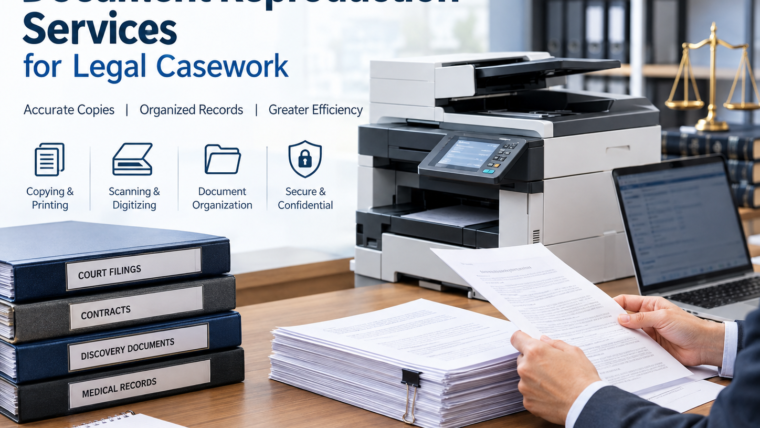


Legal cases often involve large amounts of paperwork. Court filings, contracts, medical records, discovery materials, affidavits, exhibits, invoices, and other documents may need to be copied, scanned, organized, or reproduced several times during a case. Handling these tasks manually can take valuable time and create avoidable problems.
Document reproduction services provide practical support for law firms, businesses, government agencies, and other organizations that need accurate copies of important records. Professional document handling can make case preparation more organized while reducing the administrative workload placed on legal staff.
What Are Document Reproduction Services?
Document reproduction services involve creating accurate copies or digital versions of physical and electronic records. Depending on the project, services may include high-volume copying, document scanning, printing, duplication, indexing, file organization, and preparation of records for legal proceedings.
Some projects involve simple copying, while others require careful handling of confidential or sensitive information. Legal documents may also need to be reproduced in specific formats for attorneys, courts, opposing counsel, experts, or clients.
The goal is to make important information easier to access without compromising document quality or organization.
Why Accurate Document Copies Matter in Legal Cases
Accuracy is especially important in legal work. A missing page, unclear scan, incorrect file order, or incomplete copy can create unnecessary delays.
Professional reproduction support can help legal teams maintain complete records throughout a case. Clear copies also make it easier for attorneys and other authorized parties to review evidence, prepare exhibits, and reference important information.
For example, a litigation team may need multiple copies of deposition transcripts, business records, medical documentation, or correspondence. Having those materials reproduced and organized properly can simplify preparation before hearings, negotiations, or trial.
Common Documents That May Require Reproduction
Different legal matters require different types of records. Document reproduction projects may involve:
- Court pleadings and filings
- Contracts and agreements
- Medical and billing records
- Deposition transcripts
- Discovery documents
- Business records
- Property documents
- Financial statements
- Police or incident records
- Insurance documentation
- Photographs and supporting evidence
- Exhibits for court proceedings
- Correspondence and case notes
Some records may exist only as physical documents, while others may already be available electronically. A professional service can help manage either format depending on the requirements of the project.
How Document Reproduction Supports Litigation
Litigation can generate thousands of pages of information. Legal professionals need reliable ways to access and share these materials without losing track of important details.
Document reproduction can support several stages of litigation. During discovery, records may need to be copied or converted into usable digital formats. Before a hearing, attorneys may need organized exhibits and duplicate case materials. After obtaining records from another source, reproduction services can help prepare working copies for internal review.
This administrative support allows legal teams to spend more time on case strategy and less time managing repetitive document tasks.
Combining Document Reproduction With Process Serving Support
A Process Serving Company may provide additional legal support beyond serving court documents. Legal professionals often work with multiple types of records and case materials during the same matter, making dependable document handling useful alongside service-related tasks.
For example, an attorney may need copies of legal documents prepared before they are served, while supporting records may need to be organized for internal case files. Coordinating related services can help reduce unnecessary administrative steps.
However, document reproduction and process serving are distinct functions. Reproduction focuses on creating and organizing copies of records, while process serving involves delivering legal documents to the appropriate individual or entity according to applicable requirements.
Digital Scanning and Electronic Document Management
Modern legal practices increasingly rely on digital records. Scanning physical documents can make information easier to store, search, share, and retrieve.
High-quality scanning is particularly useful for older case files or records that are difficult to manage in paper form. Documents can be converted into searchable digital files when appropriate, helping legal professionals locate information more efficiently.
Proper file naming and organization are also important. A folder containing hundreds of unidentified scans can create nearly as much frustration as a box of unsorted paperwork. Organized digital records can make future retrieval considerably easier.
Protecting Confidential Legal Information
Legal records may contain private client information, financial details, medical information, or other sensitive material. Security should therefore be an important consideration when selecting document reproduction support.
Before outsourcing a project, organizations should ask how documents are handled, stored, transferred, and returned or destroyed after completion. Access controls and secure handling procedures can help reduce unnecessary exposure of confidential records.
Legal teams should also consider whether the service provider has experience working with sensitive legal documentation and understands the importance of maintaining document integrity.
What to Look for in a Document Reproduction Provider
Choosing a provider involves more than comparing prices. Legal professionals should consider several practical factors.
Look for a service that can handle the volume and format of the project, maintains consistent copy quality, and communicates clearly about turnaround times. Experience with legal records can also be valuable because legal documents often require greater attention to organization and completeness.
Other considerations include:
- Scanning and copying capabilities
- Large-volume document handling
- Secure document processing
- Digital file organization
- Quality control procedures
- Flexible turnaround options
- Confidentiality practices
- Experience with legal and litigation records
A provider that understands these requirements can make the reproduction process smoother and more predictable.
How Professional Reproduction Saves Time
Copying and organizing large collections of records can consume hours of staff time. For small projects, handling documents internally may be practical. Larger projects can quickly become a distraction from more important legal responsibilities.
Outsourcing repetitive document tasks can help firms manage workloads more efficiently. It can also provide access to professional equipment and established workflows without requiring a firm to invest in additional resources.
The benefit is not simply producing more copies. It is creating reliable, usable records that can be accessed when the case requires them.
Final Thoughts
Reliable document reproduction services can make legal casework easier by helping organizations copy, scan, organize, and manage important records efficiently. From court documents and discovery materials to medical records and business files, properly reproduced documents can support smoother case preparation.
For law firms and legal professionals, the right provider should combine accuracy, organization, confidentiality, and dependable turnaround. When document reproduction is coordinated effectively with other legal support services, including assistance from a qualified Process Serving Company, teams can reduce administrative pressure and keep important case materials accessible throughout the legal process.