
If you manage a production line or oversee heavy equipment, you already know how costly an unplanned stoppage can be. Sandblast equipment works under constant abrasive pressure — and every component that touches the blast stream degrades over time. The difference between a machine that lasts five years and one that lasts fifteen often comes down to one decision: what parts go back in when something wears out.
Why Sandblast Equipment Fails Prematurely
Sandblasting is one of the most mechanically aggressive processes in surface preparation. Abrasive media — whether steel shot, garnet, or aluminium oxide — travels at high velocity through nozzles, hoses, valves, and blast wheels. Every component in that path experiences constant erosion.
Premature equipment failure typically traces back to three root causes:
- Substandard replacement parts that do not match original material specifications
- Incorrect part sizing that disrupts airflow, pressure, or media flow rates
- Deferred maintenance driven by the belief that a worn part can “last a little longer”
Each of these creates a compounding effect. A worn blast nozzle increases air consumption by up to 25%, which overworks the compressor. A poorly fitted control cage throws off blast wheel balance, accelerating bearing wear. What starts as a RM50 nozzle problem can quietly become a RM5,000 motor replacement.
What Makes a Spare Part “Quality”?
Not all replacement parts are equal. The term “quality” in blasting components has a specific, measurable meaning — not just a marketing claim.
Material Hardness and Composition
Blast nozzles made from tungsten carbide or boron carbide last significantly longer than ceramic or steel alternatives under equivalent blasting conditions. The material’s hardness rating (measured on the Rockwell or Vickers scale) directly determines how long it resists internal erosion. A tungsten carbide nozzle, for instance, can outlast a standard ceramic nozzle by a factor of five to ten under continuous use.
Dimensional Accuracy and Fit Tolerance
A replacement part that is even slightly off-spec causes vibration, pressure loss, or uneven media distribution. High-quality durable blasting parts are manufactured to tight tolerances — typically ±0.1mm or better — so they seat correctly and perform as the original design intended. Loose fits cause micro-movement during operation, which accelerates wear at contact points.
Heat and Pressure Ratings
Industrial blast cabinets and wheel blast machines operate under sustained mechanical stress. Quality parts are rated for operating pressures and temperatures that match or exceed the original equipment manufacturer (OEM) specifications. Generic parts sourced purely on price are often rated for lighter-duty applications and fail quickly under production-level intensity.
High-Wear Components That Demand the Most Attention
Sandblast machine maintenance is most effective when you prioritise the components that degrade fastest. These are the parts most likely to cause downtime if overlooked.
| Component | Typical Failure Sign | Impact of Delay
|
|---|---|---|
| Blast Nozzle | Enlarged bore diameter, reduced pressure | Higher air consumption, poor surface finish |
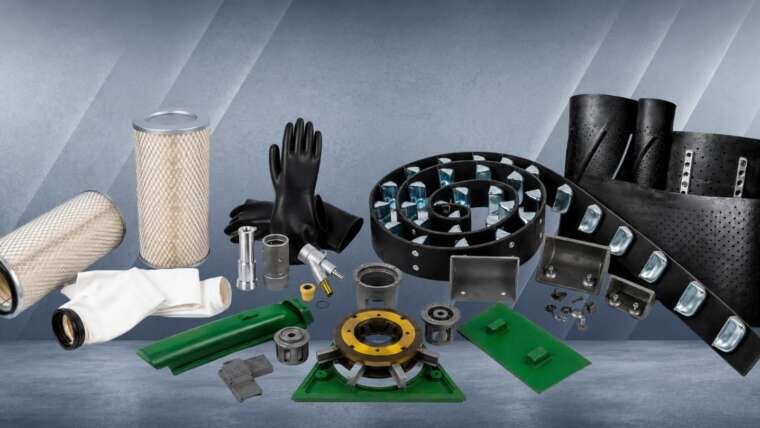
| Blast Wheel Blades | Chipping, uneven media throw pattern | Vibration damage to bearings and housing |
| Control Cage / Impeller | Cracking, asymmetric wear | Misdirected blast stream, cabinet wall erosion |
| Liner Plates | Thinning, perforations | Cabinet frame damage, media leakage |
| Blast Hose | External bulging, internal cracking | Blowouts, operator safety hazards |
| Metering Valve | Irregular media flow | Inconsistent surface preparation quality |
Tracking wear on these components through a simple inspection log — checking dimensions against baseline measurements at regular intervals — is one of the most cost-effective maintenance practices a production manager can implement.
The Real Cost of Cheap Parts in a Production Environment
It is tempting to compare spare part prices in isolation. A generic blast wheel blade at RM80 versus a quality equivalent at RM150 looks like a clear saving on paper. The actual cost calculation looks very different.
Consider a medium-volume production facility running two blast machines for eight hours a day. If a substandard blade set fails after 200 hours instead of 600, the facility replaces parts three times more frequently. Add in each replacement’s labour time — typically one to three hours of downtime per change — and the “cheaper” option costs two to three times more over a six-month period.
That figure does not account for the secondary damage. Imbalanced or degraded components rarely fail cleanly. They damage adjacent parts — bearings, housings, ducting — and these failures often happen mid-shift, when lost production time is most expensive.
Sandblast Machine Maintenance: Building a Sustainable Schedule
A structured maintenance approach is what separates facilities with high equipment uptime from those constantly reacting to breakdowns. The goal is not just to replace worn parts — it is to replace them before they cause collateral damage.
Inspection Intervals by Component Type
- Daily: Check blast hoses for external wear, inspect nozzle bore with a wear gauge, verify media flow consistency
- Weekly: Inspect blast wheel blades for chipping or asymmetric wear, check liner plate thickness at primary impact zones
- Monthly: Full disassembly of blast wheel assembly, inspect impeller and control cage, check bearing play and seals
- Quarterly: Audit all wear part dimensions against OEM baseline measurements, replace any component approaching its wear limit
This schedule is not theoretical — it is the type of regime used by contract blasting facilities in Malaysia’s oil and gas, automotive, and steel fabrication sectors, where equipment reliability is directly tied to contract performance.
How a Reliable Wear Parts Supplier Changes the Equation
Maintenance schedules only work when replacement parts are available when needed. Sourcing from a reliable wear parts supplier means you are not forced to run degraded equipment while waiting for parts to arrive from overseas or through unreliable local distributors.
Key factors to look for in a spare parts supplier for blasting equipment:
- OEM-spec or equivalent material ratings — not just visual similarity to the original part
- Local stock availability — reduces lead time and prevents production delays
- Technical support — the ability to advise on correct part selection, not just supply catalogue items
- Cross-compatibility data — especially important when maintaining a mixed fleet of different machine brands
Facilities that build a relationship with a consistent supplier typically achieve better planning accuracy. When you know your supplier’s stock levels and lead times, you can schedule maintenance proactively rather than reactively.
The Compounding Return on Quality Investment
Equipment longevity is not a single decision — it is the result of hundreds of small decisions made over a machine’s working life. Each time a quality part replaces a worn one correctly, it preserves the tolerances and performance characteristics the machine was designed around.
The inverse is also true. Each time a substandard or mismatched part is installed, it introduces a small but measurable deviation. Over months and years, these deviations accumulate. What was a precision machine becomes an unpredictable one — consuming more energy, producing inconsistent surface finishes, and generating maintenance calls that interrupt production on no predictable schedule.
Investing in quality spare parts is not a premium — it is the baseline cost of protecting a significantly larger capital asset. A blast machine that costs RM80,000 to RM200,000 deserves components that are engineered to match its performance requirements.
For factory owners and production managers in Malaysia looking for a trusted source of blasting components, Itaichu (M) Sdn Bhd provides industrial-grade spare parts designed for longevity and machine compatibility — built to keep your equipment running at full output, shift after shift.
Frequently Asked Questions
How often should I replace blast nozzles on sandblast equipment?
Blast nozzles should be replaced when the bore diameter has worn beyond 1.5mm of its original size, which typically occurs every 300 to 500 hours depending on media type and operating pressure. Regularly measuring bore diameter with a wear gauge prevents over-use that reduces blast efficiency and increases compressor load.
What are the most critical wear parts in a wheel blast machine?
The most critical wear parts in a wheel blast machine are the blast wheel blades, control cage, impeller, and liner plates. These components are in direct contact with high-velocity abrasive media and degrade fastest. Replacing them on schedule prevents vibration damage, misdirected blast streams, and costly structural damage to the machine cabinet.
Can using generic spare parts void my sandblast machine warranty?
Using non-OEM or generic spare parts can void your equipment warranty if the manufacturer specifies approved components in the warranty terms. Beyond warranty concerns, off-spec parts can alter machine performance and cause damage to connected components, leading to repair costs that far exceed any initial savings made on cheaper parts.
How do I build a sandblast machine maintenance schedule?
Start by identifying all wear components and their OEM-specified replacement intervals. Set daily, weekly, monthly, and quarterly inspection checkpoints based on operating hours and media type. Log measurements at each inspection and replace parts before they reach their wear limit — this prevents unplanned failures and extends overall machine service life significantly.
What materials are used in high-quality blast nozzles?
High-quality blast nozzles are made from tungsten carbide, boron carbide, or silicon carbide. Tungsten carbide offers a strong balance of durability and cost, lasting five to ten times longer than ceramic alternatives. Boron carbide is the hardest option, used in high-intensity continuous blasting where maximum nozzle lifespan is the priority.
Why is local spare parts availability important for blasting operations in Malaysia?
Local availability reduces equipment downtime by eliminating lengthy import lead times. In Malaysia’s manufacturing and fabrication sectors, production schedules are tight and unplanned stoppages are costly. Sourcing blasting spare parts from a local supplier means critical components can be replaced within days rather than weeks, keeping production on track.