

Introduction
Modern enterprises depend on many interconnected business systems.
Organizations use enterprise applications, databases, cloud services, analytics platforms, APIs, backup systems, and digital services to support everyday operations.
These systems frequently process sensitive information.
Encryption helps protect that information, but encryption introduces another important responsibility: managing the cryptographic keys that support it.
As enterprises expand, different business units may deploy their own applications and encryption technologies.
Without consistent governance, this can result in fragmented Key management practices.
Security teams may struggle to identify key ownership, control access, coordinate rotation, monitor activity, and retire obsolete cryptographic assets.
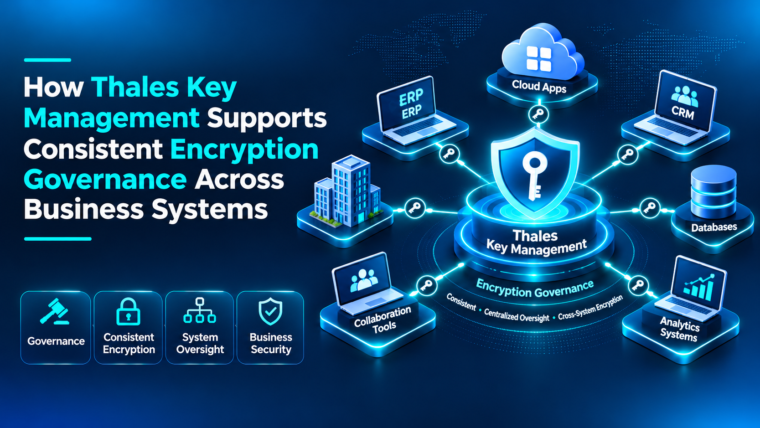
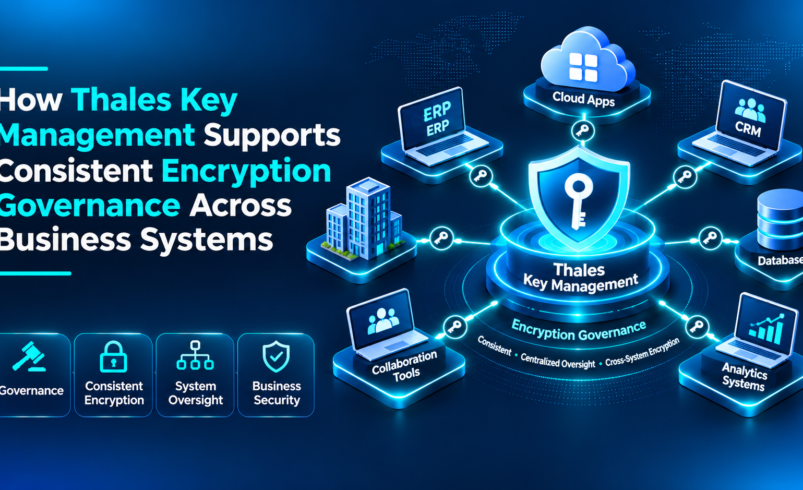
Thales key management can support organizations seeking centralized capabilities for managing cryptographic keys across business systems.
What Is Encryption Governance?
Encryption governance refers to the policies, controls, responsibilities, and processes used to manage encryption across an organization.
A governance framework should address:
- What information requires encryption
- Which keys protect it
- Who owns the keys
- Who can access them
- How keys are rotated
- How keys are backed up
- How activity is monitored
- When keys are retired
The objective is to create consistent protection across business systems.
Why Consistent Governance Matters
Different business units may have different technology requirements.
For example:
- Finance may operate transaction systems
- HR may manage employee information
- Sales may use customer platforms
- IT may manage infrastructure
- Operations may run production systems
Each area may use encryption.
Without common governance, each team may implement different practices.
This can make enterprise-wide security difficult to manage.
Key Management in Cryptography
Key management in cryptography provides the framework for managing cryptographic keys throughout their lifecycle.
The lifecycle generally includes:
- Generation
- Storage
- Distribution
- Access
- Usage
- Rotation
- Backup
- Recovery
- Expiration
- Retirement
- Destruction
Enterprise governance should cover these stages.
Thales Key Management
Thales key management can support centralized administration of cryptographic keys across business systems and distributed infrastructure.
Centralized management can help security teams establish common controls around:
- Key access
- Ownership
- Rotation
- Lifecycle management
- Monitoring
- Recovery
Organizations should design implementation according to their existing infrastructure and integration requirements.
Establishing Enterprise Key Ownership
Every important cryptographic key should have a clearly defined owner.
Ownership helps establish accountability.
The owner may be responsible for:
- Approving access
- Reviewing permissions
- Coordinating rotation
- Managing recovery
- Approving retirement
Without ownership, organizations may struggle to act quickly when a key requires attention.
Managing Access Across Business Systems
Different applications should not automatically receive access to all enterprise keys.
Organizations should apply least privilege.
For example, an HR application should receive access only to the cryptographic resources necessary to protect and process approved employee information.
This separation limits unnecessary exposure.
Centralized Key Inventory
An enterprise-wide inventory provides visibility into cryptographic assets.
Organizations should track:
- Key identifier
- Purpose
- Owner
- Associated application
- Protected data
- Access permissions
- Rotation schedule
- Lifecycle status
A centralized inventory helps security teams identify gaps.
Supporting Cloud Business Systems
Many business applications now operate in the cloud.
Organizations may use cloud platforms for:
- Customer applications
- Business analytics
- Storage
- Databases
- Backup
- SaaS services
Each environment may involve cryptographic keys.
Centralized governance can help maintain common policies across cloud workloads.
Supporting On-Premises Business Systems
Traditional enterprise applications and databases may continue to operate on-premises.
Organizations should include these systems in the same overall cryptographic governance strategy.
This helps prevent gaps between legacy and modern environments.
Supporting Hybrid Business Systems
Many organizations use hybrid infrastructure.
For example, an enterprise may run its application in the cloud while keeping sensitive databases on-premises.
Cryptographic controls need to support both environments.
A centralized governance model can help maintain consistent policies.
Database Encryption Governance
Databases often contain highly sensitive business information.
Organizations may encrypt:
- Customer data
- Financial records
- Employee information
- Transaction data
- Business documents
Governance policies should define how the keys protecting this information are managed.
Application Encryption Governance
Applications may use keys for:
- Encryption
- Authentication
- Digital signatures
- API security
- Secure communication
Development teams should follow enterprise Key management policies rather than creating isolated processes.
Digital Certificates
Digital certificates also form part of enterprise cryptographic governance.
Organizations should monitor:
- Certificate ownership
- Expiration
- Private key protection
- Renewal
- Replacement
- Revocation
These activities should connect to broader Key management policies.
Key Rotation Governance
Organizations should define enterprise requirements for key rotation.
However, rotation schedules may vary depending on:
- Data sensitivity
- Application requirements
- Risk
- Key type
- Security policy
Centralized governance can establish baseline requirements while allowing appropriate exceptions.
Monitoring Encryption Governance
Security teams should monitor cryptographic activity.
Important events include:
- Key creation
- Key access
- Key rotation
- Administrative changes
- Failed access attempts
- Key retirement
These events can provide visibility into how business systems use cryptographic assets.
Automating Governance
Automation can help enterprises enforce common processes.
Organizations can automate suitable activities such as:
- Rotation reminders
- Expiration alerts
- Inventory updates
- Access reviews
- Lifecycle notifications
Automation reduces manual administrative effort.
Handling Business System Changes
Business systems frequently change.
Applications may be migrated, replaced, consolidated, or retired.
Each change can affect cryptographic keys.
When an application is retired, security teams should identify and review its associated keys.
Unnecessary keys should be retired according to policy.
Supporting Compliance and Governance Reviews
Consistent Key management can help organizations maintain records related to:
- Key ownership
- Access
- Rotation
- Lifecycle status
- Administrative actions
These records can support internal security and governance reviews.
Common Governance Challenges
Fragmented Business Units
Different departments may use different processes.
Poor Key Visibility
Security teams may not have a complete inventory.
Unclear Ownership
No team may be clearly responsible for a key.
Excessive Access
Applications may receive unnecessary permissions.
Legacy Systems
Older systems may require special integration approaches.
Best Practices
Organizations should:
- Establish enterprise-wide cryptographic governance
- Maintain a centralized key inventory
- Assign ownership
- Apply least privilege
- Define rotation requirements
- Separate keys from protected data
- Monitor cryptographic activity
- Automate suitable lifecycle processes
- Review access regularly
- Protect backups
- Test recovery
- Retire obsolete keys
Creating a Consistent Enterprise Framework
A practical governance model can follow:
Discover → Classify → Assign → Protect → Monitor → Review → Retire
This approach gives security teams a continuous view of cryptographic assets.
It also allows business units to maintain their operational requirements while following common enterprise security principles.
Conclusion
Consistent encryption governance becomes increasingly important as enterprises adopt more applications, cloud platforms, databases, and distributed business systems.
Organizations need visibility and control over the cryptographic keys protecting their information.
Thales key management can support centralized administration and help enterprises establish common controls across distributed encryption environments.
Key management in cryptography provides the lifecycle framework for managing cryptographic keys, while effective Key management supports access control, rotation, monitoring, recovery, and retirement.
By combining centralized key administration with clear policies, ownership, least privilege, automation, and continuous monitoring, enterprises can build a more consistent encryption governance framework and strengthen protection across their critical business systems.