
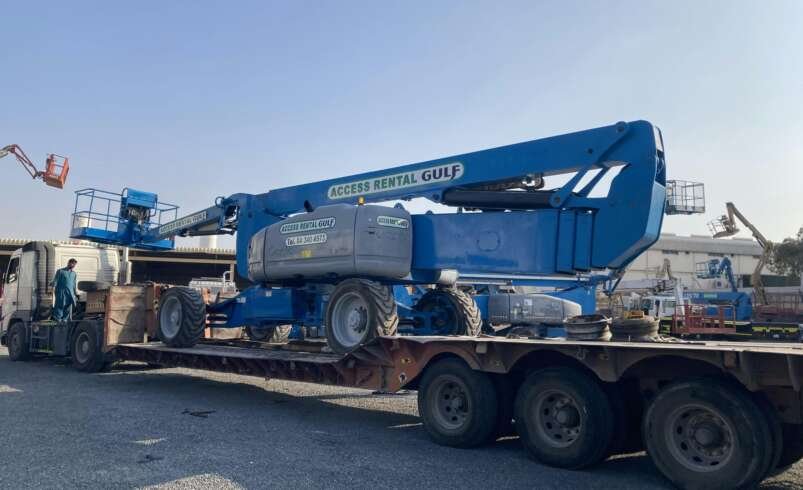

Telescopic Boom Lift: A Practical Guide for Construction and Access Work
Working at height is a routine requirement across construction, infrastructure, industrial maintenance and commercial projects. As buildings become taller and construction sites become more complex, businesses need equipment that can provide safe access to elevated work areas without relying on traditional scaffolding.
A telescopic boom lift is one of the most useful types of powered access equipment for these applications. Also known as a straight boom lift, this machine uses a telescoping boom to provide substantial vertical reach and horizontal outreach.
Across the UAE, Saudi Arabia, Qatar and Bahrain, telescopic boom lifts can be used for a wide range of projects, including structural work, steel installation, building maintenance, warehouse construction and industrial applications.
What Is a Telescopic Boom Lift?
A telescopic boom lift is a mobile elevated work platform designed to lift operators and tools to elevated working positions. Its straight telescopic boom extends outwards and upwards, allowing the platform to reach areas that may be difficult to access using conventional equipment.
Unlike a scissor lift, which primarily moves vertically, a boom lift can provide both height and outreach. This makes it particularly useful when workers need to access an elevated location that is positioned away from the machine’s base.
The exact capabilities vary according to the model, but machines are available with different working heights, platform capacities, outreach figures and drive configurations.
Understanding Boom Lift Maximum Height
One of the first specifications businesses consider is boom lift maximum height. However, maximum height should not be the only factor used when selecting equipment.
Working height refers to how high an operator can practically work from the platform. A machine’s platform height and working height are not necessarily the same measurement.
When planning a project, consider:
- Required working height
- Required horizontal outreach
- Platform capacity
- Ground conditions
- Machine dimensions
- Access restrictions
- Indoor or outdoor use
- Wind conditions
- Obstacles around the work area
Choosing a machine purely because it has the highest possible reach can result in unnecessary costs or equipment that is unsuitable for the site.
Where Are Telescopic Boom Lifts Used?
Telescopic boom lifts are particularly useful when straight vertical and horizontal access is required.
Typical applications include:
Construction
Construction teams can use boom lifts for structural installation, cladding, roofing, steelwork and other elevated activities.
Building Maintenance
Large commercial and industrial buildings often require maintenance at height. A boom lift can provide temporary access without installing permanent access systems.
Warehouses and Industrial Facilities
High-level lighting, building services, structural components and maintenance points can require specialised access equipment.
Infrastructure Projects
Bridges, transport facilities and large infrastructure developments may require machines capable of reaching difficult elevated areas.
Boom Man Lift or Boom Lift?
The term boom man lift is sometimes used when referring to equipment designed to lift workers using a boom. Although terminology can vary between markets, businesses should focus on the machine’s actual specifications and intended application rather than relying solely on terminology.
Before hiring or purchasing equipment, confirm:
- Working height
- Platform capacity
- Outreach
- Machine width
- Machine weight
- Power source
- Terrain capability
- Manufacturer requirements
This ensures that the selected machine is appropriate for the task.
Choosing Between Electric and Diesel Equipment
The power source is another important consideration.
Electric boom lifts can be particularly useful for indoor projects where emissions and noise need to be controlled. Diesel-powered machines are commonly used for outdoor construction and demanding terrain applications.
The choice should depend on the working environment rather than simply the machine’s size.
For Gulf construction projects, businesses should also consider environmental conditions such as high temperatures, dust and direct sunlight. Manufacturer operating limits should always be followed.
Should You Buy a Telescopic Boom Lift?
For companies that regularly require powered access equipment, purchasing may make sense. Businesses searching for a telescopic boom lift for sale should compare more than the purchase price.
Consider:
- Machine age
- Working hours
- Service history
- Inspection records
- Manufacturer
- Spare parts availability
- Platform capacity
- Working height
- Outreach
- Tyre condition
- Battery or engine condition
A used machine may offer a lower initial purchase price, but its condition and maintenance history should be carefully evaluated.
Safety Considerations
A boom lift should only be operated by properly trained and authorised personnel. Before use, operators should complete the required pre-use inspection and check the machine for visible damage or faults.
The work area should also be assessed for hazards such as:
- Overhead power lines
- Uneven surfaces
- Open edges
- Other vehicles
- Falling objects
- Strong winds
- Restricted access routes
The manufacturer’s operating instructions should always be followed.
Why Proper Equipment Selection Matters
The right machine can make a significant difference to productivity. If the platform does not have enough outreach, operators may struggle to reach the work area. If the machine is too large, access routes may become difficult.
For this reason, equipment planning should take place before the project begins.
A professional powered access provider can help businesses compare different machine types and specifications based on the application.
Final Thoughts
A telescopic boom lift provides a practical solution when projects require significant height and horizontal outreach. From construction and infrastructure to maintenance and industrial work, these machines can improve access while reducing reliance on temporary access systems.
Businesses operating in the UAE, Saudi Arabia, Qatar and Bahrain should consider working height, outreach, capacity, terrain, environmental conditions and operator requirements before selecting a machine.
The best equipment is not necessarily the largest machine. It is the machine that safely and efficiently meets the specific requirements of the job.