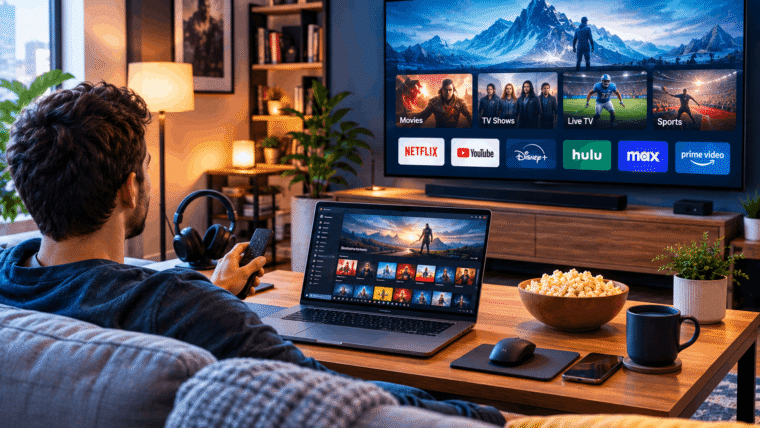

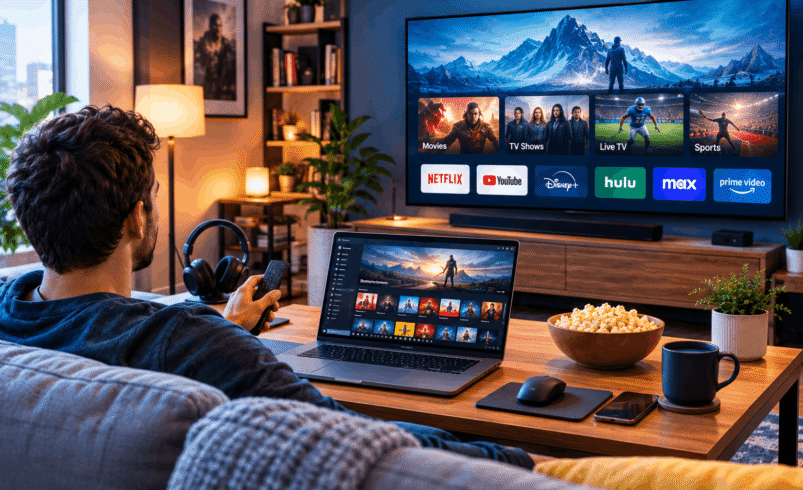

The way Americans watch television is changing faster than ever. Not long ago, “watching TV” usually meant sitting on a couch in front of a television at a specific time. Today, the experience can happen almost anywhere. A laptop at a kitchen table, a smartphone during a commute, a tablet in a bedroom, or a computer monitor in a home office can all become personal entertainment screens. For example, someone researching Xuper TV may be interested not only in what they can watch, but also in how easily entertainment can fit into everyday life.
This shift is more than a technology trend. It reflects a broader change in how people think about entertainment. Viewers want flexibility, convenience, personalized recommendations, and access to content on the devices they already use. As a result, the living-room television is no longer the only center of the entertainment experience.
Nielsen reported that streaming accounted for 48.6% of total U.S. TV usage in May 2026, while broadcast accounted for 19.2% and cable represented 20.4%. That figure shows just how significant internet-based video has become in the American entertainment landscape.
Television Is Becoming an Activity, Not Just a Device
The biggest change in digital entertainment is surprisingly simple: TV is becoming less about the television itself.
In the past, the television set was the gateway to entertainment. Today, the gateway might be a web browser, streaming application, gaming console, mobile device, smart TV, or connected computer.
Deloitte’s research supports this broader definition. Its 2025 Digital Media Trends research found that 41% of surveyed consumers consider both social media videos and streaming services forms of “watching TV.”
That is an important distinction. People are not necessarily abandoning television content. Instead, they are changing when, where, and how they consume it.
Consider a typical day:
- A person watches a news clip on a phone during breakfast.
- They stream a television episode on a laptop during lunch.
- They watch short videos between meetings.
- Later, they use a smart TV for a movie.
- Before bed, they return to a tablet for another episode.
All of those experiences compete for the same limited attention.
Deloitte’s 2026 Digital Media Trends research estimates that the average consumer spends around six hours per day on media and entertainment activities.
Therefore, the future of television is not necessarily about replacing one screen with another. It is about making entertainment available across an entire ecosystem of screens.
Why Viewers Want Entertainment Beyond the Living Room
There are several reasons viewers are moving away from traditional television-only habits.
Convenience Comes First
People have busy schedules. They may not want to plan their day around a television program.
Streaming removes much of that restriction. A viewer can choose when to start a program, pause it, continue later, or switch devices.
This flexibility is especially useful for people who work remotely, travel frequently, study from home, or simply prefer watching content privately.
Personal Screens Offer More Control
A television is usually a shared household device. A computer or smartphone, however, can provide a more personal experience.
One person might watch a documentary while another family member uses the living-room television for sports. Someone else can watch a show with headphones without disturbing anyone.
As a result, personal screens are helping entertainment become more individualized.
Entertainment Is Becoming More Portable
The smartphone helped make entertainment mobile. Laptops and tablets expanded that idea by providing larger screens without requiring a traditional television setup.
Now, viewers can move between locations while maintaining similar entertainment habits.
This does not mean every screen needs to deliver the same experience. Instead, platforms increasingly need to work comfortably across different screen sizes and environments.
The Rise of the PC as an Entertainment Center
The computer has quietly become one of the most flexible entertainment devices available.
A modern Windows PC can function as a workspace in the morning, a communication tool during the afternoon, and an entertainment center in the evening.
That versatility is one reason PC-based viewing remains attractive.
For someone exploring Xuper TV PC options, for instance, the computer may provide advantages that a smaller mobile screen cannot easily offer. A larger monitor makes long-form viewing more comfortable, while a keyboard and mouse can make navigation easier.
A PC can also connect to external speakers, headphones, monitors, projectors, and televisions. That makes it possible to create anything from a simple desk-based setup to a more complete home entertainment environment.
However, viewers should always check whether a particular streaming service offers a legitimate Windows application, browser access, or another supported method before installing third-party software.
What Makes a Great PC Streaming Experience?
Having a computer is only the starting point. The quality of the overall experience depends on several factors.
1. A Reliable Internet Connection
Streaming quality depends heavily on connection stability.
Netflix, for example, recommends at least 3 Mbps for HD-quality 720p, 5 Mbps for 1080p, and 15 Mbps for 4K viewing.
These figures should not be treated as universal requirements for every streaming platform. Different services use different compression technologies. Still, they provide a useful reference point.
More importantly, speed is only part of the equation. A connection that repeatedly drops or fluctuates can cause buffering even when a speed test looks impressive.
For a better experience:
- Use Ethernet when practical.
- Position your computer within a strong Wi-Fi range.
- Restart your router if connection problems persist.
- Reduce unnecessary downloads while streaming.
- Check whether other devices are heavily using the network.
A fast connection is helpful, but a stable connection is what makes streaming feel reliable.
2. A Capable Windows PC
You do not necessarily need an expensive gaming computer to stream television.
For standard HD viewing, many everyday laptops and desktops are perfectly capable. However, older hardware can struggle when several demanding applications are running simultaneously.
If playback is stuttering, check:
- Available RAM
- CPU usage
- GPU usage
- Browser tabs
- Background applications
- Graphics drivers
- Operating-system updates
Closing unnecessary programs can sometimes make a bigger difference than expected.
3. A Comfortable Display
Screen size matters, but so does viewing distance.
A large monitor can make movies, sports, and television programs much more immersive. On the other hand, a smaller display may be more practical for a bedroom or compact workspace.
A dual-monitor setup can also be useful. One screen can display entertainment while the other remains available for work or browsing.
Windows supports different display and video settings that can affect playback. Microsoft also notes that mismatched refresh rates across multiple monitors can sometimes contribute to playback problems.
Streaming Is Becoming More Personalized
Another major development is personalization.
Traditional television schedules offered the same programming to everyone at a particular time. Digital platforms can instead use viewing behavior, preferences, searches, and other signals to recommend content.
That creates a more individual experience.
Imagine two people opening the same streaming service. One might see sports highlights, while another sees documentaries, dramas, or international programs.
This personalization is likely to become even more sophisticated as artificial intelligence and recommendation technologies develop.
Deloitte’s 2026 research found that almost 30% of entertainment fans expressed interest in AI-generated personalized digests and highlight reels, while 22% said better AI recommendations could increase their streaming use.
The future, therefore, may not simply involve choosing from thousands of programs. Instead, technology may increasingly help viewers discover the right content at the right moment.
AI Could Change How We Discover Television
Artificial intelligence is likely to influence entertainment in several ways.
For example, future platforms could allow viewers to search using natural language rather than exact titles.
Instead of typing:
“Action movie 2025”
a viewer could potentially ask:
“Find me a fast-paced action movie under two hours with a positive ending.”
The system could then interpret the request and present relevant choices.
AI could also summarize previous episodes, identify important scenes, generate personalized recommendations, and organize content around a viewer’s interests.
However, personalization needs responsible implementation. People should have clear information about how their data is collected and used.
Convenience should not come at the expense of privacy.
The Growth of Ad-Supported Streaming
The future of digital entertainment will not be based entirely on expensive subscriptions.
Cost has become an important consideration for American viewers. Deloitte’s 2026 research found that 68% of streaming subscribers had at least one ad-supported streaming service, up from 54% in its March 2025 data.
This suggests that many consumers are willing to exchange some advertising for lower entertainment costs.
That model could become increasingly important as households manage multiple subscriptions.
In fact, Deloitte reported that U.S. households with paid SVOD services have an average of four services, while average monthly spending was around $69 in its March 2026 research.
Consequently, viewers may become more selective about which services they keep.
Free and lower-cost entertainment options can therefore play a larger role in the future media ecosystem.
Why Content Aggregation Matters
One of the biggest frustrations with modern streaming is fragmentation.
A movie may be available on one service, a sports event on another, and a television series somewhere else.
Viewers can end up switching between applications repeatedly.
This is why aggregation is becoming increasingly valuable.
A better entertainment experience could involve:
- One search interface across multiple services
- Personalized recommendations
- Unified watchlists
- Cross-platform viewing history
- Better content discovery
- Clear information about where a program is available
Instead of asking, “Which app has this show?” viewers increasingly want technology to answer the question for them.
Watching International and Niche Content
Another important part of the future is greater access to international entertainment.
Digital distribution makes it easier for audiences in the United States to discover programming from Latin America, Europe, Asia, and other regions.
This is especially meaningful for multilingual households and viewers who want entertainment that reflects their culture or interests.
Platforms and services associated with international programming can therefore reach audiences that traditional television schedules may have overlooked.
When evaluating a service such as Xuper TV, viewers should check exactly what content is offered in their region, whether the service has appropriate distribution rights, and whether the source is trustworthy.
The same principle applies to Xuper TV PC access. A convenient computer setup is useful only when the application or service being used is legitimate, secure, and compatible with the viewer’s device.
Beyond the Living Room: New Places to Watch
The future of digital entertainment is not limited to bedrooms and home offices.
People are already watching content in many different environments.
The Home Office
For remote workers, a computer may already be the most frequently used screen in the house.
Once work ends, that same device can become an entertainment center.
The Bedroom
A laptop or tablet allows people to watch independently without turning on the main television.
The Kitchen
Short-form programming, news, cooking content, and live streams can easily accompany everyday activities.
Travel
Phones, tablets, and laptops allow viewers to continue watching content while traveling, subject to internet access and service availability.
Outdoor Spaces
With suitable equipment, portable displays and wireless connections can extend entertainment to patios, balconies, or other areas.
This flexibility illustrates a larger trend: entertainment is increasingly designed around people’s lifestyles rather than a fixed room.
The Role of Better Audio
Video quality often gets most of the attention, but sound is equally important.
A beautiful 4K picture can still feel disappointing if dialogue is difficult to hear.
For PC viewing, consider:
- Quality headphones
- External desktop speakers
- A soundbar
- Proper Windows audio settings
- Lower background noise
For shared spaces, headphones can also make personal viewing more practical.
Clear dialogue is particularly important for movies, documentaries, news programs, and multilingual content.
Security Should Be Part of the Streaming Experience
As entertainment becomes more digital, security becomes more important.
Viewers should be careful when downloading unfamiliar applications or files advertised as streaming tools.
Before installing software, consider:
- Who publishes it?
- Is it available through a reputable source?
- What permissions does it request?
- Does it require unnecessary personal information?
- Does the service clearly explain its privacy practices?
- Are the content rights and distribution arrangements clear?
Avoid installing random APK files or executable programs simply because a website promises free access to premium content.
Likewise, keep Windows, browsers, antivirus software, and graphics drivers updated.
A smooth entertainment experience should also be a safe one.
What the Future May Look Like
The next generation of television will probably not look like a single device.
Instead, entertainment may become a connected experience across several technologies.
Imagine starting a movie on a smartphone while traveling home. Later, you continue watching it on a Windows laptop. In the evening, you transfer the experience to a smart TV. Your progress, recommendations, subtitles, and preferences remain synchronized.
That type of continuity is already becoming more common.
Meanwhile, AI may make discovery faster. Voice interfaces could become more useful. Social platforms may increasingly compete with traditional entertainment companies. Interactive programming could give viewers more control over stories.
Deloitte’s 2026 research highlights this broader shift, noting that fans increasingly interact with entertainment across streaming services, traditional television, social channels, merchandise, and live events.
The future of TV is less about where the screen sits and more about how easily entertainment follows the viewer.
How Consumers Can Prepare for the Next Era of Entertainment
You do not need to completely redesign your home entertainment system to benefit from these changes.
Instead, focus on flexibility.
Start with a reliable internet connection. Then make sure your primary devices are updated and capable of handling the quality you want.
It is also worth reviewing your subscriptions periodically. If you rarely use a service, canceling it may make more sense than paying for another month.
Finally, choose platforms based on more than just the size of their content libraries.
Consider:
- Reliability
- Device compatibility
- Privacy
- Security
- Content availability
- Licensing and distribution rights
- Price
- Ease of use
- Accessibility features
This approach helps create a sustainable entertainment setup rather than simply collecting more services.
Final Thoughts
Digital entertainment is moving beyond the living room because modern viewers want more freedom.
They want to watch content when it suits them, on the screen that is most convenient, without being tied to a traditional schedule. Streaming, personal computers, smartphones, tablets, smart TVs, social platforms, and emerging AI technologies are all contributing to this transformation.
The numbers support the change. Streaming represented nearly half of U.S. TV usage in May 2026, while Deloitte’s research shows that 90% of U.S. households surveyed had at least one paid streaming video service.
Yet the future is not simply about having more entertainment.
It is about having better access to the entertainment that actually matters to you.
Whether someone watches through a smart television, browser, laptop, or explores an option such as Xuper TV PC, the most useful setup will be one that combines convenience with reliability, security, affordability, and legitimate access to content.
Television is no longer confined to one room. Increasingly, it is becoming an experience that moves with us—and that may be the most important change in digital entertainment yet.
FAQs
1. Is television moving away from traditional living-room viewing?
Yes. Television and video entertainment are increasingly consumed through smartphones, computers, tablets, smart TVs, gaming devices, and social platforms. The definition of “watching TV” is becoming broader as viewers choose different devices and formats.
2. Can a Windows PC be used as an entertainment center?
Absolutely. A Windows PC can stream video, connect to external monitors and speakers, support multiple displays, and provide access to browser-based entertainment services and compatible applications.
3. What should I consider before using Xuper TV PC?
Check whether the specific Xuper TV service or application is legitimate and officially supported in your region. Verify its content rights, privacy practices, download source, and Windows compatibility before installing anything.
4. Does streaming require a very fast internet connection?
Not necessarily. Requirements vary by platform and video quality. However, a stable connection is important. Higher resolutions such as 4K generally require more bandwidth than standard or HD video.
5. Will AI change the way people watch television?
AI is likely to influence content discovery, recommendations, summaries, personalization, and interactive entertainment. However, responsible use of AI will also require attention to privacy, transparency, accuracy, and user control.