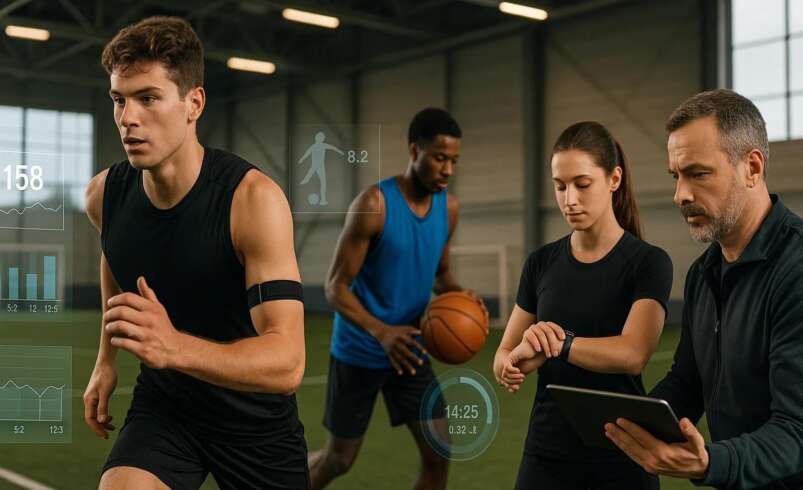

A young athlete’s progress used to be judged mainly through observation: how fast they ran, how accurately they passed, how well they performed in matches, and what a coach noticed during practice. Today, technology is adding another layer to that process.
Wearable devices, video analysis, training applications, GPS systems, smart sensors, and digital performance platforms can provide coaches with information that was difficult to capture just a decade ago.
For young players, this can mean more personalized training. Instead of giving every athlete exactly the same workload, coaches can use relevant information to understand differences in fitness, movement, recovery, and technical development.
But data-driven youth sports are not simply about collecting more numbers. The real value comes from knowing which information matters, interpreting it correctly, and making sure technology supports the child’s long-term development rather than creating unnecessary pressure.
How Data Is Changing Youth Training and Making Coaching More Individual
One of the biggest advantages of sports technology is that it can make training more individualized.
Consider a youth football academy with twenty players. Traditionally, a coach might observe the entire group and make decisions based on experience and visual assessment. That expertise remains extremely important, but technology can provide additional context.
A wearable device may record running activity, while video analysis can reveal changes in movement technique. A training application can help maintain records of sessions, while simple performance tests can show how an athlete is progressing over several months.
The information becomes particularly useful when it is combined rather than viewed in isolation.
A coach might notice that one player is struggling during repeated sprint drills. Instead of immediately assuming the athlete needs harder training, the coach can examine recent workloads, recovery, sleep, technique, and other relevant factors.
That creates a more informed conversation.
Wearables and Video Analysis Are Changing What Coaches Can See
Wearable technology has become one of the most visible developments in modern sports training. Depending on the device, it can provide information about movement, distance, acceleration, heart rate, workload, and other physical measures.
GPS and inertial systems, for example, have been used to monitor training loads in team sports. Research suggests that these tools can help coaches understand the physical demands placed on athletes, although the accuracy and usefulness of individual systems can vary.
Video analysis provides another important advantage because young athletes can actually see their technique.
A cricket batter might believe their head is staying still during a shot, until slow-motion footage shows a different movement. A basketball player can review foot placement during a defensive drill. A swimmer can compare stroke mechanics from different training sessions.
This visual feedback can make coaching instructions easier to understand.
The growing use of digital sports platforms also means young athletes and their families increasingly encounter sports-related online services while researching training, competitions, and sporting information. A search for sky exchange, for instance, represents the wider shift toward people using digital platforms as part of their sports-related online activity.
The important point is that technology should have a clear purpose.
A coach should be able to answer a simple question: What decision will this data help me make?
If the answer is unclear, collecting another metric may simply create more information without creating better training.
For example, useful questions could include whether training workload is increasing too quickly, whether a technical movement is improving, whether an athlete is recovering adequately, or whether a player needs additional practice in a particular skill.
This approach prevents technology from becoming a distraction.
Data Can Help Coaches Think About Recovery, Not Just Performance
Perhaps the most useful development in youth sports is the growing attention to recovery.
Young athletes are still growing physically. Their school responsibilities, sleep patterns, nutrition, emotional well-being, and training schedules can all influence how they respond to exercise.
The American Academy of Pediatrics has highlighted concerns surrounding excessive training and early sports specialization among young athletes and recommends paying attention to both physical and psychological development.
Research has also linked high sports specialization with increased overuse-injury risk among young athletes.
Technology cannot diagnose an injury by itself, but it can help coaches notice changes that deserve attention.
Suppose a young runner’s training volume has increased significantly while performance has stopped improving. That does not automatically mean the athlete is overtrained.
It does mean the coach should ask questions.
Is the player sleeping properly? Are they experiencing soreness? Has school become more demanding? Has their motivation changed? Are they getting enough rest between sessions?
The technology provides a signal. The human conversation provides the context.
For families researching sports-related digital services, a phrase such as skyexchange login illustrates how users often search for very specific online access information. In youth sports, the equivalent principle is understanding the exact question behind a piece of data before deciding what action to take.
That distinction is particularly important with artificial intelligence.
AI can identify patterns across large datasets, but a pattern is not automatically a diagnosis or a guaranteed prediction. Recent research into AI-supported sports injury modelling shows potential while also highlighting differences in methodologies, datasets, and validation.
A responsible coach should therefore treat AI as an additional source of information rather than an unquestionable authority.
The language used with young athletes matters too.
Instead of telling a teenager that an algorithm has decided they are at risk, coaches can explain that certain measurements have changed and that the training plan may need closer review.
This keeps the athlete involved in the decision-making process.
Using Technology Responsibly in Youth Sports
Technology can be extremely useful, but youth sports require a different approach from professional sports.
A professional athlete may have access to sports scientists, physiotherapists, nutritionists, performance analysts, and medical teams. A 13-year-old playing at a local academy may simply have a coach and a parent.
That difference should influence how much technology is introduced.
The goal should be simplicity.
If a coach wants to improve sprint performance, a basic timing system may be enough. If technique is the priority, video analysis may provide more useful information than an expensive wearable.
There is no reason to measure something simply because it can be measured.
A responsible academy should also explain to parents what information is being collected and why. Families should understand who can access the data, how it is stored, and whether it is shared with third parties.
Young athletes deserve privacy just as much as adult athletes.
Parents should also be careful about turning performance data into constant comparison.
A child who runs slower than another player at age 12 is not necessarily less talented. Young people develop at different speeds, and physical growth can dramatically change performance during adolescence.
This is one reason long-term trends are usually more meaningful than a single score.
For example, an academy could track an athlete’s development across an entire season rather than focusing on whether they achieved a particular result during one training session.
Digital resources can also make sports education more accessible. A skyexchange download search, for example, shows how users may seek direct digital access to a particular service, while sports academies can similarly provide parents and athletes with centralized access to training schedules, educational material, performance reports, and recovery guidance.
The technology itself is not the objective.
Better communication and better decisions are.
Creating a Healthy Balance Between Numbers and Human Coaching
One of the most important lessons for youth sports is that data should support coaching rather than replace it.
A sensor can tell a coach how far a player ran. It cannot explain why the player was unusually quiet during training.
A camera can show a technical error. It cannot determine whether the athlete is losing confidence.
A performance application can display a downward trend. It cannot automatically understand the pressures a young person may be experiencing at school or home.
That is why experienced coaching remains essential.
The best environment combines measurable information with observation and conversation.
An athlete might complete a demanding training session but report feeling comfortable afterward. Another player could complete the same session but feel unusually fatigued. Treating both athletes identically simply because their performance numbers look similar would ignore important context.
This is where the idea of a most trusted sky exchange site can be separated from youth coaching: trust in any digital environment comes from transparency, consistency, and responsible handling of information. In youth sports, those same principles are even more important because children and parents need to understand how their data is being used.
Another important consideration is accessibility.
Advanced technology can be expensive, and not every academy or school can afford professional-grade equipment. Youth development should not become dependent on having the latest device.
Simple methods can still be highly effective.
A coach with a stopwatch, smartphone camera, notebook, and structured training plan can provide valuable feedback. Technology becomes an enhancement rather than a barrier.
Research into mobile sports applications also shows growing interest in using digital tools for performance testing, training-load monitoring, technical development, recovery, and athlete self-management.
The key is choosing tools that match the athlete’s actual needs.
Common Mistakes and Myths About Data-Driven Youth Sports
One common mistake is assuming that more data automatically means better coaching.
It does not.
If a coach collects twenty different measurements but does not know how they affect training decisions, the information can become distracting.
Another mistake is treating technology as a way to predict injuries with certainty.
Current research does not support that level of confidence. Wearables and analytical systems can identify patterns, but they should not replace professional medical assessment when an athlete has pain or other concerning symptoms.
There is also a misconception that traditional coaching is becoming irrelevant.
In reality, technology works best when combined with human expertise.
The coach remains responsible for understanding the athlete’s personality, motivation, technical ability, social environment, and long-term development.
Young players should also not feel that every training session needs to be measured.
Sport should still include freedom, creativity, experimentation, and enjoyment.
A child playing football should sometimes be allowed to play simply because football is fun.
The same principle applies when families encounter different digital sports brands and services. A search term such as skyexch may demonstrate how users adopt shortened digital terminology, but youth sports programs should remain focused on clear communication rather than allowing online trends to dictate training priorities.
Frequently Asked Questions
Why are youth sports becoming more data-driven?
Youth sports are becoming more data-driven because wearable devices, video-analysis tools, mobile applications, and digital tracking systems make it easier to measure training and performance. The information can help coaches identify trends and personalize training when used appropriately.
Does technology make young athletes perform better?
Technology can support better decision-making, but it does not automatically make an athlete better. Coaching quality, consistent practice, recovery, motivation, nutrition, and enjoyment remain important parts of development.
Should every young athlete wear a performance tracker?
No. The appropriate approach depends on the athlete’s age, sport, training goals, resources, and coaching environment. Simple observation and video may sometimes provide more useful information than a wearable device.
Can sports technology prevent injuries?
Technology may help identify changes in workload or movement that deserve attention, but it cannot guarantee injury prevention. Research into wearable and AI-based injury prediction is still developing.
What should parents ask before an academy collects sports data?
Parents should ask what information is being collected, why it is necessary, who can access it, how it is protected, and how long it will be retained. They should also make sure technology is not creating excessive pressure or constant comparison.
Conclusion
The future of youth sports will likely involve more technology, but the most effective programs will not necessarily be those that collect the most data.
They will be the programs that understand what information is useful, interpret it carefully, and keep the young athlete at the center of every decision.
Technology can make training more personalized, help coaches identify meaningful trends, and give young players clearer feedback about their development. But numbers should remain a tool rather than the definition of an athlete.
The real objective is simple: help young players train safely, understand their development, enjoy sport, and build healthy habits that can support them for years to come.