
Artificial intelligence is becoming an important part of how businesses operate, from identifying products in online stores to helping vehicles recognize pedestrians and supporting doctors in analyzing medical images. However, even the most advanced AI model needs good training data to perform well. When images are unclear, incorrectly labeled, or missing important details, the model may struggle to make accurate predictions.
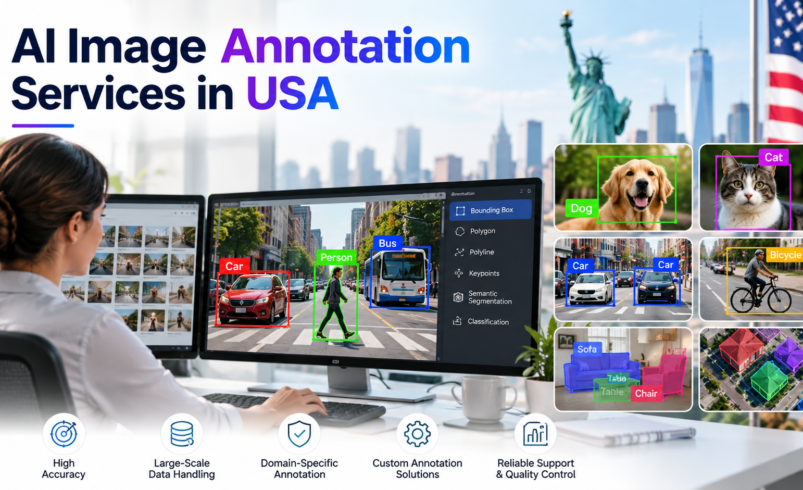
This is where AI Image Annotation Services become valuable. Image annotation involves adding meaningful labels, outlines, boxes, or other information to images so that machine learning models can understand what they contain. These annotations help AI systems recognize objects, distinguish between different categories, and identify visual patterns.
For example, an AI model designed to recognize vehicles needs training images labeled with cars, trucks, motorcycles, pedestrians, and road signs. If these labels are accurate and consistent, the model has a stronger foundation for learning. If the labels contain errors, the model may develop incorrect patterns.
Businesses developing computer vision applications must therefore pay close attention to image data quality. Working with an experienced technology partner such as Vision Infotech can help organizations prepare structured image datasets that support their AI development goals.
In this blog, we will explain how image annotation supports AI model training, which annotation techniques are commonly used, and what businesses should consider when choosing an annotation partner.
What Are AI Image Annotation Services?
AI Image Annotation Services involve labeling images with information that helps artificial intelligence systems interpret visual content. The process turns ordinary images into structured training data that machine learning algorithms can use.
An image may contain several objects, colors, shapes, and activities. An AI model does not automatically understand the meaning of everything it sees. During training, it learns from examples that show what different objects look like and how they relate to one another.
Image annotation provides those examples.
For instance, a retail company developing an AI-powered inventory system may need thousands of product images labeled by product category. An autonomous driving project may require road images in which vehicles, pedestrians, traffic lights, and lane markings are identified separately.
The annotation process depends on the purpose of the AI application. Some projects require simple labels, while others need detailed outlines around individual objects or pixel-level segmentation.
High-quality annotations help create a reliable dataset, giving developers a clearer foundation for training, evaluating, and improving their models.
Why Is Image Annotation Important for AI Model Training?
AI model training depends on examples from which a system can learn. In supervised machine learning, those examples typically include input images and their corresponding labels. The model compares its predictions with the correct labels and adjusts its internal parameters during training.
When the training labels are reliable, the model can learn more useful visual patterns. When they contain mistakes, the model may learn incorrect relationships.
1. Helps AI Models Recognize Objects
Object recognition is one of the most common applications of computer vision. AI systems must learn to distinguish between objects that may look similar but serve different purposes.
For example, an industrial inspection model might need to identify screws, bolts, cracks, and damaged components in product images. Annotators label these objects so the model can learn their visual characteristics.
Accurate labeling gives the model more useful examples to learn from. As the training dataset grows, developers can evaluate whether the model recognizes these objects reliably across different lighting conditions, backgrounds, and viewing angles.
2. Improves Training Data Quality
The quality of an AI model is influenced by the quality of its training data. Incorrect labels, inconsistent categories, and incomplete annotations can make training less effective.
Professional AI Image Annotation Services help address these problems by following defined labeling guidelines and quality-checking procedures.
Consider a dataset containing images of cats and dogs. If several dog images are labeled as cats, the model receives conflicting information. It may struggle to learn the visual differences between the two categories.
A consistent annotation process reduces such errors and makes the dataset more useful for training.
3. Supports Better Model Evaluation
Training is only one part of AI development. Developers also need to measure how well a model performs on images it has not previously encountered.
A carefully labeled validation or test dataset provides a reference against which predictions can be compared. This helps developers identify missed objects, false detections, and classification errors.
Annotation quality matters here because an inaccurate test label can produce misleading evaluation results.
When training and evaluation datasets are labeled consistently, teams can make better decisions about model improvements and deployment readiness.
Common Image Annotation Techniques Used in AI Training
Different AI projects require different annotation methods. Choosing the appropriate technique depends on the objects being identified, the level of detail required, and the intended model output.
1. Image Classification
Image classification assigns one or more labels to an entire image.
For example, a quality inspection system might classify product images as acceptable or defective. A wildlife monitoring application might classify images as containing birds, deer, or other animals.
This method is suitable when the model needs to understand the main category of an image rather than locate every object inside it.
Classification is generally straightforward to implement, but the labels must accurately reflect the image and follow the project’s category definitions.
2. Bounding Box Annotation
Bounding box annotation uses rectangular boxes to identify the location of objects in an image.
An annotator draws a box around each relevant object and assigns it a label. A road image, for example, might contain separate boxes for cars, pedestrians, bicycles, and traffic signs.
Bounding boxes are widely used for object detection models because they provide both object categories and approximate locations.
The boxes must be positioned consistently. Boxes that include too much background or cut off important parts of an object can reduce the usefulness of the training examples.
3. Polygon Annotation
Polygon annotation outlines objects using multiple connected points. It provides a more precise shape than a rectangular bounding box.
This technique can be useful when objects have irregular boundaries. Examples include identifying damaged areas on manufactured products, outlining buildings in aerial images, or separating plants from surrounding soil.
Polygon labels help computer vision systems learn object boundaries in greater detail.
4. Semantic Segmentation
Semantic segmentation assigns a class label to each relevant pixel in an image.
For example, an image of a road may contain separate pixel classes for the road surface, vehicles, sidewalks, buildings, and vegetation.
Unlike object-level bounding boxes, semantic segmentation focuses on identifying the category of each pixel. It is useful in applications where the exact shape and boundaries of visual regions matter.
5. Instance Segmentation
Instance segmentation identifies individual objects while also outlining their shapes.
Suppose a warehouse image contains ten separate boxes. Semantic segmentation might identify all ten as part of the same general object category, depending on the labeling scheme. Instance segmentation distinguishes each box as a separate object.
This distinction is important for applications that need to count items, track individual objects, or measure their positions.
6. Keypoint Annotation
Keypoint annotation marks specific points on an object, such as joints on a human body or important landmarks on a face.
It is commonly used in pose estimation, gesture recognition, sports analysis, and movement tracking.
For example, a fitness application may use annotated body joints to train a model that estimates whether a person is performing an exercise correctly.
Each method serves a different purpose. Selecting the correct technique at the beginning helps prevent unnecessary rework later.
How AI Image Annotation Services Improve the Model Training Process
Image annotation contributes to several stages of the machine learning workflow, from preparing raw images to evaluating trained models.
1. Preparing Raw Images for Training
AI projects often begin with images collected from cameras, business systems, public datasets, or other authorized sources. These images may contain duplicates, low-quality files, irrelevant content, or inconsistent formats.
Before annotation begins, the dataset should be reviewed and organized.
The preparation process may include:
- Removing duplicate images where appropriate.
- Checking image resolution and file integrity.
- Identifying irrelevant or unusable samples.
- Organizing images into suitable categories.
- Establishing labeling rules for the project.
A clean, well-organized dataset helps annotators work consistently and allows developers to prepare data more efficiently.
2. Creating Consistent Labels
Once the images are ready, annotators apply the appropriate labels according to project requirements.
AI Image Annotation Services can support this stage by using documented instructions that explain how to label each object, handle unclear cases, and resolve overlapping categories.
For example, an agricultural AI project may need to distinguish between healthy leaves, leaves with fungal damage, and leaves affected by insects. If annotators interpret these categories differently, the model may receive inconsistent training examples.
Clear definitions, reference images, and regular reviews help reduce these differences.
3. Reviewing Annotation Accuracy
Annotations should be checked before the dataset is used for training. Quality assurance can involve automated checks, manual reviews, and comparisons between multiple annotators.
Reviewers may look for missing labels, incorrect object categories, misplaced bounding boxes, and incomplete segmentation masks.
For specialized projects, subject-matter experts may also need to review difficult or ambiguous images.
The goal is not simply to produce a large dataset. It is to create data that follows the required standards and accurately represents the visual information the model must learn.
4. Supporting Model Training and Refinement
After the dataset passes the required checks, developers can use it to train the model.
The model processes the annotated images, generates predictions, and adjusts its parameters based on the training objective. Developers then evaluate the results and identify areas where performance needs improvement.
If a model repeatedly misses small objects, the team might review whether the dataset contains enough examples of those objects. If it confuses two similar categories, the annotation guidelines and label quality may need closer examination.
This feedback loop helps teams improve both their datasets and their models over time.
Real-World Applications of Image Annotation in AI
Image annotation supports many industries because businesses increasingly use computer vision to understand visual information.
Healthcare and Medical Imaging
Medical AI applications may analyze X-rays, CT scans, MRI scans, and other medical images. Annotated datasets can help train models to identify relevant structures or flag areas that require further review.
For example, specialists may annotate specific regions in medical scans to support research into image classification or segmentation models.
Medical image projects require particular care because labeling may involve clinical expertise, sensitive information, and strict data-handling requirements. AI outputs should be appropriately validated and should not replace professional medical judgment.
Automotive and Transportation
Autonomous driving and driver assistance systems rely on visual information to identify road users and surroundings.
Training datasets may include annotated cars, pedestrians, cyclists, traffic signs, road boundaries, and obstacles. Some projects also use segmentation and keypoint labels to understand road scenes in greater detail.
Accurate labels help developers assess whether a model can detect relevant objects under different weather, lighting, and traffic conditions.
Retail and E-Commerce
Retailers can use computer vision for product recognition, shelf monitoring, inventory management, and visual search.
For example, an automated shelf-monitoring system may use annotated images to recognize product packages and identify empty shelf spaces.
A well-prepared dataset can help the model distinguish products with similar packaging, although performance still depends on image quality, product variation, and real-world testing.
Manufacturing and Quality Inspection
Manufacturers may train AI models to identify scratches, cracks, missing components, and other visible defects.
Annotators label examples of acceptable and defective products so the model can learn which visual patterns require attention.
The dataset should represent different defect types, production conditions, and product variations. Otherwise, a model may perform well on familiar images but miss defects under different conditions.
Agriculture and Environmental Monitoring
Agricultural applications may use images to identify crop diseases, classify plants, monitor fruit growth, or detect weeds.
Annotators can label leaves, fruits, plant boundaries, and signs of disease. These examples help developers train models for field monitoring and agricultural analysis.
Since outdoor images can vary considerably with lighting, season, and location, datasets should include realistic examples of the conditions in which the model will operate.
How to Choose the Right Image Annotation Partner
Selecting an annotation provider is an important decision because annotation errors can increase development costs and delay AI projects.
Before choosing a partner, businesses should consider several factors.
Annotation Experience and Technical Knowledge
Look for a provider that understands the annotation techniques required for your application. Image classification, object detection, and segmentation have different requirements.
Ask how the team handles difficult images, overlapping objects, and changes in labeling instructions.
Quality Assurance Process
A reliable provider should explain how annotations are reviewed, how errors are recorded, and how corrections are made.
Ask about sampling procedures, reviewer responsibilities, quality metrics, and the process for resolving disagreements between annotators.
Data Security and Confidentiality
Image datasets may contain confidential business information, identifiable individuals, or sensitive operational details.
Review the provider’s access controls, data transfer procedures, confidentiality agreements, and retention policies. Healthcare or other regulated projects may require additional safeguards.
Scalability and Project Management
Some projects need a few thousand annotated images, while others require much larger datasets and ongoing updates.
Choose a partner that can explain its delivery process, staffing approach, timelines, and capacity to maintain consistent quality as project requirements change.
Communication and Flexibility
Annotation requirements can change as developers learn more about model performance. A useful partner should be able to document revisions, clarify uncertain cases, and incorporate approved changes into the workflow.
A clear communication process helps prevent misunderstandings and keeps the annotation work aligned with development goals.
Why Choose Vision Infotech for AI Image Annotation Services?
Vision Infotech works with businesses seeking technology solutions that support practical business and AI development requirements. When planning an image annotation project, organizations should look for a partner that understands their objectives and can align the data preparation process with the intended computer vision application.
Here are several reasons to consider Vision Infotech for your project.
Project-Specific Annotation Requirements
Every AI model has different data requirements. An object detection project may need bounding boxes, while a medical imaging or industrial inspection project may require detailed segmentation.
Vision Infotech can be considered for projects where the annotation workflow needs to be aligned with the intended application, dataset structure, and labeling guidelines. Before starting, businesses should confirm the specific annotation methods and deliverables available for their project.
Focus on Data Quality
Accurate annotations are essential for useful training data. A structured workflow should include clear labeling instructions, checks for inconsistent labels, and a process for correcting identified errors.
When evaluating Vision Infotech, discuss the quality assurance steps that will be applied to your dataset, including how annotation accuracy will be reviewed and reported.
Support for AI Development Goals
Image annotation is one part of a larger AI development process. Dataset preparation, model training, testing, and deployment must work together to produce useful results.
Vision Infotech’s technology background can be relevant to businesses looking for support with AI-related initiatives. Project discussions should establish whether the required annotation and related development capabilities match your specific needs.
Clear Communication and Defined Deliverables
A successful annotation project needs agreed expectations. These may include image volume, annotation type, output format, review requirements, data security, and delivery milestones.
Working through these details before production begins helps both parties understand the scope of work and the criteria for accepting the completed dataset.
If you are considering Vision Infotech, share your project goals and dataset requirements to determine the most suitable approach.
Best Practices for Getting Better Results From Image Annotation
Even with a capable annotation partner, businesses should establish a clear process for managing training data.
Start with a small pilot dataset. Annotate a representative sample before processing the entire image collection. This helps identify unclear instructions and unsuitable labeling methods early.
Create detailed annotation guidelines. Explain what each label means, how object boundaries should be drawn, and how ambiguous cases should be handled.
Include diverse images. Use representative examples with different backgrounds, object sizes, lighting conditions, and viewing angles. This can help reduce gaps in the training data.
Review difficult examples. Images with overlapping objects, partial visibility, or uncertain classifications may need additional review or expert input.
Track recurring errors. Record common mistakes and update the guidelines when necessary. Consistent feedback can improve annotation quality over time.
Evaluate the trained model. Review performance on separate validation and test datasets. Model evaluation can reveal weaknesses that require additional data or changes to the annotation process.
These practices make image annotation more manageable and help ensure that the dataset supports the intended training objectives.
Conclusion
Image annotation plays a central role in preparing visual data for machine learning. By assigning accurate labels, defining object boundaries, and identifying important visual features, businesses can provide AI models with the examples they need to learn useful patterns.
AI Image Annotation Services support this process through techniques such as image classification, bounding box labeling, polygon annotation, semantic segmentation, instance segmentation, and keypoint detection. The right approach depends on the application, the required level of detail, and the model’s intended output.
However, successful AI training requires more than a large number of labeled images. Consistent guidelines, quality checks, representative datasets, secure data handling, and ongoing model evaluation are equally important. Businesses that pay attention to these factors can reduce avoidable data errors and make better-informed decisions throughout AI development.
For organizations exploring AI Image Annotation Services in USA, choosing a partner should involve reviewing technical requirements, quality assurance procedures, data security, communication, and project scope.
Vision Infotech can be considered as a potential technology partner for businesses planning AI-related projects. By clearly defining your requirements and confirming the available services, you can establish an annotation workflow that supports your computer vision objectives and provides a stronger foundation for AI model training.