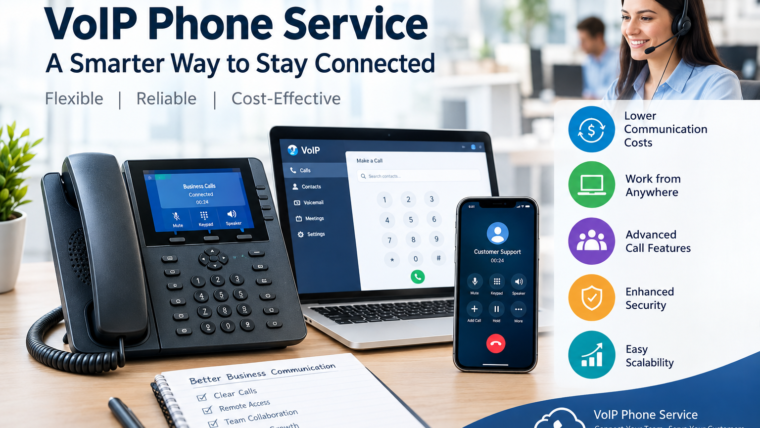

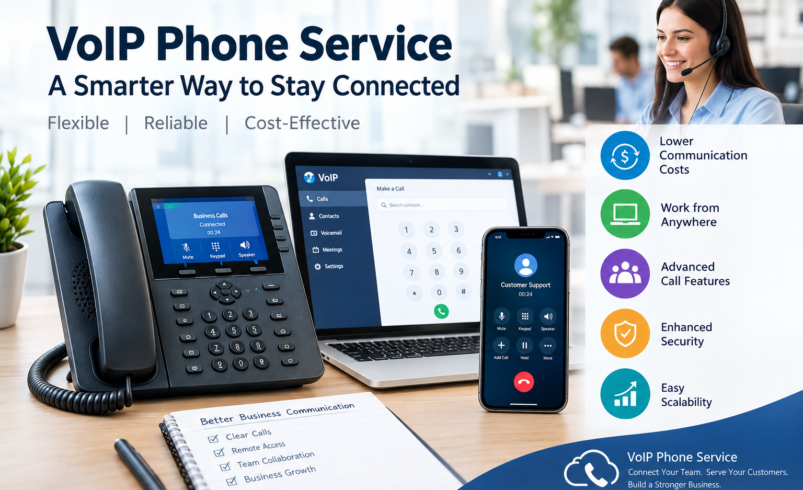

For many businesses, reliable phone communication is essential for serving customers, coordinating employees, and managing daily operations. Traditional phone systems can become expensive and difficult to maintain as a company grows. A VoIP phone service offers a flexible alternative by using an internet connection to make and receive business calls.
Voice over Internet Protocol, commonly called VoIP, converts voice communication into digital data and sends it over the internet. This allows businesses to handle calls without depending entirely on traditional telephone infrastructure.
Whether you operate a small office, a growing company, or a distributed workforce, understanding how VoIP works can help you determine whether it fits your communication needs.
What Is a VoIP Phone Service?
A VoIP phone service allows users to make and receive telephone calls through an internet connection rather than a traditional landline.
Instead of transmitting voice through conventional telephone networks, the system converts your voice into digital packets. These packets travel through an internet connection and are converted back into audio for the person receiving the call.
Depending on the provider and setup, businesses can use VoIP through desk phones, computers, smartphones, or dedicated communication applications.
This flexibility makes VoIP particularly useful for organizations that need employees to stay connected across different locations.
How Does VoIP Phone Service Work?
A VoIP system requires a stable internet connection and a VoIP service provider. When a user makes a call, the system processes the voice signal and sends it through the internet.
A typical business VoIP setup may include:
- High-speed internet connectivity
- VoIP-enabled desk phones or software
- A VoIP provider
- Business phone numbers
- Call management features
- Network equipment and security controls
Employees can often access the same business phone system from multiple locations. For example, an employee working remotely may be able to answer a business call using a laptop or mobile device.
What Problems Can VoIP Solve for Businesses?
Businesses often switch to VoIP because their existing communication system creates operational challenges.
High Phone Costs
Traditional business phone systems may involve separate charges for telephone lines, long-distance calls, maintenance, and hardware. VoIP can consolidate several communication services into one internet-based system.
Actual savings depend on the provider, calling patterns, internet costs, equipment, and required features, so businesses should compare total costs rather than focusing only on the advertised monthly rate.
Limited Remote Communication
Traditional office phone systems may not be convenient for employees who work from home or from multiple locations.
VoIP can allow employees to access business calling features from compatible computers and mobile devices. This helps organizations maintain communication when teams are distributed.
Difficult Call Management
A basic phone system may not provide the tools businesses need to manage customer calls efficiently.
Modern VoIP platforms can include features such as call forwarding, voicemail, auto attendants, call queues, caller ID, conference calling, and business texting, depending on the service.
Scaling During Business Growth
Adding traditional phone lines can require additional hardware and configuration.
Cloud-based VoIP systems can often make it easier to add users, numbers, extensions, and communication features as a company expands.
Important Features to Look for in a VoIP Phone System
Not every VoIP platform provides the same features. Businesses should evaluate their actual communication requirements before choosing a service.
Useful features may include:
Auto attendant: Automatically directs callers to the appropriate department or employee.
Call forwarding: Routes calls to another number or device when an employee is unavailable.
Voicemail: Allows callers to leave messages when nobody can answer.
Call queues: Helps organize incoming calls when several customers are waiting.
Conference calling: Allows multiple participants to communicate during a single call.
Mobile access: Helps employees manage business calls while away from their desks.
Call analytics: Provides information that can help businesses understand call activity and employee workloads.
Business texting: Allows companies to communicate with customers through supported messaging features.
The right combination depends on the size and workflow of the organization.
Is VoIP Reliable for Business Communication?
VoIP reliability depends heavily on the quality of the underlying network.
A strong internet connection, properly configured network, sufficient bandwidth, and appropriate quality-of-service settings can help support clear calls. Network congestion, inadequate bandwidth, unstable connectivity, or poorly configured equipment can result in problems such as dropped calls, delays, or poor audio quality.
Businesses should therefore evaluate their network before moving completely to an internet-based phone system.
A managed IT provider can help assess network performance, configure devices, monitor connectivity, and troubleshoot VoIP-related issues.
How Secure Is VoIP?
Security should be an important consideration when deploying any business communication platform.
Potential security measures can include encrypted communications, strong account authentication, network segmentation, access controls, software updates, and monitoring.
Businesses should also make sure employees use strong passwords and follow appropriate security practices.
If VoIP is being integrated with other business applications, the organization should also consider how user access and sensitive information are managed across the entire communication environment.
VoIP for Small Businesses
Small businesses can benefit from VoIP because it can provide enterprise-style communication features without requiring a large on-premises telephone infrastructure.
For example, a small company could use one business phone system for its office staff, remote employees, customer service team, and management.
However, choosing a provider based only on price can create problems. Businesses should consider service reliability, support, security, scalability, available features, contract terms, and integration requirements.
Working with a Top Rated IT Company can also help businesses evaluate their network and determine what type of VoIP deployment makes sense for their environment.
How to Choose the Right VoIP Phone Service
Before selecting a provider, consider these questions:
- How many users need phone service?
- Do employees work remotely?
- How much calling does the business handle?
- Does the company need business texting?
- Are call queues or auto attendants necessary?
- Does the system need to integrate with CRM software?
- What happens if the internet connection goes down?
- What security controls does the provider offer?
- Is technical support available when problems occur?
- Can the system scale as the company grows?
Answering these questions can make it easier to compare providers based on business requirements rather than simply comparing monthly prices.
Final Thoughts
A VoIP phone service can give businesses a more flexible way to manage voice communication while supporting remote work, call management, scalability, and modern collaboration.
However, VoIP is not simply a matter of replacing an old telephone with an internet-connected phone. Network reliability, security, device configuration, user requirements, and ongoing technical support all influence the quality of the experience.
Businesses should evaluate their current communication challenges and network environment before choosing a solution. With the right planning and implementation, VoIP can become an important part of a modern business communication strategy.