

Artificial intelligence is moving beyond simple chatbots and content-generation tools. Businesses are increasingly deploying AI agents that can retrieve information, interact with software, automate workflows, analyse documents, and complete tasks with limited human intervention.
This shift creates significant opportunities for productivity and automation. At the same time, it introduces a new security challenge: AI Agent Security.
An AI agent may need access to business applications, databases, cloud storage, customer records, internal documents, or other enterprise systems to complete its tasks. If these connections are not properly controlled, an AI agent could unintentionally expose sensitive information or perform actions beyond its intended purpose.
As organizations move toward more autonomous AI, protecting the systems and data connected to these agents must become a core part of enterprise security.
What Is AI Agent Security?
AI Agent Security refers to the technologies, policies, and controls used to protect AI agents, the data they access, and the systems they interact with.
Traditional AI applications often respond to a single user request. AI agents can go further by planning actions, accessing tools, retrieving information, and completing multi-step workflows.
This additional autonomy creates additional security requirements.
Organizations need to know what each AI agent is allowed to access, which actions it can perform, and how those actions are monitored.
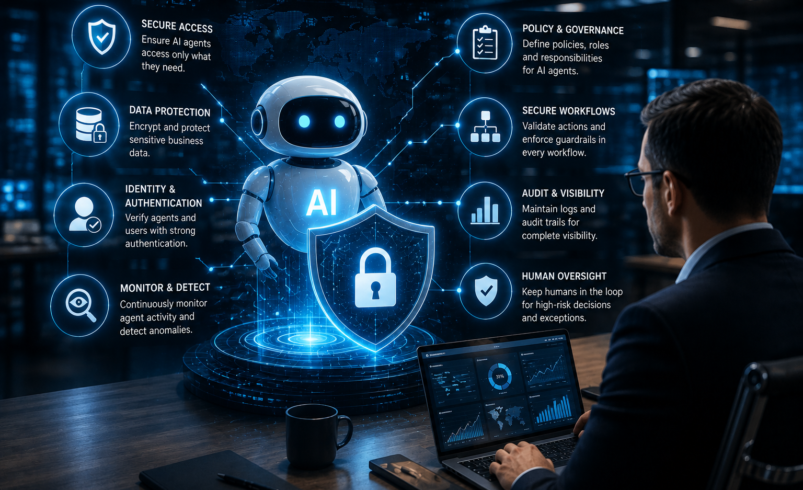
Secure AI agent deployment therefore requires a combination of identity management, access controls, data protection, monitoring, governance, and human oversight.
Why AI Agents Create New Security Risks
AI agents become more useful when they have access to business systems.
An agent connected to a CRM can retrieve customer information. An agent connected to a document repository can search internal files. An agent connected to financial software may assist with reporting or analysis.
The same access that makes an agent valuable can also increase the potential impact of a security incident.
If an agent receives excessive permissions, a compromised or incorrectly configured workflow could expose information that the agent was never intended to access.
The solution is not to avoid AI agents. It is to design their access and permissions carefully.
Protecting Enterprise Data
Enterprise data is one of the most important assets connected to AI systems.
Customer information, employee records, financial documents, intellectual property, legal contracts, source code, and strategic plans all require appropriate protection.
AI agents should only receive the information necessary to complete their assigned tasks.
Organizations can reduce exposure by applying data classification, access restrictions, anonymization, and privacy controls before sensitive information reaches an AI workflow.
This approach allows businesses to benefit from automation while maintaining stronger control over confidential information.
Apply the Principle of Least Privilege
One of the most important concepts in AI Agent Security is least-privilege access.
An AI agent should not automatically receive access to every system available to an employee or organization.
Instead, permissions should be limited according to the agent’s specific purpose.
For example, an AI agent responsible for summarizing customer support tickets may need access to support records but should not automatically have permission to access payroll information or financial systems.
Limiting permissions reduces the potential impact of errors, misuse, or compromised credentials.
Monitor AI Agent Activity
Visibility is essential when AI systems can take actions independently.
Organizations should be able to understand what their AI agents are doing, which systems they access, and what information they process.
Continuous monitoring can help security teams identify unusual behaviour and investigate potential incidents.
Audit trails are also important because they provide a record of significant AI actions.
Without sufficient visibility, organizations may struggle to determine whether an AI agent is operating within its approved boundaries.
AI Governance and Agent Management
AI governance provides the framework needed to manage AI agents responsibly.
Organizations should establish clear policies covering agent ownership, permissions, acceptable use, monitoring, risk assessment, and incident response.
Every important AI agent should have a clearly defined business purpose and an accountable owner.
Governance also helps organizations determine which AI activities require human approval.
A low-risk internal task may be automated, while a high-impact action involving financial, legal, or customer decisions may require human review.
Preventing Shadow AI Agents
Shadow AI is another growing concern for enterprises.
Employees may create or connect AI agents using external platforms without informing IT or security teams. These agents may interact with company systems without going through established security reviews.
This can create unknown data flows and unmanaged access points.
Organizations can reduce Shadow AI risks by providing approved enterprise AI tools and making secure alternatives easy for employees to use.
Clear policies and employee education also help prevent unauthorized AI deployments.
Privacy Should Be Built Into AI Agent Workflows
Security and privacy should be considered together.
AI agents may process personally identifiable information, confidential documents, or proprietary business data during routine operations.
A privacy-first approach can reduce unnecessary exposure by ensuring sensitive information is protected before it reaches an AI model or external service.
Data anonymization can also help organizations use information for AI processing while reducing the exposure of directly identifiable details.
This is particularly valuable for businesses operating in highly regulated industries.
How Questa AI Supports Secure AI Adoption
Organizations looking to strengthen AI Agent Security need a privacy-focused approach to enterprise AI.
Questa AI helps businesses adopt AI while maintaining greater control over sensitive business information. Its privacy-first approach supports secure AI workflows through data protection, anonymization, governance, and controlled AI processing.
By placing privacy and security at the center of AI adoption, Questa AI can help organizations reduce unnecessary data exposure while allowing employees to benefit from AI-powered productivity.
This approach is particularly useful for enterprises that need to balance automation with strict data privacy and compliance requirements.
Secure AI adoption should allow organizations to innovate without losing control of their information.
Human Oversight Still Matters
Even highly capable AI agents should not operate without appropriate oversight.
Human involvement becomes especially important when AI agents can make decisions that have significant financial, legal, operational, or customer impact.
Organizations can establish approval thresholds that determine when an AI agent can act independently and when a human must review its proposed action.
This creates a practical balance between automation and accountability.
The objective is not to remove humans from AI workflows. It is to ensure that human judgment is applied where it matters most.
Preparing for Autonomous Enterprise AI
AI agents will continue becoming more capable.
Future agents may coordinate across multiple applications, manage complex workflows, and collaborate with other AI systems.
As autonomy increases, businesses will need stronger controls around identity, permissions, data access, monitoring, and governance.
Organizations that establish these foundations early will be better positioned to scale AI safely.
AI Agent Security should therefore be treated as a long-term business strategy rather than a temporary technology requirement.
Conclusion
AI agents can transform enterprise operations by automating complex tasks and connecting information across business systems. However, their growing access to sensitive data also introduces new security challenges.
Strong AI Agent Security requires controlled permissions, least-privilege access, continuous monitoring, AI governance, privacy protection, and appropriate human oversight.
With privacy-first solutions such as Questa AI, businesses can build more secure AI workflows while protecting sensitive enterprise information.
The future of enterprise AI will not depend only on how autonomous AI agents become. It will also depend on how effectively organizations can keep those agents secure, accountable, and aligned with business objectives.