

Industrial businesses in Dubai increasingly rely on connected electrical and control systems to maintain productivity, manage energy consumption and reduce unnecessary manual intervention. Manufacturing plants, warehouses, pumping facilities and commercial infrastructure all require electrical equipment that can respond reliably to changing operational conditions.
Automation can improve process consistency, equipment monitoring and operational control, but its effectiveness depends on the electrical infrastructure supporting it. Power distribution, motor control, protection systems and automation equipment must be engineered to work together rather than operate as separate systems.
Connecting Automation With Industrial Power Systems
An automation system depends on a stable electrical supply for PLCs, sensors, HMIs, variable frequency drives, communication modules and other control equipment. Problems within the power distribution network, such as loose connections, voltage fluctuations or inadequate protection, can affect the performance of connected automation equipment.
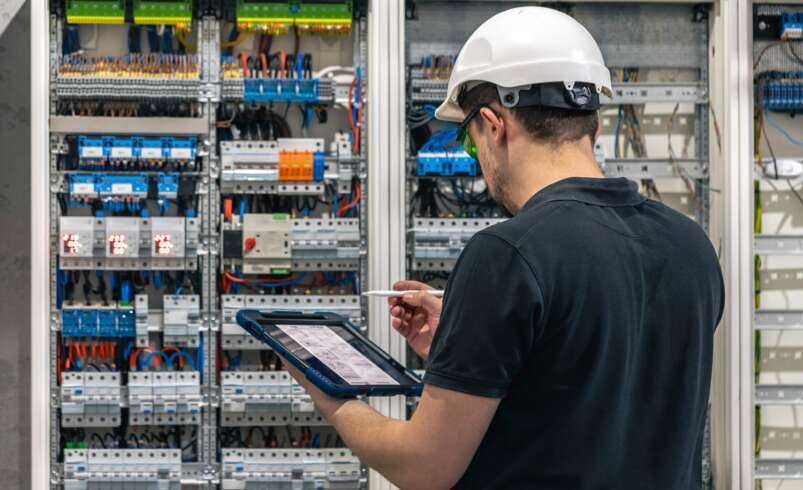
Industrial facilities may use LV switchgear, MDB panels, SMDB panels, MCC panels and control panels at different levels of their electrical network. Each component has a specific function, from distributing incoming power to controlling individual motors and processing equipment.
Effective engineering considers these systems together. Circuit breakers, overload protection, emergency stops and interlocks must continue to provide electrical safety while automated commands control equipment according to programmed operating conditions.
Where Automation Can Improve Industrial Operations
Automation is most valuable when it addresses repetitive, time-sensitive or closely monitored processes. Instead of automating every operation, businesses can focus on areas where better control can produce measurable improvements in productivity, reliability or equipment performance.
Manufacturing and Production Facilities
Factories often operate several motors, pumps, conveyors, compressors and processing machines simultaneously. MCC panels can centralize motor protection and control while automation systems coordinate equipment according to production requirements.
For example, a conveyor can be programmed to start only when downstream equipment is ready. Similarly, pumps can operate according to tank levels, pressure readings or production schedules instead of relying on continuous manual switching.
Warehouses and Logistics Facilities
Modern warehouses may use conveyors, automated handling equipment, ventilation systems and environmental controls. Sensors can provide information about equipment conditions, while control systems can trigger specific actions based on predefined parameters.
This can help reduce unnecessary equipment operation and provide operators with better visibility into the status of essential systems.
Pumping and Utility Applications
Water treatment facilities, pumping stations and utility installations often require equipment to respond to pressure, flow and level conditions. Automated controls can monitor these parameters and adjust pump operation accordingly.
Such systems also benefit from alarms and status monitoring, allowing operators to identify abnormal conditions before they develop into more serious operational problems.
Electrical Panels That Support Automation
Automation cannot operate independently of electrical distribution equipment. The panels supplying and controlling automated machinery need to accommodate both power and control requirements.
MCC Panels for Motor Management
Motor Control Centre panels are commonly used where multiple motors require centralized control and protection. They can incorporate contactors, overload relays, motor protection devices and variable frequency drives.
When connected to an automation system, the MCC can receive operating commands from a PLC and return information such as motor status or fault conditions. This creates a practical connection between the electrical system and the industrial process.
Control Panels for Process Management
Control panels provide the interface between field devices and automation equipment. Depending on the application, they may contain PLCs, relays, power supplies, terminal blocks, communication modules and other control components.
Good panel engineering should provide logical component arrangement, clear wiring identification and suitable separation between power and control circuits. These details are important during commissioning and can significantly simplify future fault diagnostics.
Distribution Panels
MDB and SMDB panels provide power to automated machinery and associated systems. Their design must consider load requirements, short-circuit levels, breaker ratings and busbar capacity.
A properly coordinated distribution system also helps isolate faults. If a downstream circuit develops a problem, appropriate protection should disconnect the affected section without unnecessarily interrupting unrelated equipment.
Benefits of Integrated Power and Automation
Businesses researching Automation Solutions Dubai should consider how automation will affect the complete electrical system rather than evaluating control technology in isolation.
An integrated approach can provide several practical benefits:
- Consistent operation: Automated sequences can reduce variations caused by manual switching.
- Improved equipment control: Motors, pumps and other machinery can respond to real-time conditions.
- Faster fault identification: Alarms and status feedback can help operators locate abnormal conditions.
- Reduced manual intervention: Repetitive switching and monitoring activities can be automated.
- Better load management: Equipment can be scheduled according to production requirements.
- Improved visibility: HMIs and monitoring systems can display operating information in real time.
The actual benefits depend on the quality of the system design. Automation should be introduced to solve a specific operational requirement rather than adding unnecessary complexity.
A Practical Approach to Automation Project Design
A successful project requires coordination between electrical engineering, control design and site operations. The following stages can help create a more reliable implementation.
1. Assess the Existing Electrical Infrastructure
Begin with single-line diagrams, load schedules, motor information and distribution-panel details. Existing equipment should be evaluated for available capacity and compatibility with the proposed automation system.
2. Identify Suitable Processes
Determine which operations would benefit most from automated control. Motor sequencing, pump control, generator management, equipment interlocking and alarm monitoring are common applications.
3. Develop the Control Architecture
Select PLCs, HMIs, sensors, variable frequency drives, communication systems and remote I/O according to the application. Future expansion should also be considered when determining available inputs, outputs and communication capacity.
4. Coordinate Electrical Protection
Automation commands must operate alongside electrical protection systems. Circuit breakers, overload protection, emergency shutdowns and interlocks should maintain their safety functions regardless of the automation sequence.
5. Test and Commission
Before handover, control signals, alarms, interlocks, communication links and equipment responses should be tested. Factory testing followed by site commissioning can help identify wiring, programming and configuration issues before full operation.
Choosing the Right Electrical and Automation Partner
The technical capability of the provider is an important consideration when planning an industrial automation project. Experience should extend beyond automation programming to include electrical panel engineering, motor control, protection systems and power distribution.
Businesses should also consider whether the provider can customize panel configurations according to equipment requirements. Panel dimensions, component selection, busbar ratings, control wiring and communication interfaces may all need to be adapted to the project.
When comparing Switchgear Companies, it is useful to review their engineering capabilities, testing procedures, project experience, documentation practices and maintenance support. A provider that understands the relationship between electrical distribution and automation can help reduce compatibility issues during installation and commissioning.
Integrating Voltronix Switchgear Into the Electrical Design Process
Automation projects often require several electrical systems to work together, including distribution boards, motor-control equipment and control panels. This makes coordination between panel engineering and automation design particularly important.
In applications where these requirements overlap, Voltronix Switchgear can form part of the electrical engineering process by considering panel configuration, power distribution, motor control and automation interfaces together. This approach keeps the focus on how each electrical component will function within the complete facility rather than treating automation as a separate addition.
For example, an automated production line may require an MDB for incoming distribution, an MCC for motor control and a dedicated control panel for PLC and instrumentation functions. Designing these elements with their communication and protection requirements in mind can simplify installation and future maintenance.
Common Challenges in Automated Electrical Systems
Automation can improve operational control, but poorly coordinated systems may introduce their own problems. Communication failures, incorrect control logic, inadequate panel ventilation and improperly configured protection can affect system performance.
Voltage fluctuations can also influence sensitive electronic equipment. Excessive heat inside panels may reduce the service life of drives, power supplies and other control components.
Fault diagnostics should therefore consider both electrical and automation factors. A motor that fails to start, for example, could have a mechanical problem, an overload trip, a breaker issue, a control-command failure or incorrect PLC logic.
Maintenance for Long-Term Performance
Automation systems require ongoing maintenance just like conventional electrical equipment. Technicians should periodically inspect panel connections, circuit breakers, contactors, drives, cooling arrangements, control wiring and communication hardware.
Thermal inspections can identify abnormal heating at cable terminations and busbar connections. Control-system backups, updated electrical drawings and accurate component records are also important because they make troubleshooting and future modifications easier.
Preventive maintenance schedules should reflect equipment criticality and operating conditions. Production-critical systems may require more frequent inspection than equipment supporting non-essential processes.
Designing for Future Expansion
Industrial facilities rarely remain unchanged for their entire operating life. Production capacity may increase, new machinery may be installed or additional monitoring functions may become necessary.
A scalable electrical and automation architecture can make these changes easier. Providing spare panel capacity, accessible cable routes, additional PLC I/O and suitable communication capacity during the original design can reduce disruption when future upgrades are required.
Conclusion
Efficient industrial automation depends on more than control software or individual automation components. Reliable results require a coordinated electrical foundation involving LV switchgear, distribution panels, MCCs, control systems, protection devices and appropriately engineered automation architecture.
For businesses in Dubai, the best approach is to begin with actual operational requirements and develop the electrical and control infrastructure around them. Careful engineering, appropriate component selection, systematic testing and preventive maintenance can help create industrial systems that deliver better control, reliability and long-term operational performance.