
Two technical decisions made in the first weeks of a project quietly determine a large share of its price: which platform you build for, and how you structure the backend. Founders often hand these choices to the agency without understanding the trade-offs, and then discover the consequences a year later when they want to grow. A clear view of how platform and architecture affect ecommerce app development cost lets you make these decisions deliberately.
This guide compares the four platform options, explains the difference between monolithic and headless architecture and shows why the cheapest option on day one is not always the cheapest over three years.
The Four Platform Options
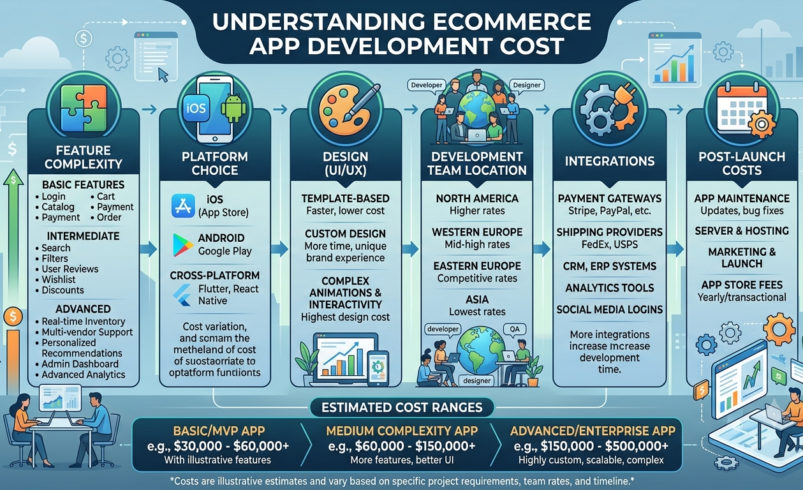
Ecommerce businesses in 2026 typically choose among native iOS, native Android, cross-platform frameworks such as Flutter and React Native, and progressive web apps. Each balances cost, performance and reach differently.
Native apps are written specifically for one operating system, offering the best performance and full access to device features. Cross-platform apps share most of their code across iOS and Android. Progressive web apps run in the browser and can be added to a home screen, but they are not distributed through app stores in the same way.
| Factor | Native iOS | Native Android | Cross-platform | PWA |
|---|---|---|---|---|
| Typical cost | $25K – $150K | $20K – $150K | $20K – $120K | $10K – $50K |
| Development time | 3 – 9 months | 3 – 9 months | 2 – 7 months | 1 – 4 months |
| Performance | Best | Best | Very good | Good |
| Cost vs cross-platform | 30 – 40% higher | 30 – 40% higher | Baseline | 50 – 60% lower |
| App store presence | Yes | Yes | Yes (both) | No store listing |
| Offline capability | Full | Full | Full | Limited |
When Each Platform Makes Sense
A progressive web app offers the lowest upfront cost and fastest launch, which makes it attractive for budget MVPs and web-first businesses. The trade-offs are no app store listing, more limited push notification support on iOS and weaker offline behaviour.
Cross-platform development is the usual sweet spot for start-ups and growing brands. It delivers a genuine app experience on both major platforms while reducing cost by roughly 30 to 40 percent compared with building two native apps. In markets where Android dominates, such as India and parts of Southeast Asia, it is particularly cost-effective.
Native development earns its premium when the experience depends on platform-specific strengths, such as advanced camera features, augmented reality or very smooth animations, or when a premium brand serves mainly iOS users.
- Choose a PWA for a budget MVP, a content-led store or a quick market test.
- Choose cross-platform for most start-ups and growing retailers.
- Choose native for premium experiences, AR or heavy device integration.
- Whatever you choose, plan the data layer so you can change the front end later.
Monolithic Architecture: Cheap to Start
In a monolithic setup, the front end and back end are tightly coupled in one system, as in traditional WooCommerce or Magento installations. This approach usually has a lower upfront cost, commonly in the range of $20,000 to $80,000, and it is faster to launch and easier for a small team to manage.
The downside appears as you grow. Backend changes often force front-end rebuilds, and adding new channels such as a mobile app, a point-of-sale tablet or voice commerce can require significant redevelopment. For a small, single-channel store that is acceptable. For a brand with growth plans, it can become a trap.
Headless Architecture: Pay More Now, Save Later
A headless architecture separates the commerce engine from any particular front end. The app, website and any future channel all connect to the same backend through APIs. This typically adds about $15,000 to $40,000 to the initial budget, and the first build may take slightly longer.
In return you get flexibility: new channels can be launched without rebuilding the backend, front ends load independently for better performance and the system is better prepared for AI personalisation and other future integrations. Businesses that outgrow a monolithic system often face rebuild costs of $50,000 to $100,000 or more, which is why headless frequently lowers the three-year total cost of ownership.
| Factor | Monolithic | Headless |
|---|---|---|
| Upfront cost impact | Baseline | +$15,000 – $40,000 |
| Time to market | Faster | Slightly longer |
| Scalability | Limited, rebuild needed | High, add channels easily |
| Best for | Small stores, one channel | Growing brands, omnichannel, enterprise |
| Three-year total cost | Often higher due to rebuilds | Often lower despite higher start |
A Simple Decision Guide
If your total budget is modest and you only need to test an idea, a monolithic or PWA approach is sensible. If your budget is around $60,000 or more and you expect to grow into several channels, the extra investment in a headless design usually pays off. The key is honesty about your growth plans: choosing the cheap option while planning to scale is the most expensive mistake in this category.
Questions to Ask Your Agency
- Why do you recommend this platform for my specific market and users?
- How would we add a second channel, such as a web store or tablet app, later?
- What would a migration from this architecture to a more scalable one involve?
- Which parts of the code can be reused if we change the front end?
- How does your recommendation change if my budget is 30 percent lower?
A Three-Year Illustration
Consider a simple illustration. Suppose a monolithic build costs a base amount, B. A headless build of the same app costs B plus $15,000 to $40,000. Now suppose the business grows, adds a web store and a second market, and the monolithic system must be rebuilt at a cost of $50,000 to $100,000. After three years, the monolithic path has cost B plus $50,000 to $100,000, while the headless path has cost B plus $15,000 to $40,000. On those assumptions, the headless route saves between $10,000 and $85,000.
The figures are illustrative, and a business that never grows beyond one channel may never need the rebuild. That is exactly why honesty about your plans matters: the correct architecture is the one that fits the future you realistically expect, not the one that looks cheapest on the proposal.
Do Not Forget Maintenance Differences
Platform choice also affects running costs. Two native apps mean two codebases to update whenever an operating system changes or a feature is added. A cross-platform app updates once. A PWA updates instantly for every user because it lives on a server, but it may need extra work to stay compatible with browser differences. When comparing options, include a year or two of maintenance in the comparison, not only the build price.
Frequently Asked Questions
Is a PWA good enough for an online store?
For many small stores, yes, especially as a first step. Be aware of limits in app store visibility and iOS notifications.
Does cross-platform hurt performance?
For typical ecommerce features the difference is small. Demanding graphics or device-specific features are where native pulls ahead.
Can I start monolithic and move to headless later?
Yes, but migration costs real money. If growth is likely, planning for headless from the beginning is usually cheaper.
Conclusion
Platform and architecture are not purely technical details; they are budget decisions with multi-year consequences. A PWA lowers entry cost, cross-platform balances speed and reach, and native maximises performance, while headless architecture trades a higher start for lower long-term cost. Weigh these options against your real growth plans, and ecommerce app development cost becomes something you can shape on purpose rather than a figure that surprises you later.