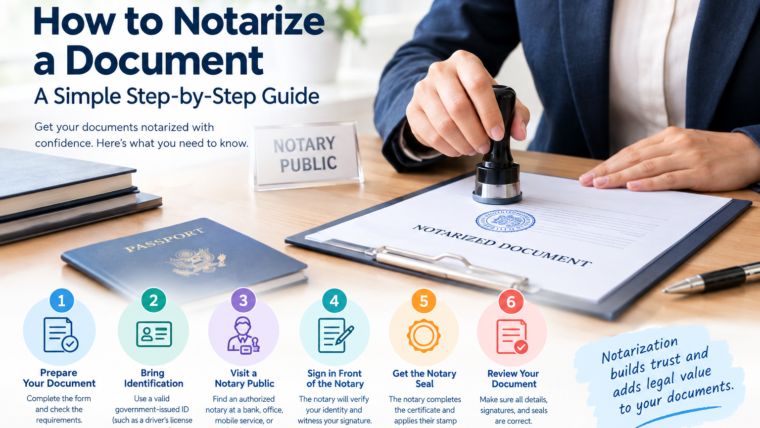

When an important document needs notarization, knowing what to expect can save time, prevent mistakes, and reduce unnecessary delays. A certified notary public helps verify the identity of a person signing a document and performs the required notarial act according to applicable rules.
Notarization is commonly needed for legal, financial, real estate, estate planning, and personal documents. However, a notary does not simply place a stamp on every document presented. There are specific requirements that must be met before a notarization can be completed.
What Does a Notary Public Do?
A notary public is an individual authorized by a state or jurisdiction to perform certain official notarial acts. The exact duties and requirements can vary depending on local law.
During a typical appointment, the notary may:
- Verify the signer’s identity
- Confirm that the signer is appearing as required
- Check whether the document is complete enough for notarization
- Complete the appropriate notarial certificate
- Record information in a notary journal when required
- Apply the official notary seal or stamp
- Administer an oath or affirmation when applicable
The notary’s role is generally focused on the notarization process rather than providing legal advice about the document itself.
Which Documents Commonly Need Notarization?
Not every document requires a notary. Whether notarization is necessary usually depends on the document, the receiving organization, or the applicable law.
Common examples include:
Power of Attorney Documents
A power of attorney gives another person authority to act on someone’s behalf. Depending on the jurisdiction and type of document, notarization may be required or strongly requested.
Estate Planning Documents
Some estate planning paperwork may require notarization as part of the signing process. Documents can include certain trusts, affidavits, powers of attorney, and related paperwork.
Real Estate Documents
Property transactions often involve documents that require notarization. Deeds, affidavits, loan documents, and other closing paperwork may contain notarial requirements.
Affidavits and Statements
An affidavit is a written statement made under oath or affirmation. A notary may administer the oath or affirmation and complete the corresponding certificate.
Financial and Business Documents
Certain contracts, authorizations, business documents, and financial forms may need notarization before they are accepted by another party.
What Should You Bring to a Notary Appointment?
Preparation can make the appointment much easier. Before meeting with a notary, check the document carefully and determine what the receiving organization requires.
You may need:
The complete document: Bring the original document or the version specifically requested for notarization. Avoid signing it in advance if the notarial instructions require you to sign in the notary’s presence.
Valid identification: A government-issued identification document may be required to establish your identity. The type of identification accepted can depend on applicable rules.
All required signers: If multiple people must sign, make sure everyone who needs to appear for the notarization is available.
Additional paperwork: Some transactions may require supporting documents or specific instructions from a lender, attorney, government office, or other organization.
If you are unsure about what is required, contact the organization that requested the notarization before the appointment.
Common Mistakes That Can Delay Notarization
Many notarization problems are simple to avoid. Taking a few minutes to prepare can help prevent an unsuccessful appointment.
Signing Too Early
Some documents must be signed in front of the notary. Signing beforehand can create a problem if the required notarial act calls for witnessing the signature.
Leaving Important Sections Incomplete
A document with missing information may not be ready for notarization. Review the paperwork before the appointment and follow the instructions provided by the document recipient.
Bringing Unacceptable Identification
Identification requirements vary. Do not assume that every type of ID will automatically be accepted.
Forgetting Other Signers
If a document requires signatures from several people, each required signer may need to appear before the notary.
Expecting Legal Advice
A notary generally cannot tell you which legal document you should use or explain legal consequences as an attorney would. If you have questions about your legal rights or the meaning of a document, consider speaking with a qualified attorney.
Can a Notary Help With Documents You Do Not Understand?
A notary can generally explain the notarial procedure, such as where a signature or acknowledgment is required, but this is different from providing legal advice.
For example, if you do not understand the terms of a power of attorney, contract, deed, or estate planning document, asking the notary to interpret its legal meaning may not be appropriate.
The safest approach is to have legal questions addressed by the person or professional who prepared the document.
How to Prepare for a Smooth Notarization
A little preparation can make the process more efficient. Start by checking whether the document actually requires notarization and what type of notarial act is requested.
Next, confirm your identification requirements and make sure all necessary signers can attend. If the document is part of a real estate closing, loan signing, estate plan, or other larger transaction, follow the instructions provided by the organization handling the transaction.
It is also helpful to avoid making last-minute changes to important paperwork unless the document provider specifically instructs you to do so.
For people with busy schedules, a mobile notary service may provide added convenience by allowing the notarization appointment to take place at an agreed location, where permitted.
What Is the Difference Between Notarization and Legal Advice?
This distinction is important.
Notarization helps authenticate or formalize a signing or other notarial act according to applicable requirements. It does not automatically mean that the document has been reviewed by a lawyer or that its contents are legally appropriate.
A notary’s responsibilities and authority are defined by the applicable jurisdiction. If you need help drafting a document, selecting a legal form, or understanding legal consequences, seek advice from an appropriately qualified legal professional.
Final Checklist Before Your Appointment
Before meeting a notary, ask yourself:
- Do I have the correct document?
- Have I followed the document provider’s signing instructions?
- Do I have acceptable identification?
- Are all required signers available?
- Does the document require witnesses?
- Do I know what type of notarization is requested?
- Have I resolved any legal questions with the appropriate professional?
- Does the receiving organization have any additional requirements?
Checking these details ahead of time can help prevent avoidable delays.
Final Thoughts
A certified notary public can play an important role when documents require identity verification, acknowledgments, oaths, or other official notarial acts. Understanding the process before your appointment helps ensure that your paperwork is properly prepared and that you know what to expect.
Whether you are handling estate planning paperwork, a real estate transaction, a power of attorney, an affidavit, or another important document, preparation is key. Bring the required identification, follow the document’s instructions, and seek legal advice separately when you need help understanding the document itself.